
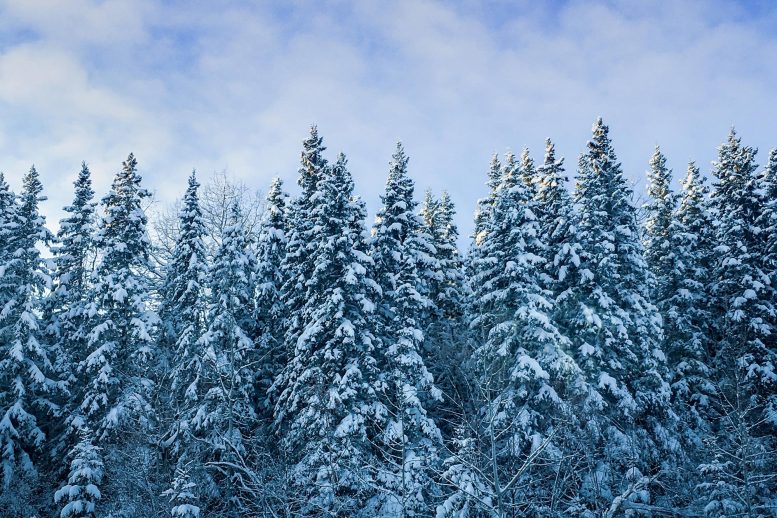
New research from Northern Arizona University shows rising temperatures are causing Earth’s coldest forests to shift northward, raising concerns about biodiversity, an increased risk of wildfires, and mounting impacts of climate change on northern communities.
Logan Berner, assistant research professor in the School of Informatics, Computing, and Cyber Systems (SICCS), and Scott Goetz, Regents’ professor and director of the GEODE Lab, authored the article, “Satellite observations document trends consistent with a boreal forest biome shift,” which was published today (February 24, 2022) in Global Change Biology. The boreal forest is a belt of cold-tolerant conifer trees that stretches nearly 9,000 miles (14,500 kilometers) across northern North America and Eurasia; it accounts for almost a quarter of the Earth’s forest area and is the coldest—though mostly rapidly warming—forest biome.
For this study, the researchers used 40 years of moderately fine (30m) resolution satellite observations and various geospatial climate-related datasets of the boreal forest and assessed where and why vegetation greened and browned during recent decades. “Greening” indicates higher rates of vegetation growth, which can happen when climate warming promotes growth of trees and shrubs, as was observed near the arctic and alpine tree lines. “Browning” indicates lower rates of vegetation growth and potentially vegetation death, such as when hotter and drier conditions suppress tree growth and kill trees.
“There is emerging evidence that climate change is causing boreal trees and shrubs to expand into arctic and alpine tundra, while at the same time causing trees to become more stressed and die along the warm southern margins of the boreal forest,” Berner said. “These dynamics could lead to a gradual northward shift in the geographic extent of the boreal forest biome, but the extent to which such changes are already underway has remained unclear.”
What they found wasn’t exactly a surprise. Vegetation became greener across much of the cold northern margins of the boreal forest; warmer conditions led to increased vegetation growth and enabled trees and shrubs to expand into arctic and alpine tundra. Conversely, vegetation became browner along parts of the warm southern margins of this biome as a result of hotter, drier conditions increasing tree stress and death. Intriguingly, Berner said, vegetation was more likely to become greener in areas with high soil nitrogen, indicating that soil nutrient availability is an important constraint on the response of boreal vegetation to climate change.
“The boreal forest ecosystem is changing in many ways over recent decades, and those changes are often linked with increasing fire disturbance,” Goetz said. “Here we intentionally focused on areas that were not recently disturbed by fire so we could tease out the effect of climate change. Our hypotheses about what would happen were verified by this analysis—forests are getting more productive in the cooler northern and higher elevation areas, and they’re getting less productive as a result of hot air masses and drying in the warmer and more southerly areas. We fully expect that will continue and probably intensify in the years to come.”
What a changing biome means for the forest
Changes in vegetation could affect both plant and animal biodiversity, especially species like caribou and moose, which have specific foraging preferences (e.g. deciduous shrubs and trees). These wildlife species are critical sources of food for subsistence communities in the boreal-tundra ecotone. Changes in vegetation along both the northern and southern margins of the boreal forest will impact wildfire regimes, likely increasing the risk of more severe fires. Changes in vegetation also impact the stability of carbon-rich permafrost soils and absorption of solar energy by the land surface in ways that could accelerate climate warming. Moreover, increasing tree mortality could have widespread implications for forest products while also leading to further degradation of semi-continuous and sporadic permafrost.
These future effects are not limited to the geographical area around the forest.
“Fundamentally, greenhouse gas emissions from human activities are causing Earth’s climate to warm, which in turn is leading the boreal forest to shift northward, as well as impacting other ecosystems across the planet,” Berner said. “To minimize adverse impacts of climate change, efforts are needed to dramatically reduce greenhouse gas emissions, especially related to fossil fuel consumption and deforestation. Furthermore, northern communities need to plan for potential changes in vegetation that could impact resource availability (e.g. wildlife, timber) and wildfire risk.”
This study is part of a larger initiative funded by NASA’s Arctic-Boreal Vulnerability Experiment (ABoVE) that will include further efforts to understand the extent, nature, cause, and consequence of an emerging boreal biome shift. Goetz is the science lead for ABoVE.
Reference: “Satellite observations document trends consistent with a boreal forest biome shift” by Logan T. Berner and Scott J. Goetz, 24 February 2022, Global Change Biology.
DOI: 10.1111/gcb.16121
Never miss a breakthrough: Join the SciTechDaily newsletter.
Follow us on Google and Google News.
2 Comments
“Satellite observations document trends consistent with a boreal forest biome shift,”
In other words, the boreal forest is re-establishing itself where it formerly grew during the Holocene Optimum and probably before the Pleistocene.
“Fundamentally, greenhouse gas emissions from human activities are causing Earth’s climate to warm,…”
That is a claim that is commonly made, largely because there is an apparent correlation between increasing CO2 concentration and human emissions. It is claimed that because the annual growth in resident atmospheric CO2 is about half of human emissions, it ‘proves’ humans are responsible. The problem is, there is no correlation found in de-trended CO2 fluxes, and sometimes the monthly rates move in opposite directions. It appears that the cumulative increases are simply a convenient coincidence. The human CO2 flux is a nearly constant 0.33 to 0.40 PPM per month, while the atmospheric flux varies from about -2 to +1 PPM per month. Anthropogenic CO2 amounts to about 4% of the annual total flux of all sources. One should expect exchanges between sources and sinks to be proportional to the source abundance. That is, human contributions are negligible!
how are you, commanding blog on unctuous loss. such a person helped.