
A group of trees that grow fast, live long lives and reproduce slowly account for the bulk of the biomass–and carbon storage–in some tropical rainforests, a team of scientists says in a paper published this week in the journal Science. The finding that these trees, called long-lived pioneers, play a much larger role in carbon storage than previously thought may have implications in efforts to preserve forests as a strategy to fight climate change.
“People have been arguing about whether these long-lived pioneers contribute much to carbon storage over the long term,” said Caroline Farrior, an assistant professor of integrative biology at The University of Texas at Austin and a primary investigator on the study. “We were surprised to find that they do.”
It is unclear the extent to which tropical rainforests can help soak up excess carbon dioxide in the atmosphere produced by burning fossil fuels. Nonetheless, the new study provides insights about the role of different species of trees in carbon storage.
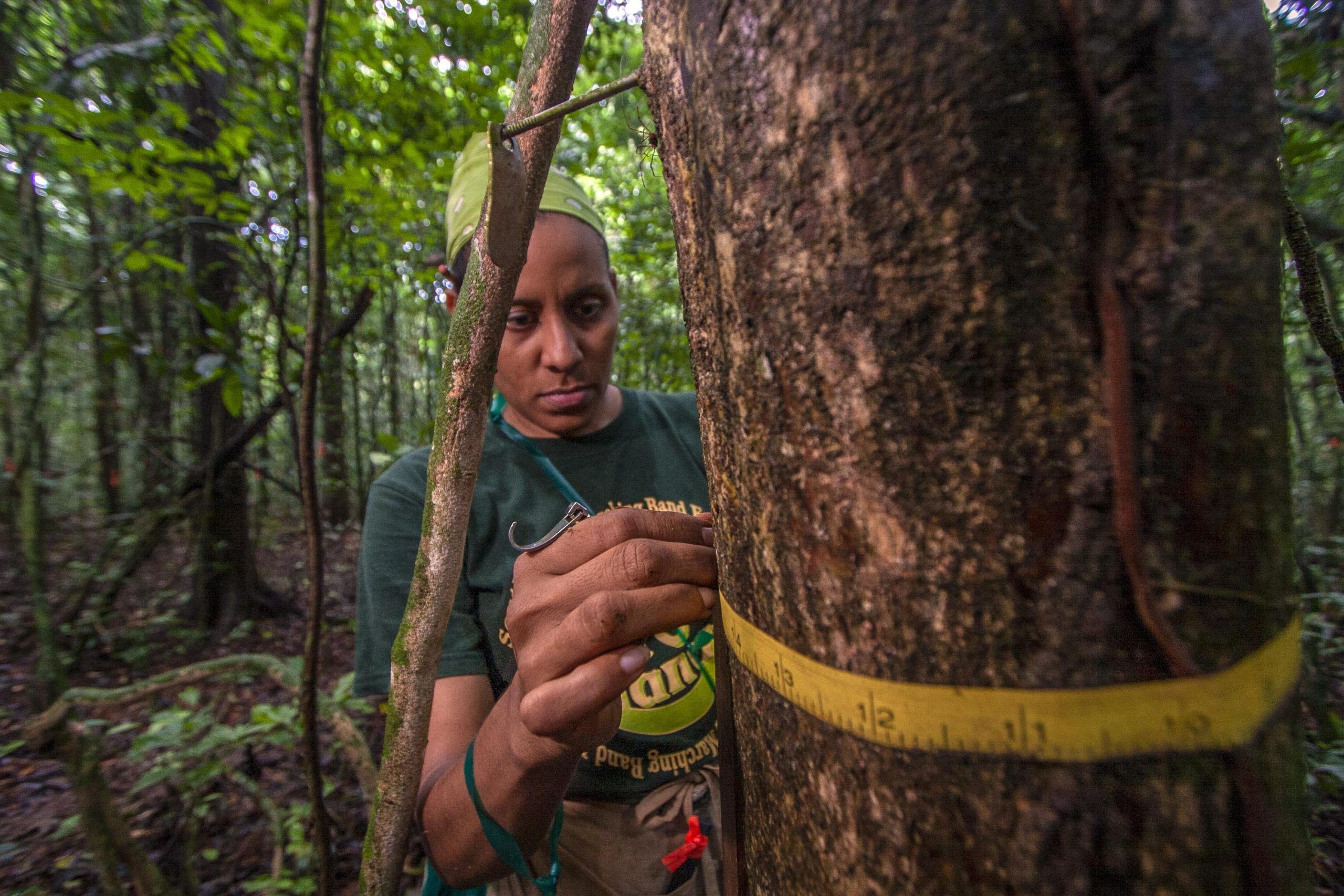
Using more than 30 years’ worth of data collected from a tropical rainforest in Panama, the team has uncovered some key traits of trees that, when integrated into computer models related to climate change, will improve the models’ accuracy. With the team’s improved model, the scientists plan to begin answering questions about what drives forest composition over time and what factors affect carbon storage.
Most existing Earth system models used to forecast global climate decades from now, including those used by the Intergovernmental Panel on Climate Change, represent the trees in a forest as all basically the same.
“This analysis shows that that is not good enough for tropical forests and provides a way forward,” Farrior said. “We show that the variation in tropical forest species’s growth, survival and reproduction is important for predicting forest carbon storage.”
The project was led by Nadja Rüger, research fellow at the German Centre for Integrative Biodiversity Research (iDiv), Halle-Jena-Leipzig.
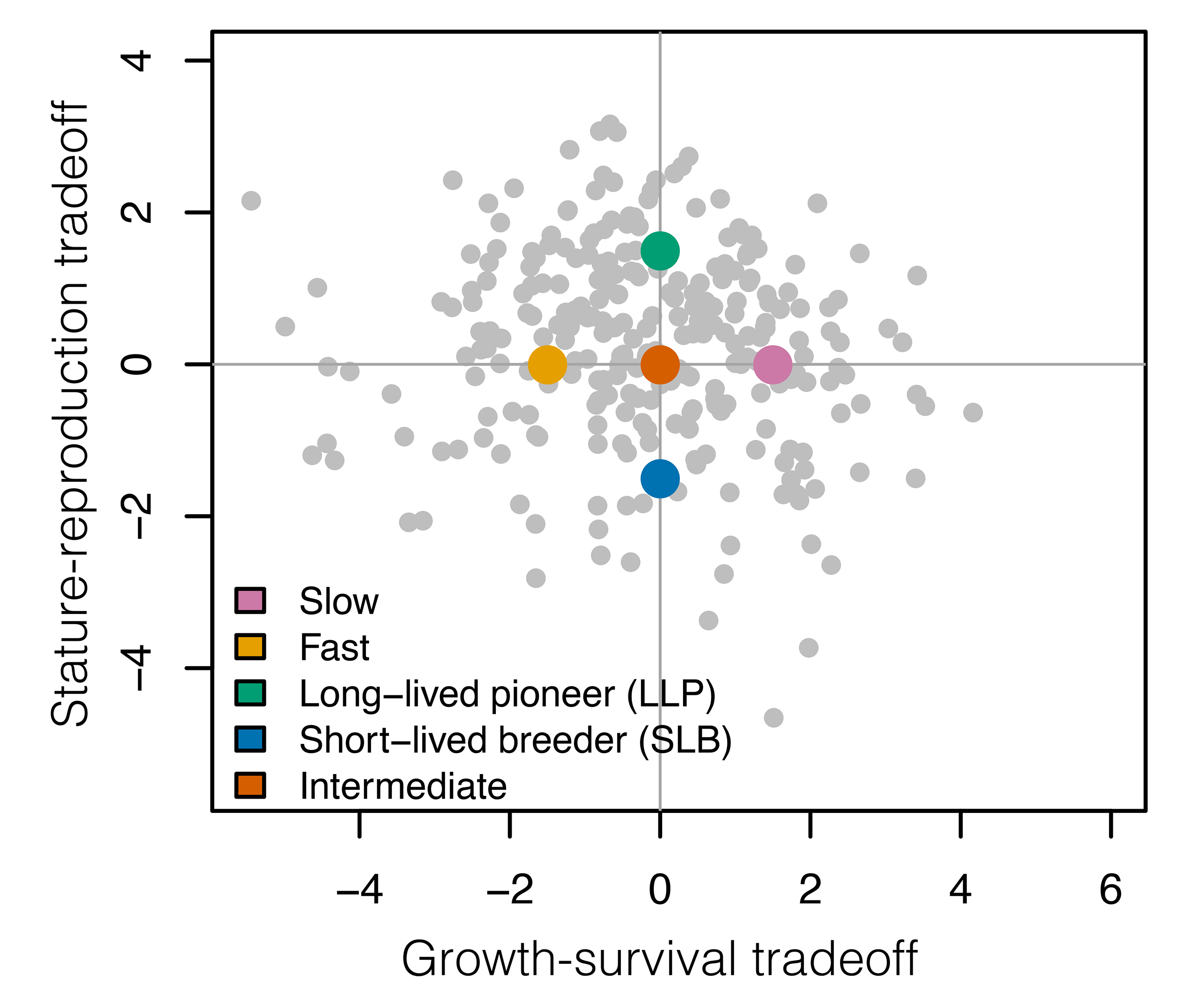
In addition to the finding about long-lived pioneers, the team found the composition of a tropical forest over time depends on how each tree species balances two different sets of trade-offs: growth versus survival (for example, one type of tree might grow fast but die young) and stature versus reproduction (another might grow tall but reproduce leisurely). Plotting every species as a point on a graph based on where they fall along these two different axes allowed the scientists to have a more sophisticated and accurate model than prior ones, which usually focused exclusively on the first of these two trade-offs or parametrized the groups by different means.
“To really appreciate that there is this second trade-off between stature and reproduction, and that it’s important in old-growth forests, is a big deal biologically,” Farrior said.
The team also discovered that the nearly 300 unique tree species that live on Barro Colorado Island, which sits in the middle of the Panama Canal, can be represented in their computer model by just five functional groups and still produce accurate forecasts of tree composition and forest biomass over time.
It’s not possible to directly verify the forecasts of a forest model in future decades. So the researchers did the next best thing: They seeded their model with forest composition data collected at their site in Panama during the 1980s and then ran the model forward to show that it accurately represents the changes that occurred from then until now. This is called “hindcasting.”
Next, they plan to explore how a warming world might benefit trees with certain traits over others, shifting forest composition and the potential of forests to store carbon.
“One of the biggest unknowns in climate forecasting is: What are trees going to do?” said Farrior. “We really need to get a handle on that if we’re going to accurately predict how climate will change and manage forests. Right now, they’re absorbing some of the excess carbon we’re producing and delaying climate change, but will they keep doing it?”
Reference: “Demographic trade-offs predict tropical forest dynamics” by Nadja Rüger, Richard Condit, Daisy H. Dent, Saara J. DeWalt, Stephen P. Hubbell, Jeremy W. Lichstein, Omar R. Lopez, Christian Wirth and Caroline E. Farrior, 10 April 2020, Science.
DOI: 10.1126/science.aaz4797
Funding was provided by the U.S. National Science Foundation, Deutsche Forschungsgemeinschaft and Secretaría Nacional de Ciencia, Tecnología e Innovación.
The other coauthors on the paper are Richard Condit at the Field Museum of Natural History in Chicago and the Morton Arboretum; Daisy H. Dent at the Smithsonian Tropical Research Institute (STRI) in Panama and the University of Stirling in the U.K.; Saara J. DeWalt at Clemson University; Stephen P. Hubbell at STRI and the University of California, Los Angeles; Jeremy W. Lichstein at the University of Florida, Gainesville; Omar R. Lopez at STRI and Instituto de Investigaciones Científicas y Servicios de Alta Tecnología in Panama; and Christian Wirth at iDiv, University of Leipzig and Max Planck Institute for Biogeochemistry in Germany.
Never miss a breakthrough: Join the SciTechDaily newsletter.
Follow us on Google and Google News.
1 Comment
A good part of knowledge is wrong or incomplete, what a misery, how can a man live knowing only what is not of this world. Damn this life.. i reject all this pain.. god take this lost soul.. may i return to dirt or dust of the stars and say hello to immortality once again