

Multi-institutional research team finds declining nitrogen availability in a nitrogen-rich world.
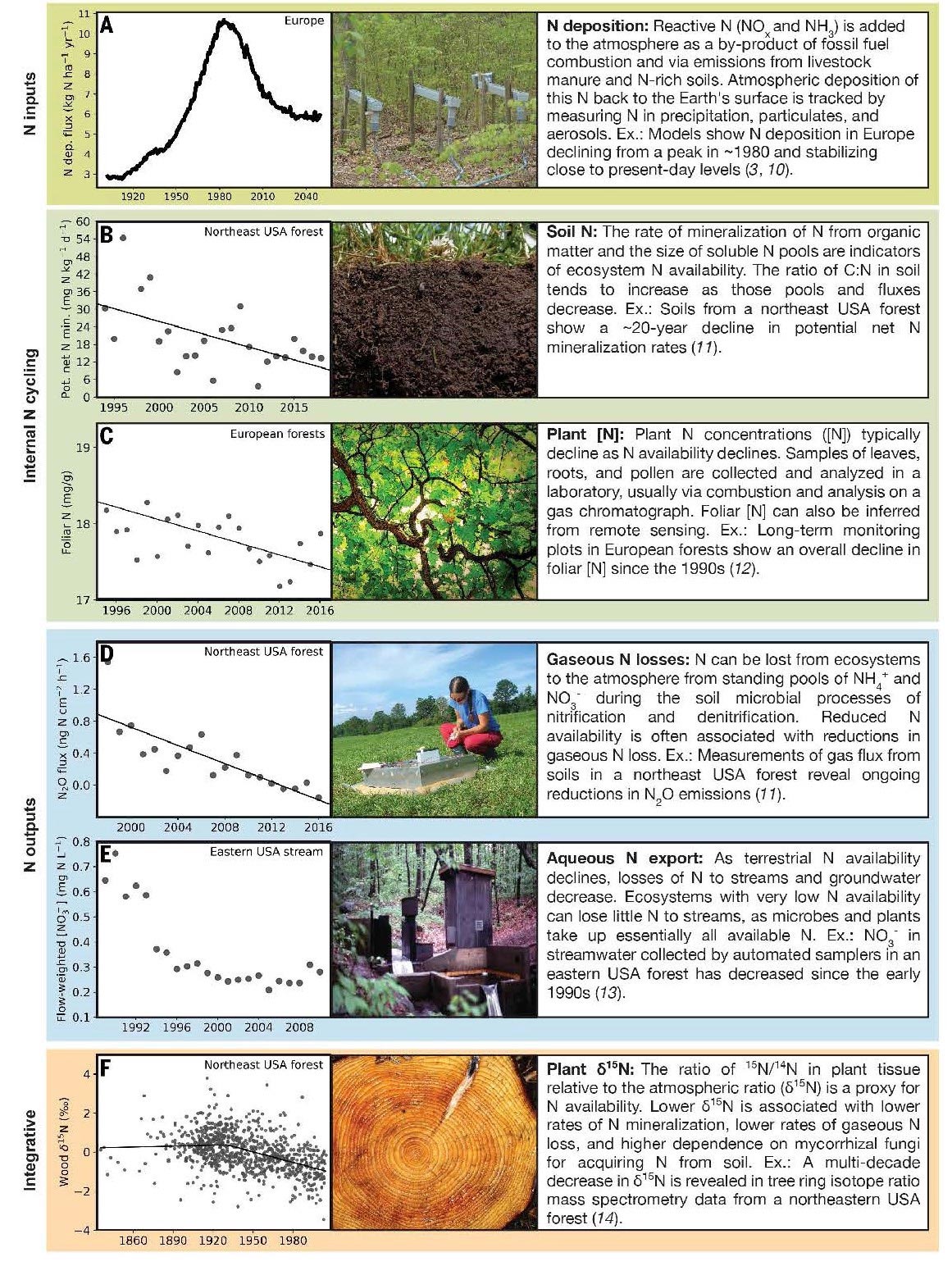
Since the mid-20th century, research and discussion have focused on the negative effects of excess nitrogen on terrestrial and aquatic ecosystems. However, new evidence indicates that the world is now experiencing a dual trajectory in nitrogen availability. Following years of attention to surplus nitrogen in the environment, our evolving understanding has led to new concerns about nitrogen insufficiency in areas of the world that do not receive significant inputs of nitrogen from human activities. In a new review paper, “Evidence, Causes, and Consequences of Declining Nitrogen Availability in Terrestrial Ecosystems,” in the journal Science, a multi-institutional team of researchers describes the causes of declining nitrogen availability and how it affects ecosystem function.
“There is both too much nitrogen and too little nitrogen on Earth at the same time,” said Rachel Mason, lead author on the paper and former postdoctoral scholar at the National Socio-Environmental Synthesis Center.
Over the last century, humans have more than doubled the global supply of reactive nitrogen through industrial and agricultural activities. This nitrogen becomes concentrated in streams, inland lakes, and coastal bodies of water, sometimes resulting in eutrophication, low-oxygen dead zones, and harmful algal blooms. These negative impacts of excess nitrogen have led scientists to study nitrogen as a pollutant. However, rising carbon dioxide and other global changes have increased the demand for nitrogen by plants and microbes, and the research team’s newly published paper demonstrates that nitrogen availability is declining in many regions of the world, with important consequences for plant growth.
“These results show how the world is changing in complex and surprising ways,” said Peter Groffman, a co-author on the paper and a professor with the Advanced Science Research Center at the CUNY Graduate Center’s Environmental Science Initiative. “Our findings show the importance of having long-term data as well as focused synthesis efforts to understand these changes and the implications they have for ecosystem and human health and well-being.”
Evidence of Declining Nitrogen Availability
Researchers reviewed long-term global and regional studies and found evidence of declining nitrogen availability caused by multiple environmental changes, one being elevated atmospheric carbon dioxide levels. Atmospheric carbon dioxide has reached its highest level in millions of years, and terrestrial plants are exposed to about 50% more of this essential resource than just 150 years ago. Elevated atmospheric carbon dioxide fertilizes plants, allowing faster growth but diluting plant nitrogen in the process. These processes have been observed in experiments that artificially elevate carbon dioxide in the air around plants, and there is now evidence that plants in natural settings are responding in the same way.
Nitrogen is an essential element for plants and the animals that eat them. Gardens, forests, and fisheries are all more productive when they are fertilized with nitrogen. If plant nitrogen becomes less available, trees grow more slowly and their leaves are less nutritious to insects, potentially reducing growth and reproduction, not only of insects, but also the birds and bats that feed on them.
“When nitrogen is less available, every living thing holds on to the element for longer, slowing the flow of nitrogen from one organism to another through the food chain. This is why we can say that the nitrogen cycle is seizing up,” said Andrew Elmore, senior author on the paper, and a professor of landscape ecology at the University of Maryland Center for Environmental Science and at the National Socio-Environmental Synthesis Center.
Impact of Warming and Other Environmental Changes
On top of increasing atmospheric carbon dioxide, rising global temperatures also affect plant and microbial processes associated with nitrogen supply and demand. Warming often improves conditions for growth, which can result in longer growing seasons, leading plant nitrogen demand to exceed the supply available in soils. Disturbances, including wildfires, can also remove nitrogen from systems and reduce availability over time.
Nitrogen is an essential element for plant growth and its declining availability has the potential to constrain the ability of plants to remove carbon dioxide from the atmosphere. Currently, global plant biomass stores nearly as much carbon as is contained in the atmosphere, and biomass carbon storage increases each year. To the extent plant storage of carbon reduces atmospheric carbon dioxide, it contributes to reductions in the global warming potential of the atmosphere. However, declining nitrogen availability jeopardizes the annual increase in plant carbon storage by imposing limitations to plant growth. Therefore, climate change models that attempt to estimate carbon stored in biomass, including trends over time, need to account for nitrogen availability.
“Despite strong indications of declining nitrogen availability in many places and contexts, spatial and temporal patterns are not yet well enough understood to efficiently direct global management efforts,” said Elmore. In the future, these data could be assembled into an annual state of the nitrogen cycle report or a global map of changing nitrogen availability that would represent a comprehensive resource for scientists, managers, and policy-makers.
Reference: “Evidence, Causes, and Consequences of Declining Nitrogen Availability in Terrestrial Ecosystems” by Rachel E. Mason, Joseph M. Craine, Nina K. Lany, Mathieu Jonard, Scott V. Ollinger, Peter M. Groffman, Robinson W. Fulweiler, Jay Angerer, Quentin D. Read, Peter B. Reich, Pamela H. Templer and Andrew J. Elmore, 15 April 2022, Science.
DOI: 10.1126/science.abh3767
About the Advanced Science Research Center
The Advanced Science Research Center at the CUNY Graduate Center(CUNY ASRC) is a world-leading center of scientific excellence that elevates STEM inquiry and education at CUNY and beyond. The CUNY ASRC’s research initiatives span five distinctive, but broadly interconnected disciplines: nanoscience, photonics, neuroscience, structural biology, and environmental sciences. The center promotes a collaborative, interdisciplinary research culture where renowned and emerging scientists advance their discoveries using state-of-the-art equipment and cutting-edge core facilities.
About The Graduate Center of The City University of New York
The CUNY Graduate Center is a leader in public graduate education devoted to enhancing the public good through pioneering research, serious learning, and reasoned debate. The Graduate Center offers ambitious students nearly 50 doctoral and master’s programs of the highest caliber, taught by top faculty from throughout CUNY — the nation’s largest urban public university. Through its nearly 40 centers, institutes, initiatives, and the Advanced Science Research Center, the Graduate Center influences public policy and discourse and shapes innovation. The Graduate Center’s extensive public programs make it a home for culture and conversation.
Never miss a breakthrough: Join the SciTechDaily newsletter.
Follow us on Google and Google News.