
Close Menu
    Facebook X (Twitter) Instagram
    SciTechDaily
    • Biology
    • Chemistry
    • Earth
    • Health
    • Physics
    • Science
    • Space
    • Technology
    Facebook X (Twitter) Pinterest YouTube RSS
    SciTechDaily
    Home»Science»Ecologists Explore Interactions of People, Buildings, Wildlife & Pollution
    Science

    Ecologists Explore Interactions of People, Buildings, Wildlife & Pollution

    By SciTechDailyNovember 26, 2012No Comments3 Mins Read
    Facebook Twitter Pinterest Telegram LinkedIn WhatsApp Email Reddit
    Share
    Facebook Twitter LinkedIn Pinterest Telegram Email Reddit
    pollution-boston
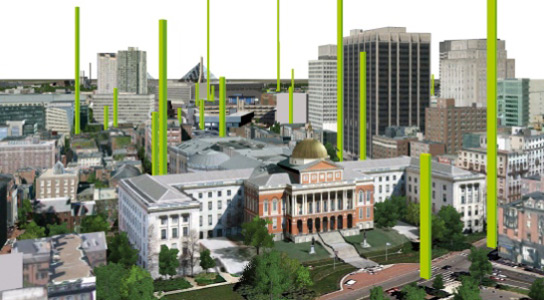
    In cities, a gas mixture forms an atmospheric dome over urban areas. Ecologists in Boston are sampling sites to compare levels of carbon dioxide, carbon monoxide, methane, and water vapor. Credit: Phillips, N. G. et al. Environ. Pollut.

    Most cities brew up a blend of gases that covers the urban area like a dome. The top of most buildings can sit outside or inside this metropolitan atmosphere, depending on the weather. Ecologists are sampling sites around Boston in order to compare levels of carbon dioxide, carbon monoxide, methane, and water vapor.

    Roofs are a different atmospheric environment from the rest of the city, states Nathan Phillips, an ecologist at Boston University, in Massachusetts. Phillips has set up collectors in order to capture the air blowing across Boston.

    Phillips and his colleagues are using the data to model how carbon dioxide and other gases move through the city, and how this particular mix differs from the one in rural areas. The work is part of a study trying to model the city’s “metabolism.” Next, they will look at carbon in the city’s soils and water, and track the flow of water, nitrogen, and pollutants.
    hidden-gas-leaks
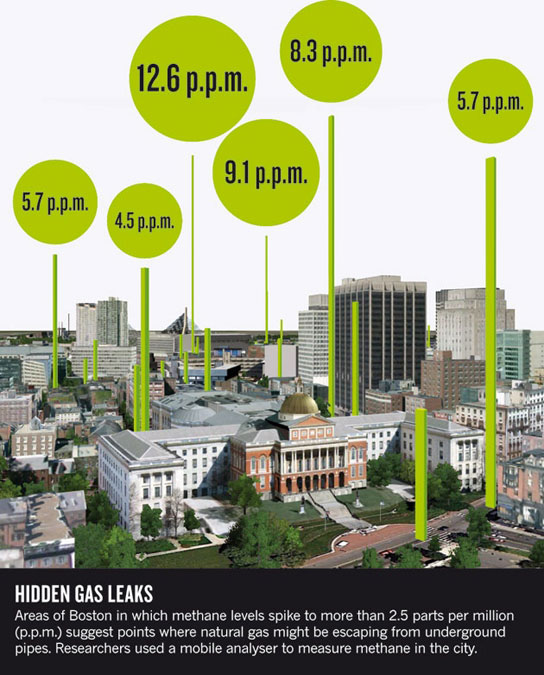
    Infographic. Credit: Nature, Phillips, N. G. et al. Environ. Pollut.

    This is part of the field of urban ecology, in which scientists study different cities as if they were ecosystems. Previously, artificial and natural elements were studied separately. Urban ecologists seek to understand the interplay between these elements, like how heat and high carbon dioxide levels boost plant growth and how trees cool cities.

    This could make cities more sustainable. Boston contains nearly 2 million trees, tons of soil, microbes, and wildlife like rats, coyotes, deer, and more than 100 bird species. This makes for complex relationships.

    There is a demand for urban ecology science and data. Paige Warren, ecologist at the University of Massachusetts in Amherst, is trying to assess how planting vegetation throughout the city has affected air quality, people, and wildlife.

    Phillips and his team are also sampling carbon dioxide levels throughout the city, using mobile sampling devices. These studies could be important in order to reduce greenhouse-gas pollution, since cities are responsible for more than two-thirds of global carbon dioxide emissions from energy use. In the US, road transportation is supposed to account for a third of all greenhouse-gas emissions, but credible inventories can differ by nearly 40%.

    Some of the findings indicate that traffic emissions in the core of the city are higher than previously estimated.

    The estimates from Phillips indicate that Boston averages 388 parts per million of carbon dioxide in the summer and 413 p.p.m. in winter.

    Never miss a breakthrough: Join the SciTechDaily newsletter.
    Follow us on Google and Google News.

    Cities Pollution Smog Urbanization
    Share. Facebook Twitter Pinterest LinkedIn Email Reddit

    Related Articles

    Major Chinese Cities Are Rapidly Sinking, Posing Serious Consequences

    The Health Challenges of the Growing Class of Megacities

    Projections of Urban Growth Highlight at Risk Areas

    Nanoparticle Pollution Affects Crop Growth

    Exposing 8,000 Years of Civilization With Satellites

    Natural Gas Mining Could Leak Enough Methane, No Longer Considered as Clean

    Intercontinental Crop Losses Caused by Ozone

    Asia’s Coal Use Up 500% Since 1980

    Da Vinci’s Last Supper Threatened By Air Pollution

    Leave A Reply Cancel Reply

    • Facebook
    • Twitter
    • Pinterest
    • YouTube

    Don't Miss a Discovery

    Subscribe for the Latest in Science & Tech!

    Trending News

    This Copper Drug Clears Alzheimer’s Brain Toxins and Boosts Memory

    Adults Over 65 Lost Massive Amounts of Weight With Ozempic

    How Flocking Birds “Defy” One of Physics’ Most Fundamental Laws

    Physicists Create a New Kind of Schrödinger’s Cat State From Exotic Quantum Building Blocks

    Your Diet Could Be Missing the Key Ingredient for Heart Protection

    Researchers Warn Widely Prescribed Blood Pressure Drugs Could Be Harming Diabetic Kidneys

    James Webb Spots Something Strange Between Day and Night on an Alien Planet

    How Ancient People Moved a 6-Ton Stone 700 Kilometers to Stonehenge

    Follow SciTechDaily
    • Facebook
    • Twitter
    • YouTube
    • Pinterest
    • Newsletter
    • RSS
    SciTech News
    • Biology News
    • Chemistry News
    • Earth News
    • Health News
    • Physics News
    • Science News
    • Space News
    • Technology News
    Recent Posts
    • Scientists Just Found Something Weird Inside Moss
    • Scientists Just Repeated a Nobel Prize-Winning Experiment in a Creature Older Than Jellyfish
    • Scientists Finally Uncover Why Solid-State Batteries Short-Circuit
    • Scientists Discover the “Achilles’ Heel” of Two of the World’s Deadliest Diarrhea Bacteria
    • Why Older Adults Need To Pay Closer Attention to Vitamin B12
    Copyright © 1998 - 2026 SciTechDaily. All Rights Reserved.
    • Science News
    • About
    • Contact
    • Editorial Board
    • Privacy Policy
    • Terms of Use

    Type above and press Enter to search. Press Esc to cancel.