
Close Menu
    Facebook X (Twitter) Instagram
    SciTechDaily
    • Biology
    • Chemistry
    • Earth
    • Health
    • Physics
    • Science
    • Space
    • Technology
    Facebook X (Twitter) Pinterest YouTube RSS
    SciTechDaily
    Home»Earth»Projections of Urban Growth Highlight at Risk Areas
    Earth

    Projections of Urban Growth Highlight at Risk Areas

    By SciTechDailySeptember 20, 2012No Comments2 Mins Read
    Facebook Twitter Pinterest Telegram LinkedIn WhatsApp Email Reddit
    Share
    Facebook Twitter LinkedIn Pinterest Telegram Email Reddit
    urban-expansion-sprawl
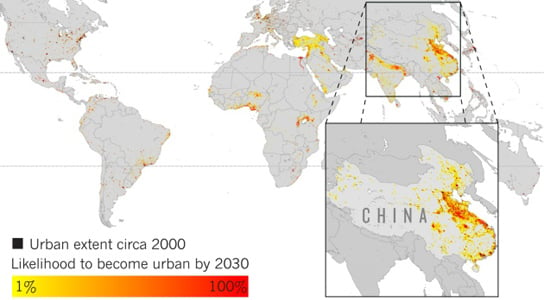
    Forecasts of different regions’ likelihood of urban expansion could be used to direct conservation efforts

    Researchers are trying to make detailed predictions about how urban areas are likely to grow in order to forecast how the next few decades of urbanization will affect biodiversity.

    The scientists published their findings in the journal Proceedings of the National Academy of Sciences. The biggest changes are currently occurring in developing countries. The UN predicts that cities will absorb all of the world’s population growth, which is about 2.3 billion people, in the next four decades. However, these predictions don’t account for variations in how the individual cities will change and evolve to meet this growth.
    urban-city-sprawl

    Karen Seto, a geographer at Yale University, in New Haven, Connecticut, and her team looked closely at how cities grow. They focused on the expansion of urban spaces, not population growth. They started with NASA satellite images from twelve years ago, as well as population-density estimates from NASA’s Global Rural-Urban Mapping Project, in order to establish a baseline distribution of city-dwellers.

    They then used UN country-level urbanization projections, coupled with economic-growth projections from the Intergovernmental Panel on Climate Change. Finally, they assigned population-projection uncertainties derived from the National Research Council.

    This yielded a model that assigned a probability of urbanization to a 25-square-kilometer (10-square-mile) block all over the globe. The team discovered that wide-ranging urbanization was likely to occur in eastern China and tropical Africa. On the other hand, Mexico can expect most of its population growth to occur on land that has already been developed.

    This map could be used to guide conservation policies, states Seto, helping policy-makers prioritize regions to protect from urbanization in order to shape the urbanization flow. The team overlaid global maps of biodiversity to show where extensive urban expansion was likely to threaten biodiversity. Urbanization in the Guinean forests of West Africa is likely to consume at least 6.8% of that hotspot.

    Reference: “Global forecasts of urban expansion to 2030 and direct impacts on biodiversity and carbon pools” by Karen C. Seto, Burak Güneralp and Lucy R. Hutyra, 17 September 2012, Proceedings of the National Academy of Sciences.
    DOI: 10.1073/pnas.1211658109

    Never miss a breakthrough: Join the SciTechDaily newsletter.
    Follow us on Google and Google News.

    Biodiversity Cities Geography Population Urban Growth Urbanization
    Share. Facebook Twitter Pinterest LinkedIn Email Reddit

    Related Articles

    Wild Islands Hiding Just off California’s Coast – And Why Scientists Call Them ‘Galápagos’

    See the Alarming Before-and-After of Ghana’s Disappearing Forests

    Can Culebra’s Coral Survive the Climate Crisis?

    Scientists Warn of “Sinking Syndrome” in Coastal Cities Worldwide

    Ecological Islands: Exploring the Alien Worlds of Venezuela’s Sky-High Tepuis

    National Parks Are the Backbone of Conservation – Here How To Make Them Better

    Agricultural Research Shows Global Cropland Could Almost Be Cut in Half

    Evidence Suggests that Earth May Be Headed Toward an Irreversible Change in the Biosphere

    Earth Recovered 10 Million Years After Permian-Triassic Mass Extinction

    Leave A Reply Cancel Reply

    • Facebook
    • Twitter
    • Pinterest
    • YouTube

    Don't Miss a Discovery

    Subscribe for the Latest in Science & Tech!

    Trending News

    Scientists May Have Found the Key to Jupiter and Saturn’s Moon Mystery

    Scientists Uncover Brain Changes That Link Pain to Depression

    Saunas May Do More Than Raise Body Temperature – They Activate Your Immune System

    Exercise in a Pill? Metformin Shows Surprising Effects in Cancer Patients

    Hidden Oceans of Magma Could Be Protecting Alien Life

    New Study Challenges Alzheimer’s Theories: It’s Not Just About Plaques

    Artificial Sweeteners May Harm Future Generations, Study Suggests

    Splashdown! NASA Artemis II Returns From Record-Breaking Moon Mission

    Follow SciTechDaily
    • Facebook
    • Twitter
    • YouTube
    • Pinterest
    • Newsletter
    • RSS
    SciTech News
    • Biology News
    • Chemistry News
    • Earth News
    • Health News
    • Physics News
    • Science News
    • Space News
    • Technology News
    Recent Posts
    • Historians Reveal Secrets of the Strange Hat Wars That Shook Early Modern England
    • “A Plague Is Upon Us”: The Mass Death That Changed an Ancient City Forever
    • This Strange Material Can Turn Superconductivity on and off Like a Switch
    • Scientists Discover Game-Changing New Way To Treat High Cholesterol
    • Breakthrough Drug Delays Rheumatoid Arthritis for Years After Treatment Ends
    Copyright © 1998 - 2026 SciTechDaily. All Rights Reserved.
    • Science News
    • About
    • Contact
    • Editorial Board
    • Privacy Policy
    • Terms of Use

    Type above and press Enter to search. Press Esc to cancel.