
The Psychology Behind “Just-Below” Pricing
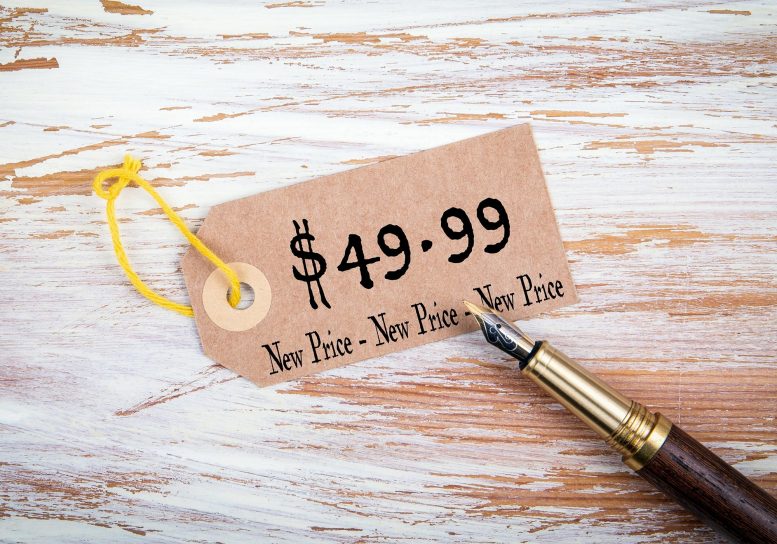
Setting a price just below a round number ($39.99 instead of $40) may lead consumers into thinking a product is less expensive than it really is – but it can sometimes backfire on sellers, a new study shows.
Researchers found that this “just-below” pricing makes consumers less likely to upgrade to a more expensive version of the product or service, such as a bigger size or higher-end trim on a car.
The just-below price that makes a product itself seem like a good bargain also makes the leap to the premium product seem too expensive, said Junha Kim, lead author of the study and doctoral student in marketing at The Ohio State University’s Fisher College of Business.
Round Number Thresholds Distort Perception
“Going from $19.99 to $25 may seem like it will cost more than going from $20 to $26, even though it is actually less,” Kim said.
“Crossing that round number threshold makes a big difference for consumers.”
Kim conducted the study with Joseph Goodman and Selin Malkoc, both associate professors of marketing at Ohio State. Their research was published on August 26, 2021, in the Journal of Consumer Research.

The threshold-crossing effect held for everything from coffee and face masks to streaming services to cars and apartments in seven different experiments, Goodman said.
“We found this effect works in experiential categories, as well as products. It replicated very consistently,” he said.
In one field study, the researchers set up a coffee stand on the Ohio State campus for two days, rotating the prices regularly. About half the time, they offered a small coffee with a “just below” price of 95 cents or a larger cup upgrade for $1.20. In order to choose the upgrade option, customers had to cross that $1 round-number boundary.
Roughly every hour, they changed the price of the small cup to $1 and increased the price of the larger cup by 5 cents to $1.25.
While the larger cup was now more expensive than before, so was the smaller cup. Critically, both prices were on the same side of the $1 boundary, which the researchers predicted would make customers more likely to choose the upgrade.
How did customers respond? Well, 56% of them upgraded to the larger cup when they didn’t have to cross the round-number boundary to upgrade ($1 to 1.25). But only 29% did when the smaller cup was at the just-below price of 95 cents and they had to cross the $1 threshold for the larger cup.
“In other words, we sold more of the large coffee when it was objectively more expensive than it was earlier ($1.25 vs. $1.20),” Malkoc said. “It was amazing how increasing prices – from $1.20 to $1.25 – actually increased sales. It is a testament to how strong the effect was.”
The effect also worked for larger purchases with multiple upgrade options, findings showed.
In one study in the lab, college students were more likely to say they would choose a more expensive car and apartment option when the base price was just above a round number rather than just below. That included scenarios where participants had multiple upgrades to choose from.
Psychological Anchors in Price Perception
These findings fit in well with studies that have found threshold-crossing effects in other parts of life, Kim said.
“Research has shown that going across a state boundary makes a destination seem farther away,” Kim said. “It is crossing that threshold that makes a difference. In our studies, the round number is like the state boundary, magnifying the perception of a difference in price.”
One reason that this effect works so well is that people often don’t have a good idea of what the “right” price of a product or service should be, Goodman explained. So consumers look for some context to help understand if what they’re buying is expensive or inexpensive.
“For many of the things we purchase, price is perceptual. We have a feeling about whether the price is right or not,” Goodman said.
“In our study, people often said an upgrade purchase seemed less expensive when the base price was above the round number, even though it was objectively more expensive.”
When the Effect Doesn’t Work
There are some conditions where the threshold-crossing effect doesn’t happen. One is for small price differences on expensive items. It also doesn’t work on people who are familiar with prices for a product or service – for example, those who book hotels on a regular basis.
People who know prices well aren’t affected because they don’t rely on their perceptions, as many of the participants in this research did, Malkoc said.
“As consumers, we need to realize that our perceptions are often flawed. We need to rely on actual numbers and not just our sense of what the numbers are,” she said.
Reference: “The Threshold-Crossing Effect: Just-Below Pricing Discourages Consumers to Upgrade” by Junha Kim, Selin A Malkoc and Joseph K Goodman, 25 August 2021, Journal of Consumer Research.
DOI: 10.1093/jcr/ucab049
Never miss a breakthrough: Join the SciTechDaily newsletter.
Follow us on Google and Google News.
3 Comments
“One reason that this effect works so well is that people often don’t have a good idea of what the ‘right’ price of a product or service should be, …”
And inflation tends to destroy any internal price calibration acquired over time. That is, experience doesn’t help to determine the “right price.”
It’s time to call in the debt from all of those tenths-of-a-cent on gas that service stations have been taking all these years.
I’d argue that this strategy MOST times backfires on sellers, it’s just that they’re all so used to doing it and we buyers are so used to seeing it that we’ve all just resigned to its employment as ‘par-for-the-course’.
It’s not as if the majority of us aren’t aware of the manipulation. Of course we are! It’s simply that there’s absolutely nothing we can DO about it as the days of being able to haggle the odds are long gone; We either pay the advertised price or we go without- which is, IMHO,the greatest folly in our system- there should ALWAYS be room for haggle in any transaction!
But I digress; The seller who prices in an alternative manner is now seen as a ‘more honest’ seller whose trying to balance his costs with his pricing. It signals (perceptually) a seller whose cognizent of his customers’ needs and is making effort to meet them.