
Close Menu
    Facebook X (Twitter) Instagram
    SciTechDaily
    • Biology
    • Chemistry
    • Earth
    • Health
    • Physics
    • Science
    • Space
    • Technology
    Facebook X (Twitter) Pinterest YouTube RSS
    SciTechDaily
    Home»Biology»Lens-Free System Shows Spiraling Swimming Pattern of Human Sperm
    Biology

    Lens-Free System Shows Spiraling Swimming Pattern of Human Sperm

    By SciTechDailySeptember 20, 2012No Comments2 Mins Read
    Facebook Twitter Pinterest Telegram LinkedIn WhatsApp Email Reddit
    Share
    Facebook Twitter LinkedIn Pinterest Telegram Email Reddit
    sperm-microscope-image
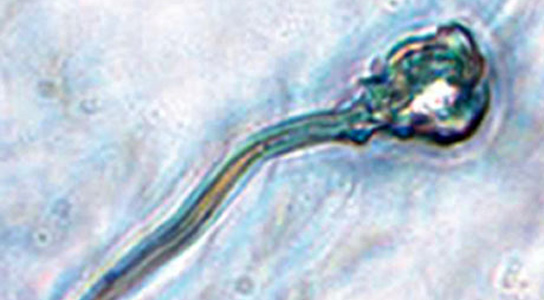
    Microscope image of sperm.

    A new three-dimensional imaging technique has shown the spiraling movements that human sperm accomplishes while swimming. Previously, these movements had only been inferred from two-dimensional data.

    The scientists published their findings in the journal Proceedings of the National Academy of Sciences. The high-resolution recordings in three dimensions tracked more than 1,500 cells over several hours. The heads of human sperm are only 3 to 4 micrometers long, and can only be seen under high magnification, but zoom around at up to 100 micrometers per second, ducking in and out of focus, or darting out of range.

    sperm-background

    Aydogan Ozcan, a bioengineer at the University of California, Los Angeles, led the study and he states that this was the first observation of something entirely hidden. The team used a light-sensing chip that measures about 4 to 6 mm, placed underneath the samples. A red LED shines down on the sperm and forms a hazy shadow that the chip is able to follow. A second blue LED illuminates the sperm from a different angle, casting shadows that change with each sperm.

    image-sperm-head-chip
    Sperm movements are notoriously hard to catch on camera

    At about 90 frames per second, the researchers were able to characterize the sperm movement more precisely. More than 90% of the sperm moved along slightly curved paths, wriggling their heads slightly from side to side. 4 to 5% traveled in near-perfect spiral, forming helices between 0.5 and 3 micrometers in radius. Most of these helices were right-handed, but it’s impossible to know whether this preference serves any physiological function

    Chip-based imaging systems could replace costly computer systems that are used to analyze microscopic images. The technique only captured the sperm heads, not the complex tail movements, which are crucial to understanding the sperm function and dysfunction.

    Reference: “High-throughput lensfree 3D tracking of human sperms reveals rare statistics of helical trajectories” by Ting-Wei Su, Liang Xue and Aydogan Ozcan, 17 September 2012, Proceedings of the National Academy of Sciences.
    DOI: 10.1073/pnas.1212506109

    Never miss a breakthrough: Join the SciTechDaily newsletter.
    Follow us on Google and Google News.

    Imaging Reproduction Sperm
    Share. Facebook Twitter Pinterest LinkedIn Email Reddit

    Related Articles

    Sperm Get Lost in Space and Scientists Finally Know Why

    DIANA Debunked by MIT: The MRI That Couldn’t Read Minds

    Timing Is Everything: Squid Birth Dates Influence Love Strategies

    Scientists Develop World’s First 3D-Printed “Brain Phantom”

    Not Science Fiction – This Bizarre Worm-Lizard Is Like the Dune Sandworm but Weirder

    Scientists Unveil Unprecedented “Live” View Into the Brain’s Complexity

    Mosquitoes No More? New Research Could Help Control Infectious Pests

    Researchers Study Regulatory Gene’s Role in Sperm Quality Control

    Researchers Show Sperm Production Has Health Implications

    Leave A Reply Cancel Reply

    • Facebook
    • Twitter
    • Pinterest
    • YouTube

    Don't Miss a Discovery

    Subscribe for the Latest in Science & Tech!

    Trending News

    The Universe Is Expanding Too Fast and Scientists Can’t Explain Why

    “Like Liquid Metal”: Scientists Create Strange Shape-Shifting Material

    Early Warning Signals of Esophageal Cancer May Be Hiding in Plain Sight

    Common Blood Pressure Drug Shows Surprising Power Against Deadly Antibiotic-Resistant Superbug

    Scientists Uncover Dangerous Connection Between Serotonin and Heart Valve Disease

    Scientists Discover a “Protector” Protein That Could Help Reverse Hair Loss

    Bone-Strengthening Discovery Could Reverse Osteoporosis

    Scientists Uncover Hidden Trigger Behind Stem Cell Aging

    Follow SciTechDaily
    • Facebook
    • Twitter
    • YouTube
    • Pinterest
    • Newsletter
    • RSS
    SciTech News
    • Biology News
    • Chemistry News
    • Earth News
    • Health News
    • Physics News
    • Science News
    • Space News
    • Technology News
    Recent Posts
    • Scientists Overcome Major Quantum Bottleneck, Potentially Transforming Teleportation and Computing
    • Quantum Physics’ Strangest Problem May Hold the Key to Time Itself
    • Scientists Create “Liquid Gears” That Spin Without Touching
    • The Simple Habit That Could Help Prevent Cancer
    • Forgotten Medicinal Plant Shows Promise in Fighting Dangerous Superbugs
    Copyright © 1998 - 2026 SciTechDaily. All Rights Reserved.
    • Science News
    • About
    • Contact
    • Editorial Board
    • Privacy Policy
    • Terms of Use

    Type above and press Enter to search. Press Esc to cancel.