
Close Menu
    Facebook X (Twitter) Instagram
    SciTechDaily
    • Biology
    • Chemistry
    • Earth
    • Health
    • Physics
    • Science
    • Space
    • Technology
    Facebook X (Twitter) Pinterest YouTube RSS
    SciTechDaily
    Home»Space»Scientists Model Saturn’s Interior – Thick Layer of Helium Rain May Influence the Planet’s Magnetic Field
    Space

    Scientists Model Saturn’s Interior – Thick Layer of Helium Rain May Influence the Planet’s Magnetic Field

    By Johns Hopkins UniversityMay 10, 20212 Comments3 Mins Read
    Facebook Twitter Pinterest Telegram LinkedIn WhatsApp Email Reddit
    Share
    Facebook Twitter LinkedIn Pinterest Telegram Email Reddit
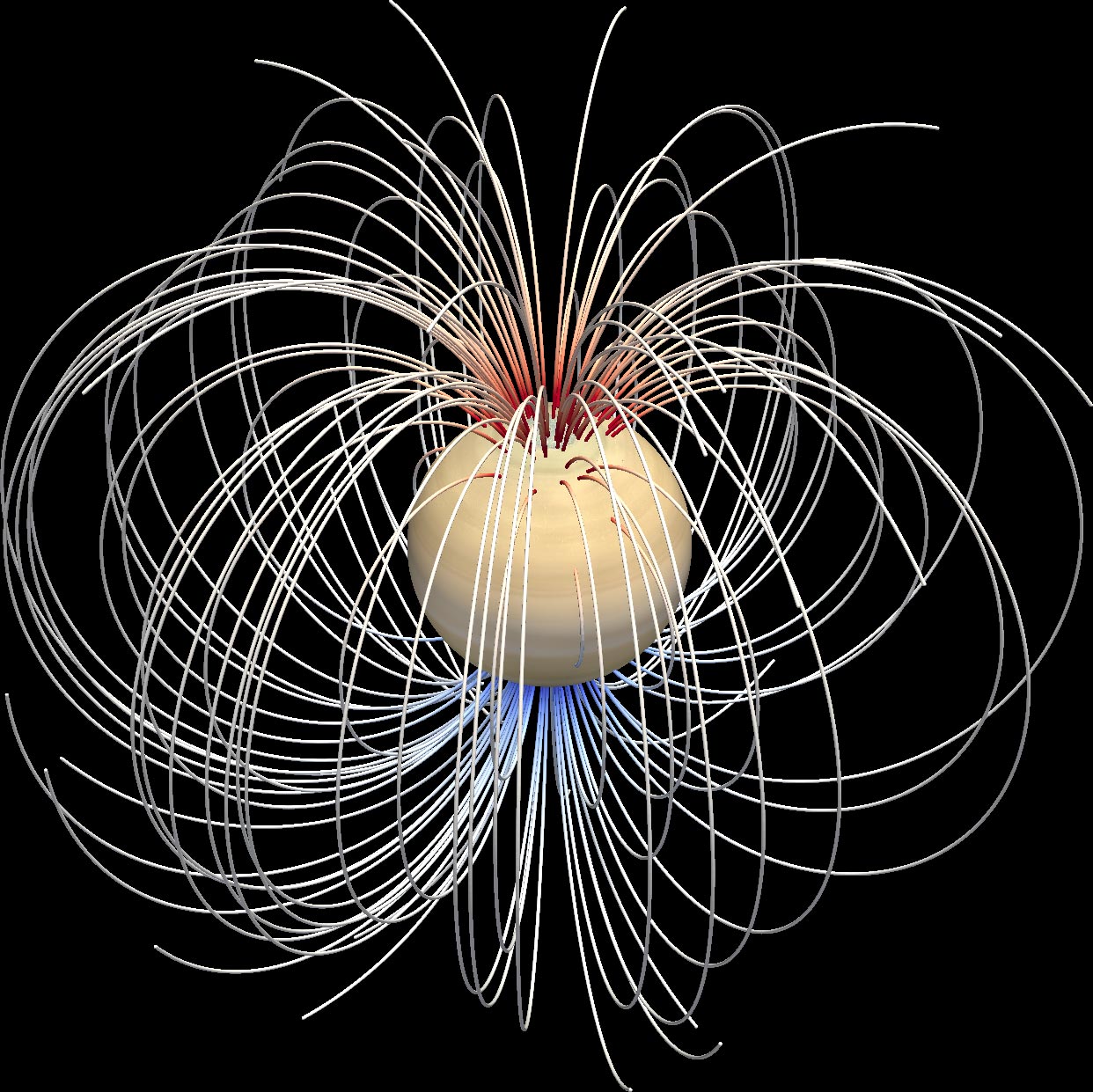
    Saturn’s Magnetic Field
    The magnetic field of Saturn seen at the surface. Credit: Ankit Barik/Johns Hopkins University

    Researchers simulate conditions necessary for planet’s unique magnetic field.

    New Johns Hopkins University simulations offer an intriguing look into Saturn’s interior, suggesting that a thick layer of helium rain influences the planet’s magnetic field.

    The models, published recently in AGU Advances, also indicate that Saturn’s interior may feature higher temperatures at the equatorial region, with lower temperatures at the high latitudes at the top of the helium rain layer.

    It is notoriously difficult to study the interior structures of large gaseous planets, and the findings advance the effort to map Saturn’s hidden regions.

    “By studying how Saturn formed and how it evolved over time, we can learn a lot about the formation of other planets similar to Saturn within our own solar system, as well as beyond it,” said co-author Sabine Stanley, a Johns Hopkins planetary physicist.

    Cassini Data Powers New Dynamo Simulations

    Saturn stands out among the planets in our solar system because its magnetic field appears to be almost perfectly symmetrical around the rotation axis. Detailed measurements of the magnetic field gleaned from the last orbits of NASA’s Cassini mission provide an opportunity to better understand the planet’s deep interior, where the magnetic field is generated, said lead author Chi Yan, a Johns Hopkins PhD candidate.
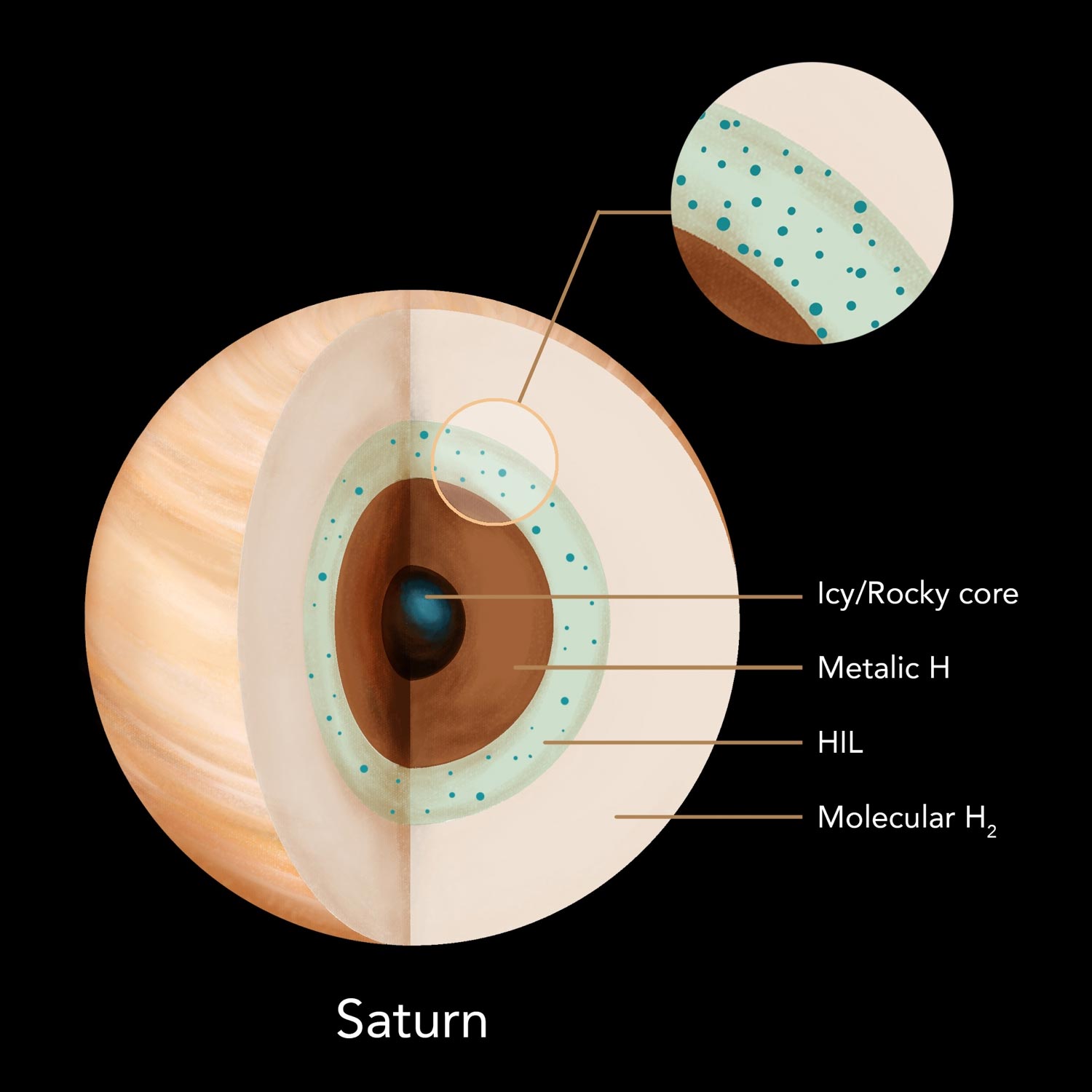
    Saturn’s Interior
    Saturn’s interior with stably stratified Helium Insoluble Layer. Credit: Yi Zheng (HEMI/MICA Extreme Arts Program)

    By feeding data gathered by the Cassini mission into powerful computer simulations similar to those used to study weather and climate, Yan and Stanley explored what ingredients are necessary to produce the dynamo—the electromagnetic conversion mechanism—that could account for Saturn’s magnetic field.

    Temperature Sensitivity Reveals Interior Structure

    “One thing we discovered was how sensitive the model was to very specific things like temperature,” said Stanley, who is also a Bloomberg Distinguished Professor at Johns Hopkins in the Department of Earth & Planetary Sciences and the Space Exploration Sector of the Applied Physics Lab. “And that means we have a really interesting probe of Saturn’s deep interior as far as 20,000 kilometers down. It’s a kind of X-ray vision.”

    Strikingly, Yan and Stanley’s simulations suggest that a slight degree of non-axisymmetry could actually exist near Saturn’s north and south poles.

    “Even though the observations we have from Saturn look perfectly symmetrical, in our computer simulations we can fully interrogate the field,” said Stanley.

    Direct observation at the poles would be necessary to confirm it, but the finding could have implications for understanding another problem that has vexed scientists for decades: how to measure the rate at which Saturn rotates, or, in other words, the length of a day on the planet.

    Reference: “Recipe for a Saturn‐Like Dynamo” by C. Yan and S. Stanley, 5 May 2021, AGU Advances.
    DOI: 10.1029/2020AV000318

    This project was conducted using computational resources at the Maryland Advanced Research Computing Center (MARCC).

    Never miss a breakthrough: Join the SciTechDaily newsletter.
    Follow us on Google and Google News.

    Geophysics Johns Hopkins University Planets Popular Saturn
    Share. Facebook Twitter Pinterest LinkedIn Email Reddit

    Related Articles

    Space Scientists Discover a Never-Before-Seen Mechanism Fueling Huge Planetary Aurorae on Saturn

    “Helium Rain Is Real!” – Experiments Validate the Possibility of Helium Rain Inside Jupiter and Saturn

    Interplanetary Storm Chasing – New Explanation for Mysterious Hexagonal Storm on Saturn

    Surprise on Mars – Unexpected Reaction to Solar Eclipses From Martian Moon Phobos

    NASA InSight Lander Takes Deep Mars Measurements: Seismograph Data Reveals Boundaries From Crust to Core

    Evidence Pluto Started Out With Liquid Oceans That Have Been Slowly Freezing Over Time

    Most Extensive System of Haze Layers in the Solar System Have Been Discovered on Saturn

    Saturn’s Great Atmospheric Mystery Explained by New Data From NASA’s Cassini

    Saturn’s Moon Phoebe Has Planet-Like Qualities

    2 Comments

    1. xABBAAA on May 10, 2021 12:17 pm

      … is this “May” the most important word in a title… I like May, but June is nice in some places, and April has some charm too…
      ups, not to forget about the 12 months, and some planets… yadda,,,,

      Reply
      • xABBAAA on June 26, 2021 9:42 am

        … As matter of fact it looks like the rings on the Saturn do look like electrons in the orbit around the nucleus…

        Reply
    Leave A Reply Cancel Reply

    • Facebook
    • Twitter
    • Pinterest
    • YouTube

    Don't Miss a Discovery

    Subscribe for the Latest in Science & Tech!

    Trending News

    Scientists Discover How Coffee Impacts Memory, Mood, and Gut Health

    Why Did the Neanderthals Disappear? Scientists Reveal Humans Had a Hidden Advantage

    Physicists Propose Strange Experiment Where Time Goes Quantum

    Magnesium Magic: New Drug Melts Fat Even on a High-Fat, High-Sugar Diet

    Weight-Loss Drugs Like Ozempic May Come With an Unexpected Cost

    Mezcal “Worm” in a Bottle Mystery: DNA Testing Reveals a Surprise

    New Research Reveals That Your Morning Coffee Activates an Ancient Longevity Switch

    This Is What Makes You Irresistible to Mosquitoes

    Follow SciTechDaily
    • Facebook
    • Twitter
    • YouTube
    • Pinterest
    • Newsletter
    • RSS
    SciTech News
    • Biology News
    • Chemistry News
    • Earth News
    • Health News
    • Physics News
    • Science News
    • Space News
    • Technology News
    Recent Posts
    • This New Memory Technology Could Make Devices Last Months on One Charge
    • Scientists Turn Cancer’s Own Bacteria Against It in Breakthrough Therapy
    • Cannabis Can Make You Remember Things That Never Happened
    • Doctors Are Surprised by What This Vaccine Is Doing to the Heart
    • Quantum Breakthrough Turns Simple Forces Into Powerful New Interactions
    Copyright © 1998 - 2026 SciTechDaily. All Rights Reserved.
    • Science News
    • About
    • Contact
    • Editorial Board
    • Privacy Policy
    • Terms of Use

    Type above and press Enter to search. Press Esc to cancel.