
Close Menu
    Facebook X (Twitter) Instagram
    SciTechDaily
    • Biology
    • Chemistry
    • Earth
    • Health
    • Physics
    • Science
    • Space
    • Technology
    Facebook X (Twitter) Pinterest YouTube RSS
    SciTechDaily
    Home»Science»Exposing 8,000 Years of Civilization With Satellites
    Science

    Exposing 8,000 Years of Civilization With Satellites

    By SciTechDailyMarch 22, 20123 Comments2 Mins Read
    Facebook Twitter Pinterest Telegram LinkedIn WhatsApp Email Reddit
    Share
    Facebook Twitter LinkedIn Pinterest Telegram Email Reddit
    model-human-settlement-small
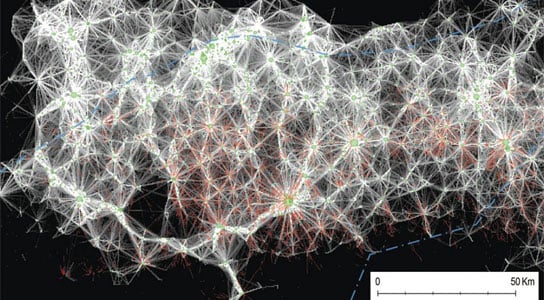
    Analysis of the locations of ancient settlements can reveal the many connections between them.

    Hidden beneath mounds of Earth, in the fertile crescent of the Middle East, lie overlooked networks of small settlements that date back millennia. Archaeologists are now probing these mounds to find out more about early human settlements.

    Satellite photos were combined with modern multi-spectral images and digital maps of the Earth’s surface to create a new method to map large-scale patterns of human settlement. 14,000 settlements were mapped, spanning eight millennia, in 23,000 square kilometers *8,880 square miles) of northeastern Syria. The researchers published their findings in the journal Proceedings of the National Academy of Sciences.
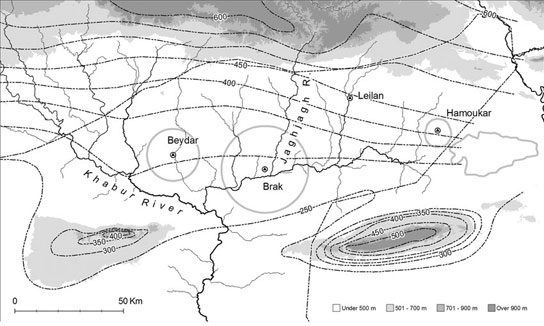
    map-settlement-tell-brak

    Traditionally, archeology targets the biggest features, like palaces or cities, but tends to ignore smaller settlements. It’s hoped that such a comprehensive map will uncover long-term trends in urban activity.

    The new method relies on the fact that all human activity leaves a distinctive signature on the soil. This is called anthrosols, and it’s formed from organic waste and decayed mud-brick architecture. Anthrosols with higher levels of organic matter leave a finer texture behind on undisturbed soil, which results in a reflective property that can be detected by satellites.
    tell-brak-mitanni-palace
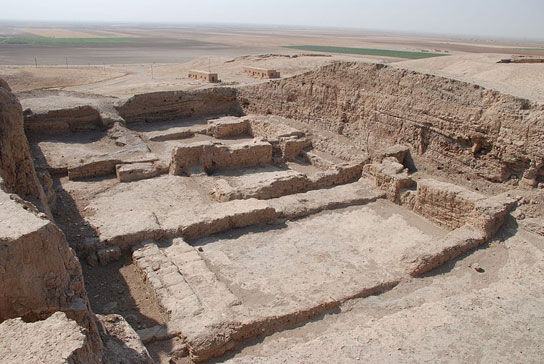
    Tell Brak, Syria, Mitanni palace

    Software was developed to automate the process, the larger the mounds of earth, the longer the older the settlement.

    The method has already renewed speculation about the importance of water to the development of cities. The study has found that a number of sites are larger than expected given the fact that they aren’t located near rivers or in areas of high precipitation. The Tell Brak settlement is an example of such a site. Archeologists believe that irrigation might be an after-effect of urbanization.

    Reference: “Mapping patterns of long-term settlement in Northern Mesopotamia at a large scale” by Bjoern H. Menze and Jason A. Ur, 19 March 2012, Proceedings of the National Academy of Sciences.
    DOI: 10.1073/pnas.1115472109

    Never miss a breakthrough: Join the SciTechDaily newsletter.
    Follow us on Google and Google News.

    Archaeology Satellites Urbanization
    Share. Facebook Twitter Pinterest LinkedIn Email Reddit

    Related Articles

    “Unlike Anything Else” – Archaeologists Unearth Massive Bronze Age City After 3500 Years

    It Wasn’t Just Drought: Scientists Propose New Theory on the Maya Urban Collapse

    Inequality Isn’t Inevitable: New Study Challenges Economic Myths

    Ancient Pacific City Discovered: Urbanization Began 700 Years Earlier Than Thought

    396 Forgotten Forts Revealed – Declassified Spy Satellite Images Unearth Rome’s Lost Frontier

    Reproductive Cycle Put Dinosaurs at a Disadvantage

    Million-Year-Old Ash in South African Cave Yields Evidence of Cooking

    Humans Implicated in Africa’s Deforestation 3,000 Years Ago

    Archaeologists Inch Closer to Understanding Stonehenge

    3 Comments

    1. David Pulliam on September 19, 2013 3:32 pm

      What is the model-human settlement map of, what is the location?

      Reply
      • Satff on September 19, 2013 4:48 pm

        …”Satellite photos were combined with modern multi-spectral images and digital maps of the Earth’s surface to create a new method to map large-scale patterns of human settlement. 14,000 settlements were mapped, spanning eight millennia, in 23,000 square kilometers of northeastern Syria.”

        Reply
    2. Eric M. Jones on December 16, 2024 8:26 am

      Exposing 8,000 Years of Civilization With Satellites

      SB

      Satellites Expose 8,000 Years of Civilization

      Unless there really were civilizations with satellites 8,000 years ago.

      Reply
    Leave A Reply Cancel Reply

    • Facebook
    • Twitter
    • Pinterest
    • YouTube

    Don't Miss a Discovery

    Subscribe for the Latest in Science & Tech!

    Trending News

    The Universe Is Expanding Too Fast and Scientists Can’t Explain Why

    “Like Liquid Metal”: Scientists Create Strange Shape-Shifting Material

    Early Warning Signals of Esophageal Cancer May Be Hiding in Plain Sight

    Common Blood Pressure Drug Shows Surprising Power Against Deadly Antibiotic-Resistant Superbug

    Scientists Uncover Dangerous Connection Between Serotonin and Heart Valve Disease

    Scientists Discover a “Protector” Protein That Could Help Reverse Hair Loss

    Bone-Strengthening Discovery Could Reverse Osteoporosis

    Scientists Uncover Hidden Trigger Behind Stem Cell Aging

    Follow SciTechDaily
    • Facebook
    • Twitter
    • YouTube
    • Pinterest
    • Newsletter
    • RSS
    SciTech News
    • Biology News
    • Chemistry News
    • Earth News
    • Health News
    • Physics News
    • Science News
    • Space News
    • Technology News
    Recent Posts
    • A Common Diabetes Drug May Hold the Key to Stopping HIV From Coming Back
    • Ancient “Syphilis-Like” Disease in Vietnam Challenges Key Scientific Assumptions
    • Drinking Alcohol To Cope in Your 20s Could Damage Your Brain for Life
    • Scientists Crack Alfalfa’s Chromosome Mystery After Decades of Debate
    • Ancient Ant-Plant Alliance Collapses As Predatory Wasps Move In
    Copyright © 1998 - 2026 SciTechDaily. All Rights Reserved.
    • Science News
    • About
    • Contact
    • Editorial Board
    • Privacy Policy
    • Terms of Use

    Type above and press Enter to search. Press Esc to cancel.