

A century after one of developmental biology’s most influential experiments, researchers have revisited the concept of the embryonic “organizer” in one of the oldest animal lineages alive today.
A tiny cluster of cells in an embryo can act like a construction manager for an entire body. It helps determine which end becomes the head, which side becomes the back, and how the basic body plan takes shape. For a century, biologists have known that this kind of developmental command center exists in vertebrates.
Now, researchers in Germany have found evidence that the same ancient system reaches much deeper into animal history than expected.
Scientists at Friedrich Schiller University Jena report in Nature that comb jellies, also known as ctenophores, appear to use a similar embryonic signaling system to organize their body axes. Because comb jellies are among the earliest branches of the animal family tree, the discovery suggests that one of the most important instructions for building an animal body may have emerged near the dawn of multicellular life.
A Century-Old Experiment Reimagined
The finding builds on one of the most famous experiments in developmental biology. In 1924, biologist Hans Spemann and his student Hilde Mangold identified what became known as the “organizer.” Working with amphibian embryos, they moved tissue from the blastopore, an early embryonic structure, into another embryo. The recipient embryo then began forming a second body axis.
That result showed that a small group of cells could guide neighboring tissue and help establish the three-dimensional layout of a developing animal. Spemann later received the 1935 Nobel Prize for the discovery. Mangold, who had studied at the University of Jena, died in a fire in 1924 at age 25 and did not live to see the full impact of her work.
Comb Jellies Reveal an Ancient Blueprint
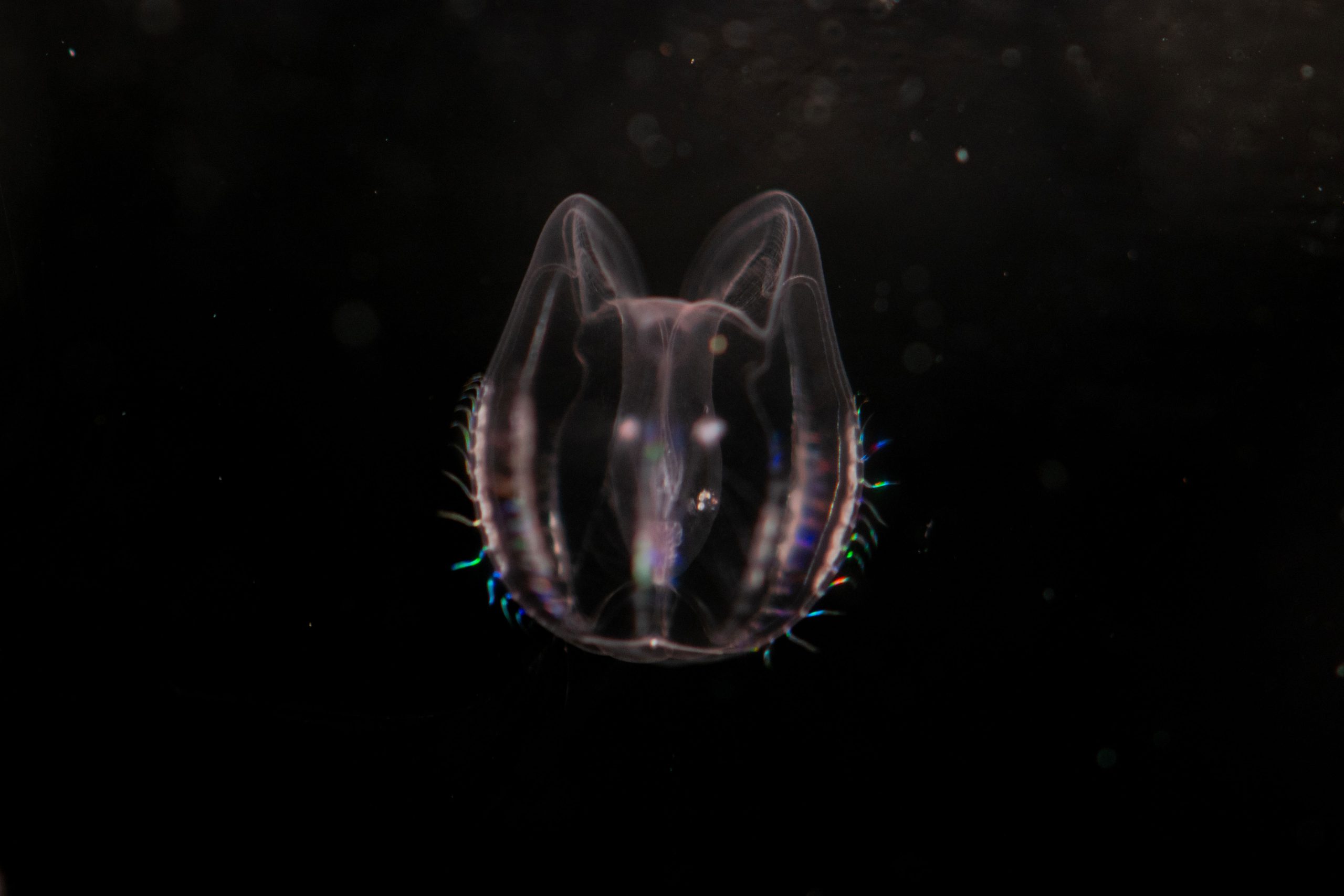
The Jena team has now revisited that classic experiment in comb jellies, a group of delicate marine animals that move through the water using rows of shimmering, hairlike structures called cilia. Although they are sometimes confused with jellyfish, comb jellies belong to a separate lineage.
The researchers transplanted tissue from the blastopore region of one comb jelly embryo into another. The recipient embryo formed a second body axis, closely echoing the result seen in amphibians a century ago. Because the transplanted cells were stained, the team could also track their behavior and show that they influenced nearby cells in the new embryo.
“Through our experiments, we were able to show that this key mechanism, which coordinates the axes of the entire body, dates back in evolutionary terms to the dawn of animal multicellularity,” explains Prof. Dr. Andreas Hejnol, an evolutionary biologist and leader of the Jena research team. “This is because, according to current understanding, the lineage of the Ctenophora, the scientific name for comb jellies, diverged from ours around 700 million years ago.”
Surgery on Embryos Smaller Than a Speck
The work required extraordinary precision. The comb jelly species used in the study can grow up to 12 centimeters (4.7 inches) long, but its embryos are only about 120 micrometers (0.0047 inches) across, slightly wider than a human hair.
Dr. Stanislav Kremnyov, a biologist in Jena, managed to transplant tissue samples measuring only about 20 micrometers (0.0008 inches). The cells had to be placed directly into the recipient embryo’s tissue so they would be accepted and continue developing. “The editor of Nature suspected that these experiments must have felt like dissecting clouds,” says Andreas Hejnol.
A Signal That Works Across Species
The team then pushed the experiment further. They did not only transfer organizer tissue between comb jelly embryos. They also transplanted it into the embryo of a sea anemone, an animal from the cnidarian lineage.
The transplanted tissue again triggered the formation of an additional body axis. That result is striking because ctenophores and cnidarians are separated by a vast stretch of evolutionary history. According to the researchers, the cnidarian lineage diverged from the ctenophore lineage roughly 60 million years later in animal evolution.
“Such a xenotransplantation, that is, the transfer of tissue from one animal group to another, across so many millions of years has never been demonstrated before,” says Andreas Hejnol.
The experiment also allowed the researchers to identify, for the first time, the gene responsible for organizer formation in the sea anemone.
The study suggests that the organizer is not only a feature of vertebrate development. A similar body-patterning system exists in comb jellies and can even function in a sea anemone embryo.
Reference: “A blastoporal organizer in a ctenophore” by Stanislav Kremnyov, Tatiana Lebedeva, Grigory Genikhovich and Andreas Hejnol, 17 June 2026, Nature.
DOI: 10.1038/s41586-026-10643-z
Never miss a breakthrough: Join the SciTechDaily newsletter.
Follow us on Google and Google News.