

Researchers have uncovered a critical mechanism behind battery failure in solid-state batteries, offering new insights that could help unlock safer, longer-lasting energy storage technologies.
Every time a smartphone is charged or an electric vehicle is plugged in, billions of lithium ions move through a battery to store energy. Future devices could perform far better with solid-state batteries, a technology that promises longer-lasting phones, safer energy storage, and electric vehicles capable of traveling much farther on a single charge. Yet one stubborn problem has kept these batteries from reaching the mainstream: tiny structures called dendrites that can destroy a battery from the inside.
Now, researchers at the Max Planck Institute for Sustainable Materials (MPI-SusMat) have uncovered exactly how these microscopic defects trigger battery failure. Their findings, published in Nature, provide new insight into one of the most important challenges facing next-generation energy storage.
Unlike conventional lithium-ion batteries, which rely on a liquid electrolyte to move ions between electrodes, solid-state batteries use a solid ceramic electrolyte. Eliminating the liquid component offers several advantages. Solid-state designs can potentially store more energy in the same amount of space, reduce fire risks, and remain functional for longer periods.
The technology has attracted enormous interest from automakers and electronics manufacturers because it could dramatically improve battery performance. In theory, smartphones could go days without charging, while electric vehicles could achieve driving ranges up to three times greater than current models.
Why Soft Lithium Can Break a Hard Ceramic
Despite those advantages, solid-state batteries face a surprising weakness. During charging, needle-like dendrites can grow from the lithium anode and extend into the solid electrolyte. If they reach the opposite electrode, they create an internal short circuit that can rapidly disable the battery.
What has puzzled scientists is how lithium, a soft metal, can penetrate and fracture a ceramic material that is far harder and more rigid.
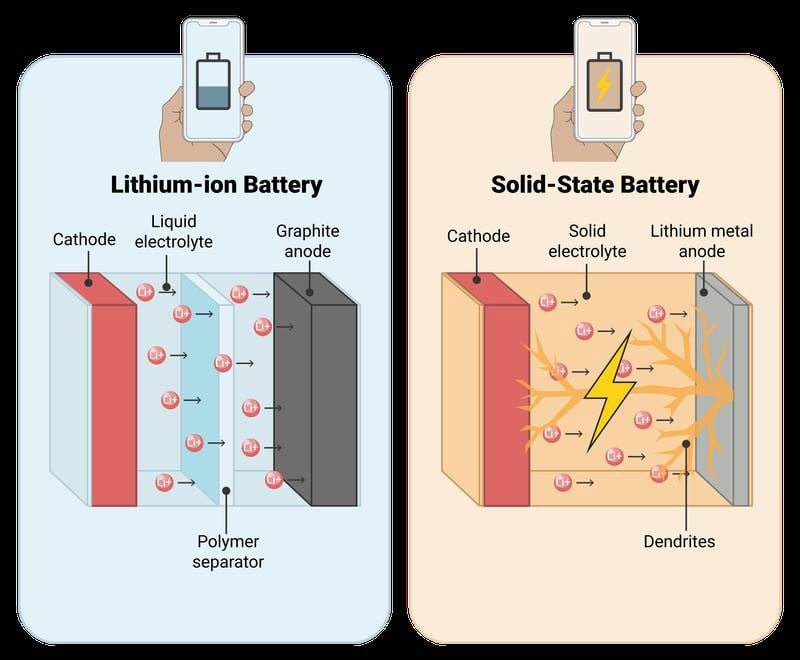
“Although the electrodes and the forming dendrites consist of lithium metal, which is soft like a gummy bear, the dendrites are able to penetrate the ceramic electrolyte and lead to a short circuit,” said Dr. Yuwei Zhang, lead author of the study and head of the “Chemo-Mechanics of Battery Materials” group at MPI-SusMat.
“How can soft dendrites fracture the stiff solid ceramic? There are two hypotheses: either internal stress is built up inside the dendrites and induces mechanical fracture of the solid electrolyte. Or, electrons leak along the grain boundaries of the solid electrolyte promoting the formation of lithium nuclei that interconnect later.”
To determine which explanation was correct, the researchers developed an extensive experimental approach that allowed them to study the materials under vacuum and at cryogenic temperatures. These conditions prevented contamination from oxygen and moisture while also minimizing unwanted effects from electron microscopy.
The Battery Failure Mechanism Revealed
The team closely examined lithium dendrites trapped within cracks in the ceramic electrolyte. Their measurements showed no evidence that lithium was accumulating ahead of the advancing dendrite tip, a finding that weakens the second hypothesis.
Instead, the results pointed to pressure buildup inside the dendrite itself.
“The soft lithium metal is able to penetrate the stiff ceramic electrolyte, like a continuous waterjet that penetrates a rock. We calculated that hydrostatic stress in the dendrite leads to brittle fracture of the solid electrolyte in the end,” said Zhang.
The results were further supported by phase field simulations and electron backscatter diffraction measurements.
With a better understanding of how dendrite-related cracking occurs, the team is now investigating ways to stop it. Potential solutions include making the solid electrolyte more resistant to cracking, adding microscopic voids that redirect dendrite growth and reduce crack propagation, and applying protective coatings to lithium electrodes to limit dendrite formation.
The researchers say the work underscores the importance of understanding how materials behave at a fundamental level when developing technologies for real-world use.
Reference: “Mechanically driven Li dendrite penetration in garnet solid electrolyte” by Yuwei Zhang, Soroush Motahari, Eric V. Woods, Stefan Zaefferer, Peter Schweizer, Zhiyuan Zhang, Yuqi Liu, Baptiste Gault, Franz Roters, Dierk Raabe, Christina Scheu, Yug Joshi, Siyuan Zhang, Chuanlai Liu and Gerhard Dehm, 22 April 2026, Nature.
DOI: 10.1038/s41586-026-10415-9
Never miss a breakthrough: Join the SciTechDaily newsletter.
Follow us on Google and Google News.
3 Comments
It should surprise no one that soft things can penetrate hard things. Consider the mushroom!
This is not cutting edge news. Dendritic degradation has been a problem for most battery chemistry. New Toyota solid state battery technology has supposed to have solved this. Out in 2027.
that’s the trouble with “profit”, it serves very narrow remits. double edged sword. Toyota will be keeping that shit to themselves. it’s scenarios like this that shows the damage profit does. a cooperative rather than competitive, adversarial economic system system wouldn’t have such failures. unfortunately, economic theory has been under a strangle hold ever since currency became a thing. so since forever. that’s why it’s considered a mystery (like predicting the weather) mainstream economics will have us believe it’s too complex to model. well with ai that’s no longer part of the stack. not to say that argument is valid, it isn’t. the way economics is taught is pretty much exactly the same as any other area of specialisation, under lock and key from the uninitiated. the lock and key of specialist (obfuscating) terminology. specialists create their own language to help explain discovery and invention then use that language to lie about how one’s specialism works. patents and ip further foster competition and discourage cooperation. as is fundamental to an economic system based upon greed and acquisition.