
Likely to be especially valuable in the early stages of any pandemic, suggest researchers.
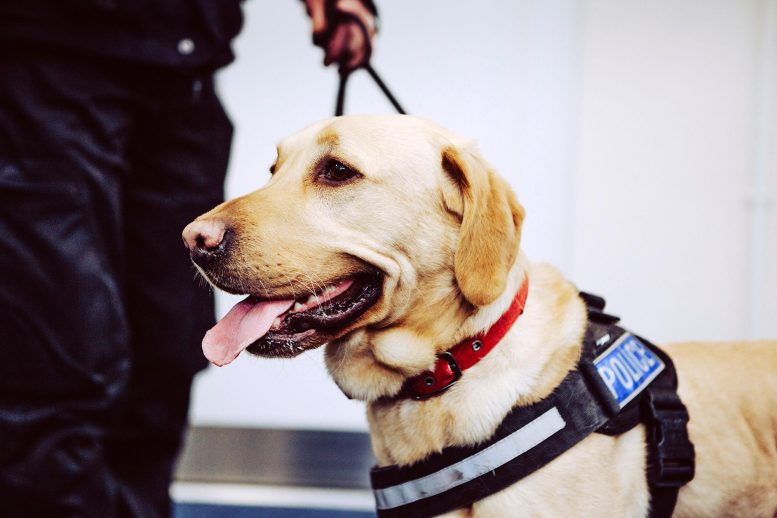
Trained sniffer dogs can accurately detect airport passengers infected with SARS-CoV-2, the virus responsible for COVID-19, finds research published today (May 16, 2022) in the open access journal BMJ Global Health.
According to the researchers, this form of detection is likely to be very important not just in the early phases of a pandemic when other resources may not yet be accessible, but also in helping to contain an ongoing epidemic.
Dogs have an extremely acute sense of smell, and can pick up a scent at levels as low as one part per trillion, far exceeding any available mechanical techniques.
It is thought that they are able to detect distinct volatile organic compounds released during various metabolic processes in the body, including those generated by bacterial, viral, and parasitic infections.
Training and Real-Life Testing of Sniffer Dogs
Preliminary data suggest that dogs can be trained within weeks to detect samples from patients with COVID-19 infection, with a degree of accuracy comparable to that of a standard PCR nose and throat swab test.
While promising, these lab data results needed to be replicated in real-life conditions. The researchers, therefore, trained 4 dogs to sniff out SARS-CoV-2 in Spring 2020. Each of the dogs had previously been trained to sniff out illicit drugs or dangerous goods or cancer.
To test the dogs’ detection skills, 420 volunteers provided four skin swab samples each. The 4 dogs each sniffed the skin samples from 114 of the volunteers who had tested positive for SARS-CoV-2 on a PCR swab test and from 306 who had tested negative. The samples were randomly presented to each dog over 7 trial sessions.
High Diagnostic Accuracy in Controlled Conditions
Overall, the diagnostic accuracy of all samples sniffed was 92%: combined sensitivity— accuracy of detecting those with the infection—was 92% and combined specificity—accuracy of detecting those without the infection—was 91%.
Only minor variation was seen among the dogs: the best performance reached 93% for sensitivity and 95% for specificity; the worst reached 88% for sensitivity and 90% for specificity.
Some 28 of the positive samples came from people who had had no symptoms. Only one was incorrectly identified as negative and two weren’t sniffed, meaning that 25 of the 28 (just over 89%) were correctly identified as positive: the lack of symptoms didn’t seem to affect the dogs’ performance.
The 4 dogs were then put to work sniffing out 303 incoming passengers at Helsinki-Vantaa International Airport, Finland, between September 2020 and April 2021. Each passenger also took a PCR swab test.
The PCR and sniffer results matched 296 out of 303 (98%) of the real-life samples. The dogs correctly identified the samples as negative in 296 out of 300 (99%) PCR negative swab tests and identified three PCR positive cases as negative.
After re-evaluation with clinical and serological data, one was judged to be SARS-CoV-2 negative, one SARS-CoV-2 positive, and one a likely post-infectious positive PCR test result.
Similarly, the dogs indicated 4 PCR negative cases as positive. These were all judged to be SARS-CoV-2 negative.
Because the prevalence of SARS-CoV-2 among the airport passengers was relatively low (less than 0.5%), 155 samples from people who had tested positive on a PCR swab test were also presented to the dogs.
The dogs correctly identified just under 99% of them as positive. Had these ‘spike’ samples been included in the real-life study, the dogs’ performance would have reached a sensitivity of 97% and a specificity of 99%.
Calculating the Effectiveness of Sniffer Dogs in Various Scenarios
Based on these results, the researchers then calculated the proportion of true positive results (PPV) and the proportion of true negative results (NPV) in two hypothetical scenarios reflecting a population prevalence of SARS-CoV-2 of 40% and 1%.
For the prevalence of 40%, they estimated a PPV of 88% and an NPV of 94.5%. This means that the information provided by the dog increases the chances of detection to around 90%.
For a population prevalence of 1%, on the other hand, they estimated a PPV of just under 10% and an NPV of just under 100%.
In both scenarios, the high NPV backs the use of sniffer dogs for screening, with the aim of excluding people who don’t need a PCR swab test, say the researchers.
And they suggest that: “dogs could be used both in sites of high SARS-CoV-2 prevalence, such as hospitals (to prescreen patients and personnel), as well as in low prevalence sites, such as airports or ports (to prescreen passengers).” This could save both considerable time and resource, they say.
The researchers acknowledge that dogs trained to sniff out other substances may mistakenly identify these substances as SARS-CoV-2 positive. The required storage period of the training and spiked samples may also have affected the viability of the volatile organic compounds, they say.
Dogs’ Ability to Differentiate COVID-19 Variants
A key finding was that the dogs were less successful at correctly identifying the alpha variant as they had been trained to detect the wild type. But this just goes to show how good dogs are at distinguishing between different scents, say the researchers.
“This observation is remarkable as it proves the scent dogs’ robust discriminatory power. The obvious implication is that training samples should cover all epidemiologically relevant variants. Our preliminary observations suggest that dogs primed with one virus type can in a few hours be retrained to detect its variants.”
Reference: “Scent dogs in detection of COVID-19: triple-blinded randomised trial and operational real-life screening in airport setting” by Anu Kantele, Juuso Paajanen, Soile Turunen, Sari H Pakkanen, Anu Patjas, Laura Itkonen, Elina Heiskanen, Maija Lappalainen, Loic Desquilbet, Olli Vapalahti and Anna Hielm-Björkman, 16 May 2022, BMJ Global Health.
DOI: 10.1136/bmjgh-2021-008024
Funding: Evidensia; Swedish Cultural Foundation in Finland; The Finnish Kennel Club; Finnish Cultural Foundation
Never miss a breakthrough: Join the SciTechDaily newsletter.
Follow us on Google and Google News.