
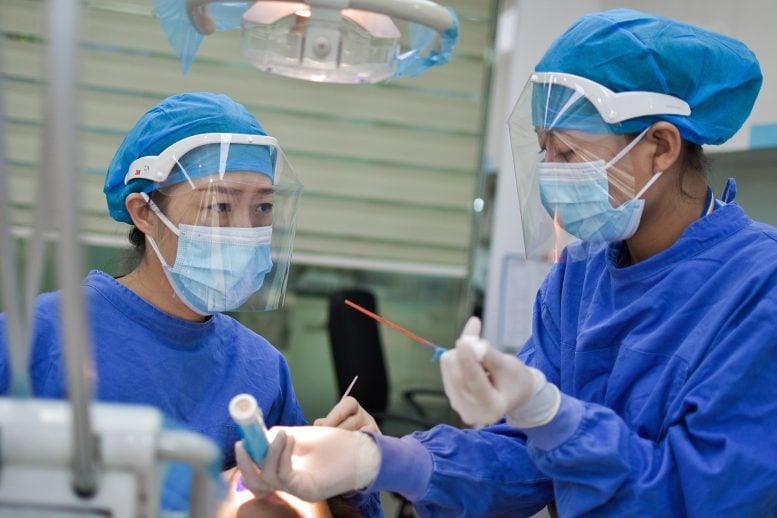
Overall risk of admission low, but those in patient-facing roles are at particular risk, say researchers.
Healthcare workers and their families account for a sixth (17%) of hospital admissions for COVID-19 in the working-age population (18-65 years), finds a study from Scotland published by The BMJ today.
Although hospital admission with COVID-19 in this age group was very low overall, the risk for healthcare workers and their families was higher compared with other working-age adults, especially for those in “front door” patient-facing roles such as paramedics and A&E department staff, say the researchers.
As such, they say these findings have implications for the safety and wellbeing of healthcare workers, and their households.
Many healthcare staff work in high-risk settings for contracting COVID-19 and transmitting it to their household, workplace contacts, or both. Yet the extent of these risks is not well understood, as studies are lacking or have been beset by quality issues.
To address this evidence gap, a team of UK researchers set out to assess the risk of hospital admission for COVID-19 among patient-facing and non-patient-facing healthcare workers and their household members.
Their findings are based on Scottish workforce data for 158,445 healthcare workers (aged 18-65 years), 229,905 household members, and other members of the general population during the peak period for COVID-19 infection in Scotland (March 1 to June 6, 2020).
The researchers found that admission to hospital with COVID-19 was uncommon, with an overall risk of less than 0.5%.
However compared with other adults of working age, healthcare workers and their households accounted for 17% of all COVID-19-related hospital admissions, even though they represent only 11% of the working-age population.
After adjusting for factors such as age, sex, ethnicity, and underlying health conditions (comorbidities), the risk of hospital admission for COVID-19 in non-patient-facing healthcare workers and their household members was similar to the risk in the general population.
However, patient-facing healthcare workers were three times more likely to be admitted to hospital for COVID-19, while members of their households were nearly twice as likely to be admitted to hospital for COVID-19 than other working-age adults.
Those working in “front door” roles, such as paramedics and A&E department staff, were at the highest risk of hospital admission for COVID-19.
Among healthcare workers who were admitted, 1 in 8 were admitted into critical care, and six (2.5%) died. To put this into context, this corresponds to just 0.004% of deaths as a proportion of all healthcare workers. In admitted household members, 1 in 5 were admitted to critical care and 18 (13%) died.
This is an observational study, so can’t establish cause, and the researchers acknowledge that some misclassification is likely to have occurred. What’s more, the study included predominantly white healthcare workers, so results may not apply to ethnic minority groups.
Nevertheless, the researchers say these findings from the “first wave” in Scotland show that healthcare workers in patient-facing roles — especially those in “front door” roles — are, along with their households, at particular risk.
And they call on governments, healthcare managers, and occupational health specialists to consider how best to protect healthcare workers and their families in the event of a resurgent pandemic.
These findings should inform decisions about the organization of health services, the use of personal protective equipment (PPE), and redeployment, they conclude.
In a linked editorial, researchers at Skane University Hospital in Sweden welcome these findings and say reasons for the observed increase in risk “need to be explored to help to guide safety improvements in healthcare settings.”
They call for high-quality studies evaluating new prevention and control practices “to guide improvements in our approach to protecting health care workers and their families, including those from ethnic minority communities who have the highest risks of infection and poor outcomes, widening workplace inequality.”
They also call on the international community to support efforts by the World Health Organization to secure adequate supplies of PPE and COVID-19 tests for low and middle-income countries, and say an effective vaccine, if and when available, “must be distributed fairly and healthcare workers must be prioritized globally.”
In accordance with United Nations Sustainable Development Goals, “we must ensure the protection and security of all health workers in all settings,” they conclude.
Reference: “Risk of hospital admission with coronavirus disease 2019 in healthcare workers and their households: nationwide linkage cohort study” by Anoop S V Shah, Rachael Wood, Jennifer Bishop, Alison Smith-Palmer, Jim McMenamin, Colin Fischbacher, Sharon Hutchinson, Paul McKeigue, Helen Colhoun and David A McAllister, 28 October 2020, The BMJ.
DOI: 10.1136/bmj.m3582
Funding: British Heart Foundation, Wellcome Trust Intermediate Clinical Fellowship and Beit fellowship
Never miss a breakthrough: Join the SciTechDaily newsletter.
Follow us on Google and Google News.