
Close Menu
    Facebook X (Twitter) Instagram
    SciTechDaily
    • Biology
    • Chemistry
    • Earth
    • Health
    • Physics
    • Science
    • Space
    • Technology
    Facebook X (Twitter) Pinterest YouTube RSS
    SciTechDaily
    Home»Science»240 Million-Year-Old Marine Predator Species With Fang-Like Teeth Uncovered in China
    Science

    240 Million-Year-Old Marine Predator Species With Fang-Like Teeth Uncovered in China

    By Taylor & Francis GroupOctober 28, 2020No Comments4 Mins Read
    Facebook Twitter Pinterest Telegram LinkedIn WhatsApp Email Reddit
    Share
    Facebook Twitter LinkedIn Pinterest Telegram Email Reddit
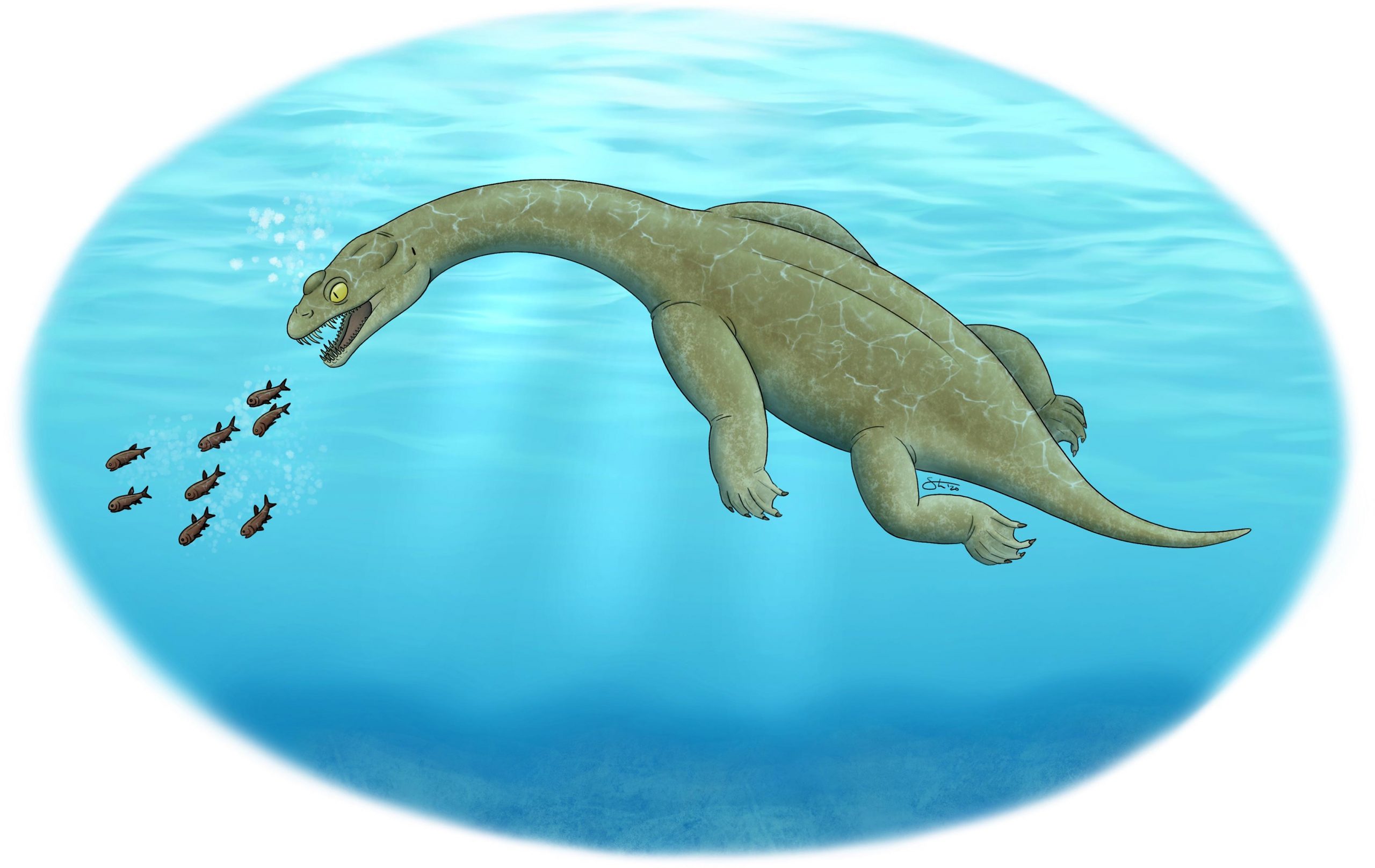
    Brevicaudosaurus Illustration
    An illustration of Brevicaudosaurus. Credit: Illustration by Tyler Stone BA ’19, art and cinema; https://tylerstoneart.wordpress.com

    About 240 million years ago, when reptiles ruled the ocean, a small lizard-like predator floated near the bottom of the edges in shallow water, picking off prey with fang-like teeth. A short and flat tail, used for balance, helps identify it as a new species, according to research published in the Journal of Vertebrate Paleontology.

    Paleontologists at the Chinese Academy of Scientists and Canadian Museum of Nature have analyzed two skeletons from a thin layer of limestone in two quarries in southwest China. They identified the skeletons as nothosaurs, Triassic marine reptiles with a small head, fangs, flipper-like limbs, a long neck, and normally an even longer tail, probably used for propulsion. However, in the new species, the tail is short and flat.

    Brevicaudosaurus jiyangshanensis Skeleton
    Brevicaudosaurus jiyangshanensis, gen. et sp. nov., skeletons in dorsal view. A, IVPP V 18625, holotype; B, IVPP V 26010, referred specimen. Credit: Qing-Hua Shang, Xiao-Chun Wu and Chun, Journal of Vertebrate Paleontology

    “Our analysis of two well-preserved skeletons reveals a reptile with a broad, pachyostotic body (denser boned) and a very short, flattened tail. A long tail can be used to flick through the water, generating thrust, but the new species we’ve identified was probably better suited to hanging out near the bottom in shallow sea, using its short, flattened tail for balance, like an underwater float, allowing it to preserve energy while searching for prey,” says Dr. Qing-Hua Shang from the Chinese Academy of Sciences, in Beijing.

    The scientists have named the new species Brevicaudosaurus jiyangshanensis, from the Latin ‘brevi’ for ‘short,’ ‘caudo’ for ‘tail,’ and the Greek ‘sauros’ for ‘lizard.’ The most complete skeleton of the two was found in Jiyangshan quarry, giving the specimen its species name. It’s just under 60cm (24in) long.

    The skeleton gives further clues to its lifestyle. The forelimbs are more strongly developed than the hind limbs, suggesting they played a role in helping the reptile to swim. However, the bones in the front feet are short compared to other species, limiting the power with which it could pull through the water. Most of its bones, including the vertebrae and ribs, are thick and dense, further contributing to the stocky, stout appearance of the reptile, and limiting its ability to swim quickly but increasing stability underwater.
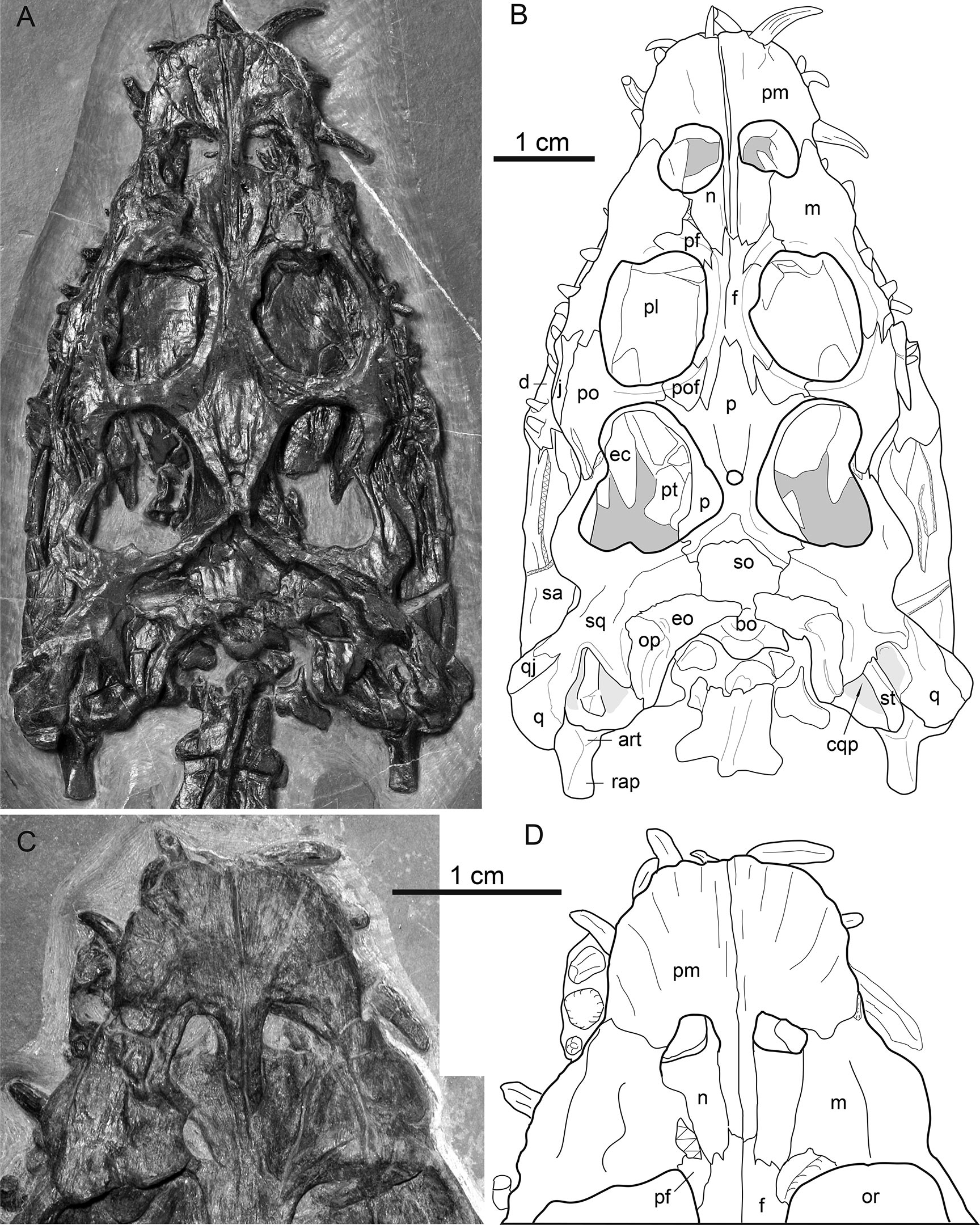
    Brevicaudosaurus jiyangshanensis Skull
    Brevicaudosaurus jiyangshanensis, gen. et sp. nov., IVPP V 18625, photographs and outlines of the skull and the mandible in dorsal view. A, B, IVPP V 18625, holotype, in dorsal view; C, D, IVPP V 26010, referred specimen, snout portion of the skull. Zigzag lines indicate broken areas. Abbreviations: art, articular; bo, basioccipital; cqp, cranio-quadrate passage; d, dentary; ec, ectopterygoid; eo, exoccipital; f, frontal; j, jugal; m, maxilla; n, nasal; op, opisthotic; or, orbit; p, parietal; pf, prefrontal; pl, palatine; pm, premaxilla; po, postorbital; pof, postfrontal; pt, pterygoid; q, quadrate; qj, quadratojugal; rap, retroarticular process; sa, surangular; so, supraoccipital; sq, squamosal; st, stapes. Credit: Qing-Hua Shang, Xiao-Chun Wu and Chun, Journal of Vertebrate Paleontology

    However, thick, high-mass bones act as ballast. What the reptile lost in speed, it gained in stability. Dense bones, known as pachyostosis, may have made it neutrally buoyant in shallow water. Together with the flat tail, this would have helped the predator to float motionless underwater, requiring little energy to stay horizontal. Neutral buoyancy should also have enabled it to walk on the seabed searching for slow-moving prey.

    Highly dense ribs may also suggest the reptile had large lungs. As suggested by the lack of firm support of the body weight, nothosaurs were oceanic but they needed to come to the water surface for oxygen. They have nostrils on the snout through which they breathed. Large lungs would have increased the time the species could spend under water.

    The new species features a bar-shaped bone in the middle ear called the stapes, used for sound transmission. The stapes was generally lost in other nothosaurs or marine reptiles during preservation. Scientists had predicted that if a stapes was found in a nothosaur, it would be thin and slender like in other species of this branch of the reptilian family tree. However, in B. jiyangshanensis it is thick and elongated, suggesting it had good hearing underwater.

    “Perhaps this small, slow-swimming marine reptile had to be vigilant for large predators as it floated in the shallows, as well as being a predator itself,” says co-author Dr. Xiao-Chun Wu from the Canadian Museum of Nature.

    Reference: “A New Ladinian Nothosauroid (Sauropterygia) from Fuyuan, Yunnan Province, China” by Qing-Hua Shang, Xiao-Chun Wu and Chun Li 29 October 2020, Journal of Vertebrate Paleontology.
    DOI: 10.1080/02724634.2020.1789651

    Never miss a breakthrough: Join the SciTechDaily newsletter.
    Follow us on Google and Google News.

    Archaeology New Species Paleontology Taylor & Francis Group
    Share. Facebook Twitter Pinterest LinkedIn Email Reddit

    Related Articles

    New Species of Iguanodontian Dinosaur Discovered on Isle of Wight

    Neptune’s Vishnu Otter: A New Species Discovered in Germany

    Giant Waikato Penguin: School Kids in New Zealand Discover New Species

    The “One Who Causes Fear” – Extremely Powerful New Meat-Eating Predator Discovered

    Bizarre “Crazy Beast” That Lived Among the Dinosaurs Perplexes Scientists

    Indian Fossils Support New Hypothesis for Origin of the Horse, Rhino, and Tapir

    New Species of Ancient Cynodont Discovered – 220-Million-Year-Old Precursor of Modern-Day Mammals

    5-Million-Year-Old Honey Badger-Like Animal Discovered

    Terror Crocodiles With “Teeth the Size of Bananas” Preyed on Even the Very Largest Dinosaurs

    Leave A Reply Cancel Reply

    • Facebook
    • Twitter
    • Pinterest
    • YouTube

    Don't Miss a Discovery

    Subscribe for the Latest in Science & Tech!

    Trending News

    New Study Reveals Why Ozempic Works Better for Some People Than Others

    Climate Change Is Altering a Key Greenhouse Gas in a Way Scientists Didn’t Expect

    New Study Suggests Gravitational Waves May Have Created Dark Matter

    Scientists Discover Why the Brain Gets Stuck in Schizophrenia

    Scientists Engineer “Tumor-Eating” Bacteria That Devour Cancer From Within

    Even “Failed” Diets May Deliver Long-Term Health Gains, Study Finds

    NIH Scientists Discover Powerful New Opioid That Relieves Pain Without Dangerous Side Effects

    Collapsing Plasma May Hold the Key to Cosmic Magnetism

    Follow SciTechDaily
    • Facebook
    • Twitter
    • YouTube
    • Pinterest
    • Newsletter
    • RSS
    SciTech News
    • Biology News
    • Chemistry News
    • Earth News
    • Health News
    • Physics News
    • Science News
    • Space News
    • Technology News
    Recent Posts
    • The Surprising Reason You Might Want To Sleep Without a Pillow
    • Household Cats Could Hold the Secret to Fighting Breast Cancer
    • Scientists Say This Natural Hormone Reverses Obesity by Targeting the Brain
    • This 15,000-Year-Old Discovery Changes What We Know About Early Human Creativity
    • 35-Million-Year-Old Mystery: Strange Arachnid Discovered Preserved in Amber
    Copyright © 1998 - 2026 SciTechDaily. All Rights Reserved.
    • Science News
    • About
    • Contact
    • Editorial Board
    • Privacy Policy
    • Terms of Use

    Type above and press Enter to search. Press Esc to cancel.