
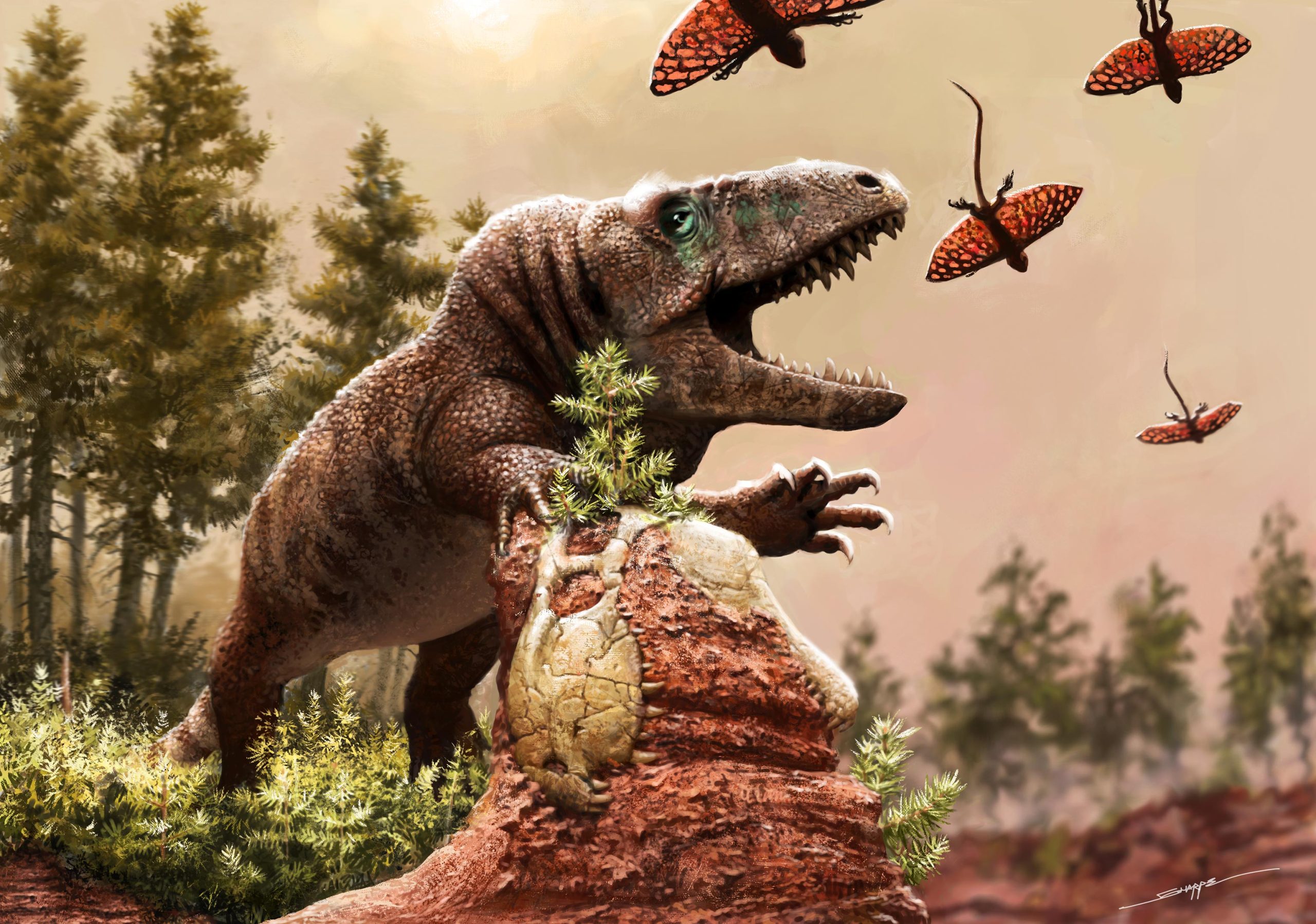
Harvard researchers find rapid evolution of reptiles was triggered by nearly 60 million years of global warming and climate change.
Researchers can explore the impact of environmental crises on organismal evolution by studying climate change-induced mass extinctions in the deep geological past. One principal example is the Permian-Triassic climatic crises. This series of climatic shifts was driven by global warming that occurred between the Middle Permian (265 million years ago) and the Middle Triassic (230 million years ago). These climatic shifts caused two of the largest mass extinctions in the history of life at the end of the Permian, the first at 261 million years ago and the other at 252 million years ago, the latter eliminating 86% of all animal species worldwide.
In addition to their magnitude, the end-Permian extinctions are also important because they mark the onset of a new era in the history of the planet when reptiles became the dominant group of vertebrate animals living on land. Synapsids, the ancestors of mammals, dominated the terrestrial vertebrate faunas throughout the Permian. In the Triassic Period (252-200 million years ago), after the Permian extinctions, reptiles evolved at rapid rates, creating an explosion of reptile diversity. This expansion was critical to the construction of modern ecosystems and many extinct ecosystems. Most paleontologists believed these rapid rates of evolution and diversification were due to the extinction of competitors allowing reptiles to take over new habitats and food resources that several synapsid groups had dominated before their extinction.
Reptile Evolution Started Before the Permian-Triassic Extinction
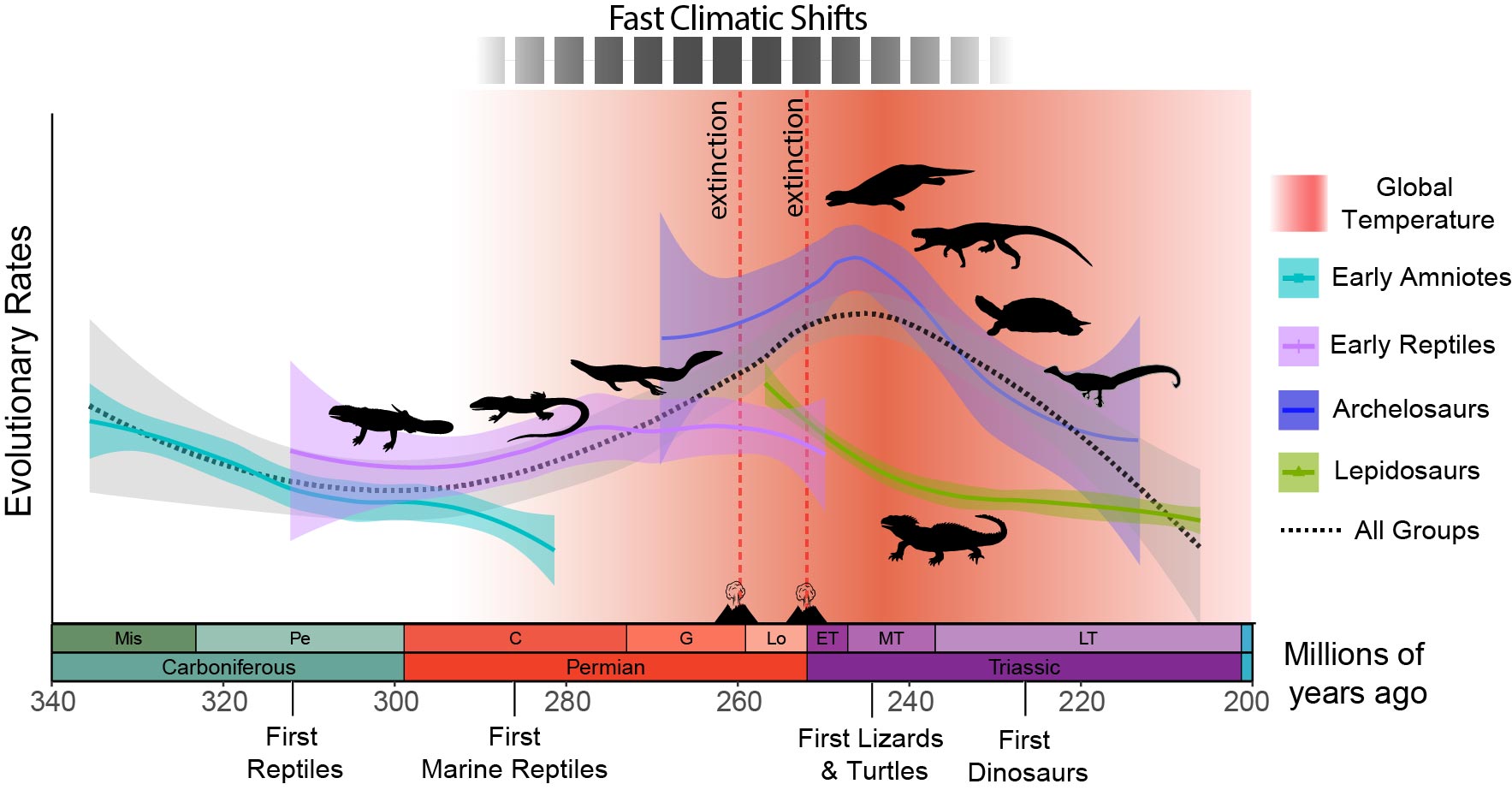
However, in a new study published on August 19, 2022, in the journal Sciences Advances, researchers in the Department of Organismic and Evolutionary Biology and the Museum of Comparative Zoology at Harvard University and collaborators reveal the rapid evolution and radiation of reptiles began much earlier, before the end of the Permian. This was in connection to the steadily increasing global temperatures through a long series of climatic changes that spanned almost 60 million years in the geological record.
Link Between Climate Change and Reptile Evolution
“We found that these periods of rapid evolution of reptiles were intimately connected to increasing temperatures. Some groups changed really fast and some less fast, but nearly all reptiles were evolving much faster than they ever had before,” said lead author postdoctoral fellow Tiago R Simões.
Previous research on the impacts of these changes often neglected terrestrial vertebrates due to limited data availability, focusing mostly on the response from marine animals
In this study, Simões and senior author Professor Stephanie E. Pierce (both at Harvard) worked alongside collaborators Professor Michael Caldwell (University of Alberta, Canada) and Dr. Christian Kammerer (North Carolina Museum of Natural Sciences) to examine early amniotes. They represent the forerunners of all modern mammals, reptiles, birds, and their closest extinct relatives, at the initial phase of their evolution. At this point in time, the first groups of reptiles and mammal ancestors were splitting from each other and evolving along their own separate evolutionary paths.
“Reptiles represent an ideal and rare terrestrial system to study this question as they have a relatively good fossil record and survived a series of climatic crises including the ones leading up to the largest extinction in the history of complex life, the Permian-Triassic mass extinction,” said Simões.
Reptiles were relatively rare during the Permian compared to mammalian ancestors. However, things took a major shift during the Triassic when reptiles underwent a massive explosion in the number of species and morphological variety. This led to the appearance of most of the major living groups of reptiles (crocodiles, lizards, turtles) and several groups that are now entirely extinct.
The scientists created a dataset based on extensive first-hand data collection of more than 1,000 fossil specimens from 125 species of reptiles, synapsids, and their closest relatives during approximately 140 million years before and after the Permian-Triassic extinction. They then analyzed the data to detect when these species first originated and how fast they were evolving using state-of-the-art analytical techniques such as Bayesian evolutionary analysis, which is also used to understand the evolution of viruses such as SARS-COVID-19. The researchers then combined the new dataset with global temperature data spanning several million years in the geological record to provide a broad overview of the animals’ major adaptive response toward climatic shifts.
“Our results reveal that periods of fast climatic shifts and global warming are associated with exceptionally high rates of anatomical change in most groups of reptiles as they adapted to new environmental conditions,” said Pierce, “and this process started long before the Permian-Triassic extinction, since at least 270 million years ago, indicating that the diversification of reptile body plans was not triggered by the P-T extinction event as previously thought, but in fact started tens of million years before that.”
Body Size in Reptile Adaptation
“One reptile lineage, the lepidosaurs, which gave rise to the first lizards and tuataras, veered in the opposite direction of most reptile groups and underwent a phase of very slow rates of change to their overall anatomy,” said Simões, “essentially, their body plans were constrained by natural selection, instead of going rogue and radically changing like most other reptiles at the time.” The researchers suggest this is due to pre-adaptations on their body size to better cope with high temperatures.
“The physiology of organisms is really dependent on their body size,” said Simões, “small-bodied reptiles can better exchange heat with their surrounding environment. The first lizards and tuataras were much smaller than other groups of reptiles, not that different from their modern relatives, and so they were better adapted to cope with drastic temperature changes. The much larger ancestors of crocodiles, turtles, and dinosaurs could not lose heat as easily and had to quickly change their bodies in order to adapt to the new environmental conditions.”
Impact of Rising Temperatures on Reptile Body Plans
Simões, Pierce, and collaborators also mapped out how body size changed across geographical regions during this timeframe. They revealed that climatic pressures on body size were so high there was a maximum body size for reptiles to survive in tropical regions during the lethally hot periods of this time.
“Large-sized reptiles basically took two routes to deal with these climate shifts,” said Pierce, “they either migrated closer to temperate regions or invaded the aquatic world where they didn’t need to worry about overheating because water can absorb heat and maintain its temperature much better than air.”
“This strong association between rising temperatures in the geological past and a biological response by dramatically different groups of reptiles suggests climate change was a key factor in explaining the origin and the explosion of new reptile body plans during the latest Permian and Triassic,” said Simões.
Reference: “Successive climate crises in the deep past drove the early evolution and radiation of reptiles” by Tiago R. Simões, Christian F. Kammerer, Michael W. Caldwell and Stephanie E. Pierce, 19 August 2022, Science Advances.
DOI: 10.1126/sciadv.abq1898
The researchers would like to thank the Museum of Comparative Zoology (MCZ), Harvard University, vertebrate paleontology staff, and the curators across 50+ natural history collections worldwide for their help with specimen access. Funding was provided by: Alexander Agassiz Postdoctoral Fellowship, MCZ; National Sciences and Engineering Research Council of Canada (NSERC) postdoctoral fellowship; Grant KA 4133/1-1 from the Deutsche Forschungsgemeinschaft; NSERC Discovery Grant #23458 and NSERC Accelerator Grant; Faculty of Science, Chairs Research Allowance, University of Alberta; Lemann Brazil Research Fund; Funds made available through Harvard University.
Never miss a breakthrough: Join the SciTechDaily newsletter.
Follow us on Google and Google News.