
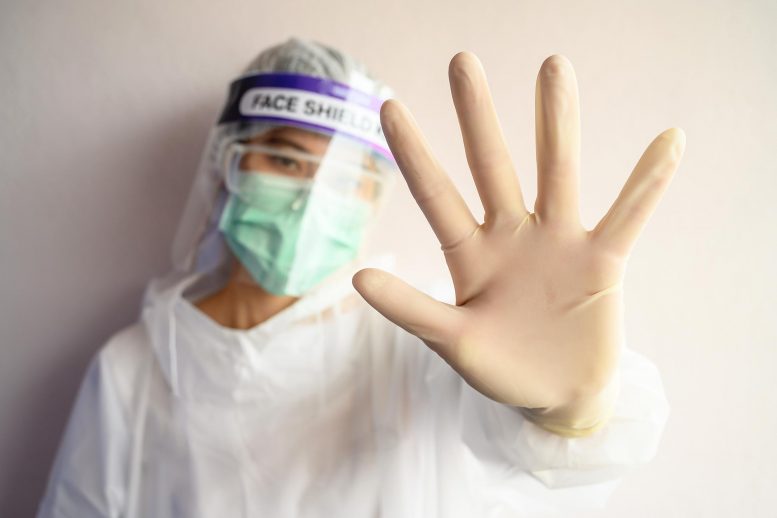
New study underlines importance of adequate PPE and training for frontline health professionals to prevent COVID-19 infection.
Despite being at high risk of exposure to COVID-19, frontline healthcare professionals who were appropriately protected did not contract infection or develop protective immunity against the virus, finds a study from China published by The BMJ today (June 10, 2020).
The researchers acknowledge that the healthcare professionals were working away from home, so had limited social interactions after work, which probably contributed to the absence of infection.
But they say this does not affect their conclusion that appropriate personal protective equipment (PPE) is effective in preventing infection in healthcare professionals who work in highly exposed environments.
As such, they say healthcare systems “must give priority to the procurement and distribution of personal protective equipment, and provide adequate training to healthcare professionals in its use.”
Covid-19 infection among healthcare professionals was very common in Wuhan and in other countries in the early phase of the outbreak, and inappropriate PPE is believed to be a major factor in infection among healthcare professionals.
However, the pattern of infection and immune response of healthcare professionals with high exposure to COVID-19 is not known.
So a team of researchers from Sun Yat-sen University, China, and University of Birmingham, UK, set out to examine the protective effects of appropriate PPE for frontline healthcare professionals who provided care for patients with COVID-19.
Their findings are based on 420 healthcare professionals (116 doctors and 304 nurses) with an average age of 36 years, who were deployed to Wuhan for 6-8 weeks from January 24 to April 7, 2020 to care for patients with COVID-19.
Participants worked 4-6 hour shifts for an average of 5.4 days a week, and an average of 16.2 hours each week in intensive care units.
All participants were provided with appropriate PPE, including protective suits, masks, gloves, goggles, face shields, and gowns. They also received training in the correct use of PPE and in reducing their exposure to infection when caring for patients.
During the deployment period in Wuhan, none of the study participants reported covid-19 related symptoms. When the participants returned home, they all tested negative for COVID-19 infection or its antibodies.
The researchers point out that this study does not address the question of what the minimal level of PPE should be to effectively prevent infection among healthcare professionals, and say the findings only apply to frontline clinical staff.
And they acknowledge that these healthcare professionals were working away from home, which probably contributed to the absence of infection.
“However, this limitation does not affect our conclusion that appropriate PPE is effective in preventing infection in healthcare professionals who work in highly exposed environments,” they write.
“Before a safe and effective vaccine becomes available, healthcare professionals remain susceptible to COVID-19,” they add. “Healthcare systems must give priority to the procurement and distribution of PPE, and provide adequate training to healthcare professionals in its use.”
Reference: “Use of personal protective equipment against coronavirus disease 2019 by healthcare professionals in Wuhan, China: cross sectional study” by Min Liu, Shou-Zhen Cheng, Ke-Wei Xu, Yang Yang, Qing-Tang Zhu, Hui Zhang, Da-Ya Yang, Shu-Yuan Cheng, Han Xiao, Ji-Wen Wang, He-Rui Yao, Yu-Tian Cong, Yu-Qi Zhou, Sui Peng, Ming Kuang, Fan-Fan Hou, KK Cheng and Hai-Peng Xiao, 10 June 2020, The BMJ.
DOI: 10.1136/bmj.m2195
Never miss a breakthrough: Join the SciTechDaily newsletter.
Follow us on Google and Google News.
1 Comment
Be aware that nurses and other front line workers develop “subclinical immunities” to a variety of viral/bacterial infections. We are a hardy bunch to start with (a lot of physical effort goes into caring for the very ill) and constant exposure to pathogens keep our immune systems tuned up at all times.
You see something similar when you go away to college. Spend 6 weeks sniffling over everything and then you are fine for the rest of the program.
This does not mean we don’t need and want PPEs.