
Low-cost simulation technique can efficiently increase hospital workplace safety during COVID-19 pandemic.
Despite the use of personal protective equipment (PPE), reports show that many health care workers contracted the coronavirus disease (COVID-19), which raises substantial concerns about the effectiveness of PPE. Highly sought-after PPE used in hospitals and other health care settings is critical in ensuring the safety of those on the frontline of COVID-19, but only if they are used properly.
A physician from Florida Atlantic University’s Schmidt College of Medicine and collaborators from the University of Arizona College of Medicine-Tucson and the Indiana University School of Medicine conducted a novel training technique to reinforce the importance of using proper procedures to put on and take off PPE when caring for patients during the pandemic. Researchers were able to vividly demonstrate how aerosol-generating procedures can lead to exposure of the contagion with improper use of PPE.
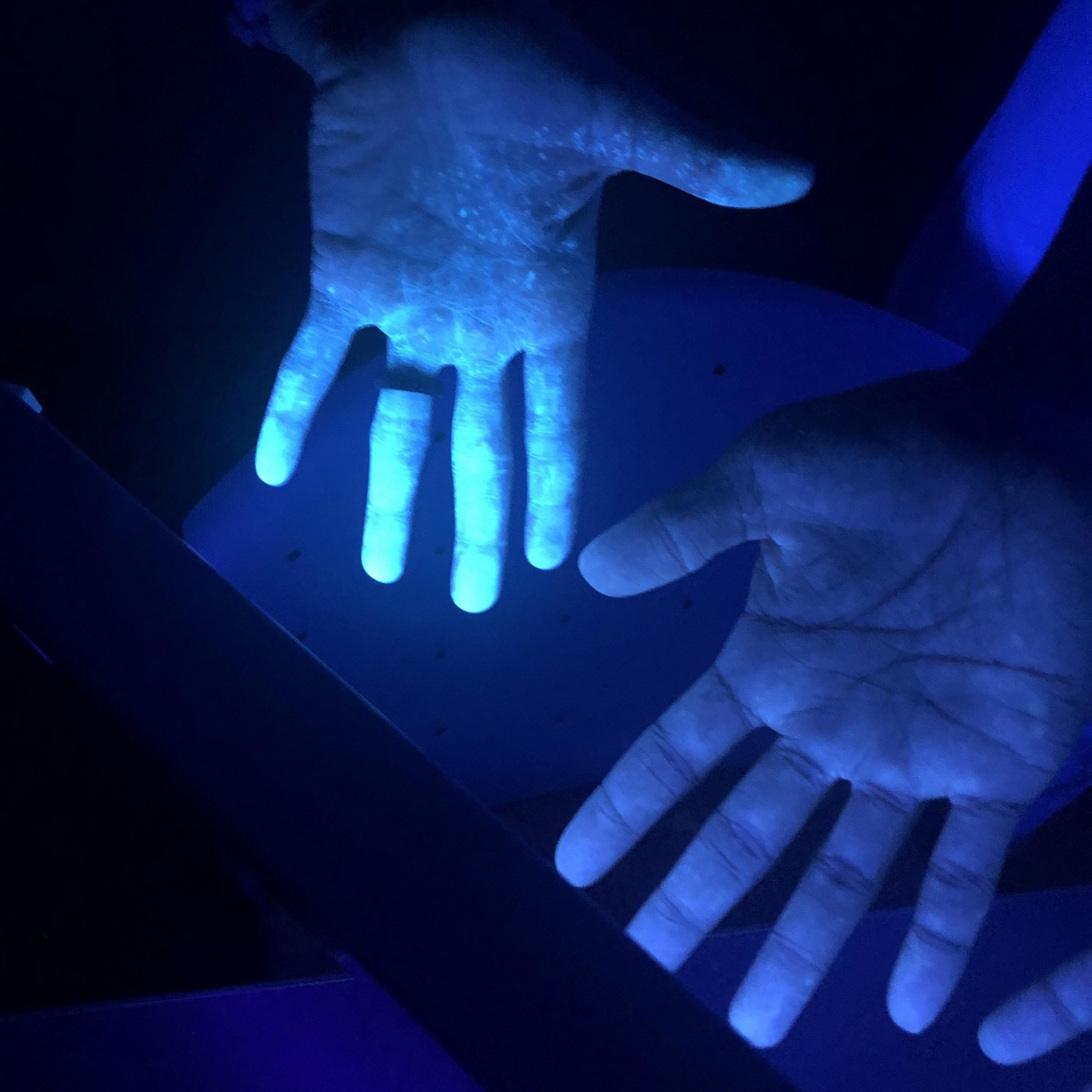
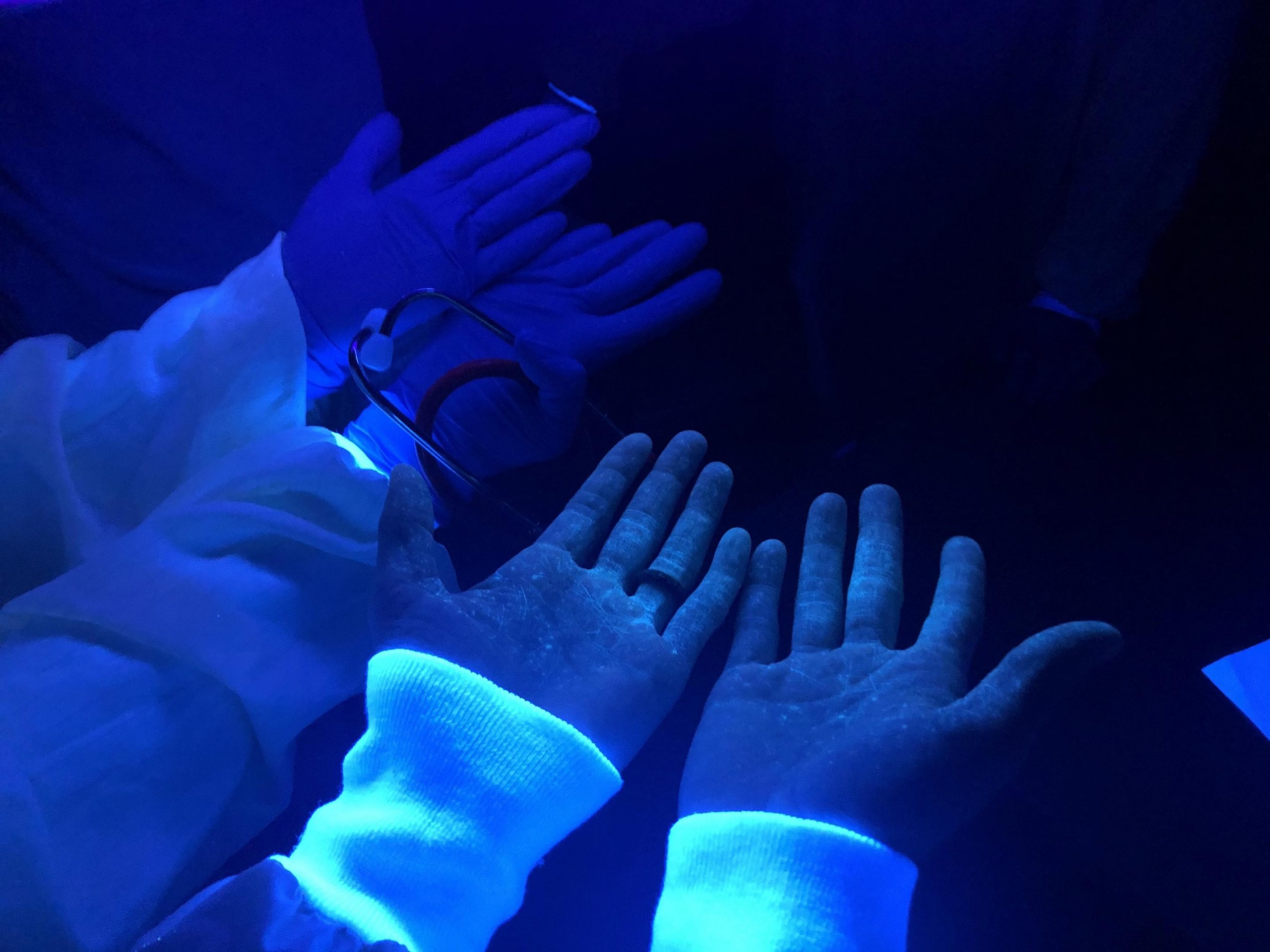
To detect contamination, Patrick G. Hughes, D.O., lead author, director of FAU’s emergency medicine simulation program and an assistant professor of Integrated Medical Science, FAU’s Schmidt College of Medicine, and collaborators, used a nontoxic fluorescent solution during a PPE training session for health care staff. They placed a highlighter refill in a warm water bath for 15 minutes to create a fluorescent solution, which is only visible under ultraviolet light.
For the experiment, published in the journal Medical Education, the researchers instructed health care staff to put on PPE, which included a cap, gown, surgical gloves, eye protection, face shield, and N95 mask. In order to conserve vital PPE, supplies were wiped off and reused for multiple trainings. After health care staff in the study put on their PPE, they went in to a room to care for a simulated patient sprayed down with the invisible simulated contagion. In addition, the researchers added the fluorescent solution to a simulated albuterol nebulizer treatment, which was given to the mannequins during the scenario (not in a negative pressure room).
After completing the simulated case, the health care staff remained in their PPE and were taken to another room, where the lights were turned off prior to removing their PPE. Turning off the lights enabled the identification of widespread simulated contagion on the PPE, both on the gloves and gowns from directly touching the simulated patient and on the face shields and masks from the aerosolized solution. The researchers used a black light flashlight to examine each health care worker and to identify the presence of any fluorescent solution.
Following the flashlight examination, the health care staff completely removed their PPE. Researchers discovered the presence of fluorescent solution on the health care staff’s skin, which represented an exposure to the contagion and indicated that they made an error while putting on or taking off their PPE.

Results from the experiment revealed that the most common error made by the health care staff was contaminating the face or forearms during PPE removal. In contrast, those who put on and took off their PPE according to guidelines had no signs of the fluorescent contagion on their skin or face.
“This training method allows educators and learners to easily visualize any contamination on themselves after they fully remove their personal protective equipment,” said Hughes. “We can make immediate corrections to each individual’s technique based on visual evidence of the exposure.”
By providing health care staff with visual evidence of protection during patient encounters with high-risk aerosol-generating procedures, this innovative training method is helping to inspire trust in their training and PPE.
“This experiment demonstrated that following PPE training improves workplace safety and decreases the risk of transmission,” said Hughes. “This simulation-based approach provides an efficient, low-cost solution that can be implemented in any hospital.”
Hughes also conducted this training technique with FAU’s emergency medicine resident physicians in the medical school’s Clinical Skills Simulation Center, which uses high-tech and high-fidelity patient mannequins in life-like hospital and emergency room settings. The center applies sophisticated simulation and trainer technologies to educate medical students, resident physicians, registered nurses, first responders, certified nursing assistants, home health aides, and community health care providers. The center has created models of hospital rooms, patient examinations, and emergency rooms for simulated patient treatment. The rooms are fully equipped with hospital beds, gurneys or exam tables, monitors, IV poles, defibrillators, blood pressure cuffs, simulated oxygen ports, otoscope, and ophthalmoscopes and all equipment and supplies required to respond to medical and nursing interventions, including emergencies.
The simulation team uses high fidelity wireless, full body male and female mannequins. The simulators track all actions taken and all pharmacological agents given to the patients. If incorrect drugs or dosages are administered, the high-fidelity patient responds exactly as a human patient would respond. Preceptors and session facilitators provide guidance during the simulations.
Reference: “Does my PPE really work? A simulation‐based approach” by Patrick G. Hughes, Kate E. Hughes and Rami A. Ahmed, 24 April 2020, Medical Education.
DOI: 10.1111/medu.14188
Study co-authors are Kate E. Hughes, D.O., emergency medicine, University of Arizona College of Medicine -Tucson; and Rami A. Ahmed, D.O., emergency medicine, Indiana University School of Medicine, Indianapolis.
Never miss a breakthrough: Join the SciTechDaily newsletter.
Follow us on Google and Google News.