
Close Menu
    Facebook X (Twitter) Instagram
    SciTechDaily
    • Biology
    • Chemistry
    • Earth
    • Health
    • Physics
    • Science
    • Space
    • Technology
    Facebook X (Twitter) Pinterest YouTube RSS
    SciTechDaily
    Home»Chemistry»Seeking the Most Effective Virus-Resistant Polymers for Personal Protective Equipment
    Chemistry

    Seeking the Most Effective Virus-Resistant Polymers for Personal Protective Equipment

    By American Institute of PhysicsNovember 17, 2020No Comments3 Mins Read
    Facebook Twitter Pinterest Telegram LinkedIn WhatsApp Email Reddit
    Share
    Facebook Twitter LinkedIn Pinterest Telegram Email Reddit
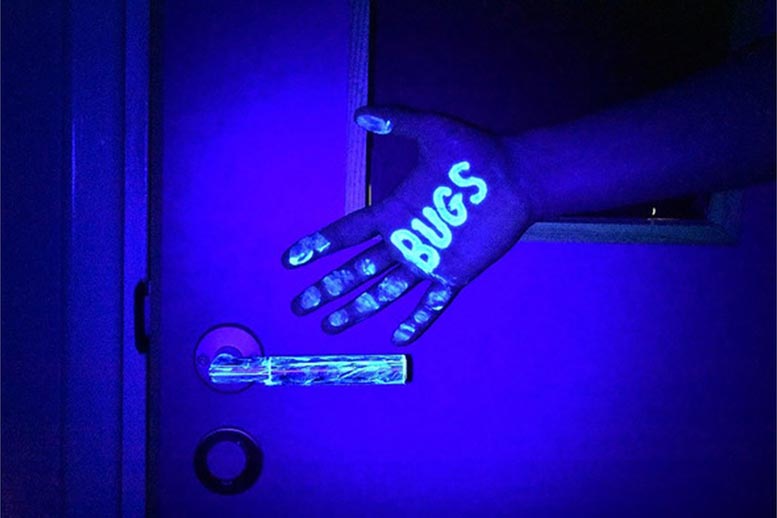
    Fluorescence to Demonstrate Particles
    Using fluorescence to demonstrate how particles bind differently to different types of materials. Credit: Morgan Alexander

    Some polymers can resist bacteria; can they be designed to work against viruses?

    Personal protective equipment, like face masks and gowns, is generally made of polymers. But not much attention is typically given to the selection of polymers used beyond their physical properties.

    To help with the identification of materials that will bind to a virus and speed its inactivation for use in PPE, researchers from the University of Nottingham, EMD Millipore, and the Philipps University of Marburg developed a high-throughput approach for analyzing the interactions between materials and viruslike particles. They report their method in the journal Biointerphases, from AIP Publishing.

    “We’ve been very interested in the fact that polymers can have effects on cells on their surface,” said Morgan Alexander, an author on the paper. “We can get polymers, which resist bacteria, for example, without designing any particular clever or smart material with antibiotic in there. You just have to choose the right polymer. This paper extends this thinking to viral binding.”

    The group created microarrays of 300 different monomer compositions of polymers representing a wide variety of characteristics. They exposed the polymers to Lassa and Rubella viruslike particles — particles with the same structure as their viral counterparts but without the infectious genomes activated — to see which materials were able to preferentially adsorb the particles.

    “Knowing that different polymers bind and possibly inactivate viruses to different degrees means we may be able to make recommendations. Should I use this existing glove material or that glove if I want the virus to bind to it and die and not fly into the air when I take the gloves off?” Alexander said.

    Though this may seem like an obvious method for quickly screening large quantities of materials, the team’s interdisciplinary makeup makes them uniquely positioned to conduct such a study. The surface scientists have the capabilities to create large numbers of chemicals on microarrays, and the biologists have access to virus-like particles.

    So far, the tests have only looked at virus-like particles of Lassa and Rubella, but the group is hoping to acquire a grant to look at virus-like particles of SARS-CoV-2, the COVID-19 virus.

    Once a handful of the best-performing materials have been determined, the next step of the project will be to use live viruses to evaluate the viral infectious lifetime on the materials, taking into account real-world environmental conditions, like humidity and temperature. With enough data, a molecular model can be built to describe the interactions.

    “Strong binding and quick denaturing of a virus on a polymer would be great,” said Alexander. “It remains to be seen whether the effect is significantly large to make a real difference, but we need to look to find out.”

    Reference: “Polymer microarrays rapidly identify competitive adsorbents of virus-like particles” by Andrew J. Blok, Pratik Gurnani, Alex Xenopoulos, Laurence Burroughs, Joshua Duncan, Richard A. Urbanowicz, Theocharis Tsoleridis, Helena Müller, Thomas Strecker, Jonathan K. Ball, Cameron Alexander and Morgan R. Alexander, 17 November 2020, Biointerphases.
    DOI: 10.1116/6.0000586

    Never miss a breakthrough: Join the SciTechDaily newsletter.
    Follow us on Google and Google News.

    American Institute of Physics COVID-19 Infectious Diseases Materials Science Polymers Public Health
    Share. Facebook Twitter Pinterest LinkedIn Email Reddit

    Related Articles

    COVID-19 Pandemic Could Be Stopped if at Least 70% of the Public Wore Face Masks Consistently

    Disinfected by the Sun: New Cotton Face Mask Kills Up to 99.9999% of Bacteria and Viruses in Daylight

    COVID-19 Transmission: Tracking Flight Trajectory of Evaporating Cough Droplets

    Face Mask With Anti-viral Layer to Deactivate COVID-19 Virus

    Aerosol Microdroplets Not Very Effective at Spreading the COVID-19 Virus

    Scientists Compare How COVID-19 Cough Clouds Travel With and Without Face Masks

    Medication Used for Alcoholism Treatment Is Potentially Effective Against COVID-19

    You’re Using Disinfectants Wrong. Here’s How to Destroy 99.9% of Viruses/Coronaviruses and Bacteria [Video]

    Air Filter Created That Can Kill the Coronavirus – 99.8% Effective on SARS-CoV-2

    Leave A Reply Cancel Reply

    • Facebook
    • Twitter
    • Pinterest
    • YouTube

    Don't Miss a Discovery

    Subscribe for the Latest in Science & Tech!

    Trending News

    Bone-Strengthening Discovery Could Reverse Osteoporosis

    Scientists Uncover Hidden Trigger Behind Stem Cell Aging

    Scientists Find Way to Reverse Fatty Liver Disease Without Changing Diet

    Could Humans Regrow Limbs? New Study Reveals Promising Genetic Pathway

    Scientists Reveal Eating Fruits and Vegetables May Increase Your Risk of Lung Cancer

    Scientists Reverse Brain Aging With Simple Nasal Spray

    Scientists Uncover Potential Brain Risks of Popular Fish Oil Supplements

    Scientists Discover a Surprising Way To Make Bread Healthier and More Nutritious

    Follow SciTechDaily
    • Facebook
    • Twitter
    • YouTube
    • Pinterest
    • Newsletter
    • RSS
    SciTech News
    • Biology News
    • Chemistry News
    • Earth News
    • Health News
    • Physics News
    • Science News
    • Space News
    • Technology News
    Recent Posts
    • Europe’s Most Active Volcano Just Got Stranger – Here’s Why Scientists Are Rethinking It
    • Why Are Giant Ants Letting Tiny Ants Crawl All Over Them?
    • Revolutionary Technique Sends Healthy Mitochondria Exactly Where They’re Needed
    • This Student Recreated the Universe in a Bottle. What She Discovered Could Help Reveal How Life Started on Earth
    • Alzheimer’s Symptoms May Start Outside the Brain, Study Finds
    Copyright © 1998 - 2026 SciTechDaily. All Rights Reserved.
    • Science News
    • About
    • Contact
    • Editorial Board
    • Privacy Policy
    • Terms of Use

    Type above and press Enter to search. Press Esc to cancel.