
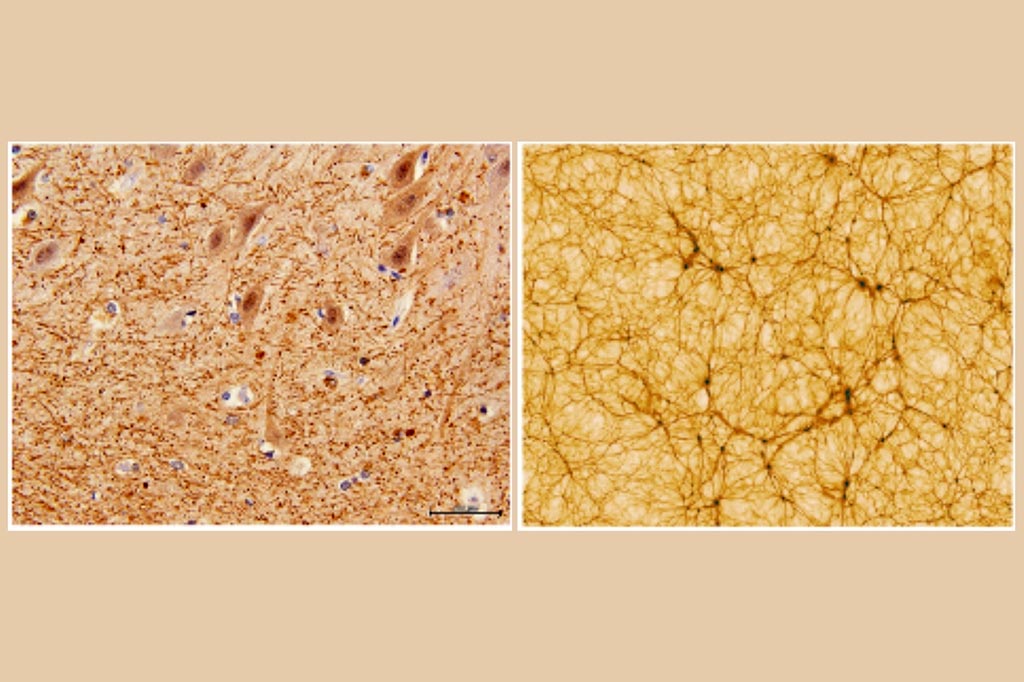
In their paper published in Frontiers of Physics, Franco Vazza (astrophysicist at the University of Bologna) and Alberto Feletti (neurosurgeon at the University of Verona) investigated the similarities between two of the most challenging and complex systems in nature: the cosmic network of galaxies and the network of neuronal cells in the human brain.
Despite the substantial difference in scale between the two networks (more than 27 orders of magnitude), their quantitative analysis, which sits at the crossroads of cosmology and neurosurgery, suggests that diverse physical processes can build structures characterized by similar levels of complexity and self-organization.
The human brain functions thanks to its wide neuronal network that is deemed to contain approximately 69 billion neurons. On the other hand, the observable universe can count upon a cosmic web of at least 100 billion galaxies. Within both systems, only 30% of their masses are composed of galaxies and neurons. Within both systems, galaxies and neurons arrange themselves in long filaments or nodes between the filaments. Finally, within both systems, 70% of the distribution of mass or energy is composed of components playing an apparently passive role: water in the brain and dark energy in the observable Universe.
Starting from the shared features of the two systems, researchers compared a simulation of the network of galaxies to sections of the cerebral cortex and the cerebellum. The goal was to observe how matter fluctuations scatter over such diverse scales.
“We calculated the spectral density of both systems. This is a technique often employed in cosmology for studying the spatial distribution of galaxies”, explains Franco Vazza. “Our analysis showed that the distribution of the fluctuation within the cerebellum neuronal network on a scale from 1 micrometer to 0.1 millimeters follows the same progression of the distribution of matter in the cosmic web but, of course, on a larger scale that goes from 5 million to 500 million light-years”.
The two researchers also calculated some parameters characterizing both the neuronal network and the cosmic web: the average number of connections in each node and the tendency of clustering several connections in relevant central nodes within the network.
“Once again, structural parameters have identified unexpected agreement levels. Probably, the connectivity within the two networks evolves following similar physical principles, despite the striking and obvious difference between the physical powers regulating galaxies and neurons”, adds Alberto Feletti. “These two complex networks show more similarities than those shared between the cosmic web and a galaxy or a neuronal network and the inside of a neuronal body”.
The encouraging results of this pilot study are prompting the researchers to think that new and effective analysis techniques in both fields, cosmology, and neurosurgery, will allow for a better understanding of the routed dynamics underlying the temporal evolution of these two systems.
This study was published in Frontiers of Physics with the title “The quantitative comparison between the neuronal network and the cosmic web.” Its authors are Franco Vazza from the Department of Physics and Astronomy of the University of Bologna, and Alberto Feletti from the Department of Neurosciences, Biomedicine, and Movement of the University of Verona.
Reference: “The Quantitative Comparison Between the Neuronal Network and the Cosmic Web” by F. Vazza and A. Feletti, 16 November 2020, Frontiers of Physics.
DOI: 10.3389/fphy.2020.525731
Never miss a breakthrough: Join the SciTechDaily newsletter.
Follow us on Google and Google News.