
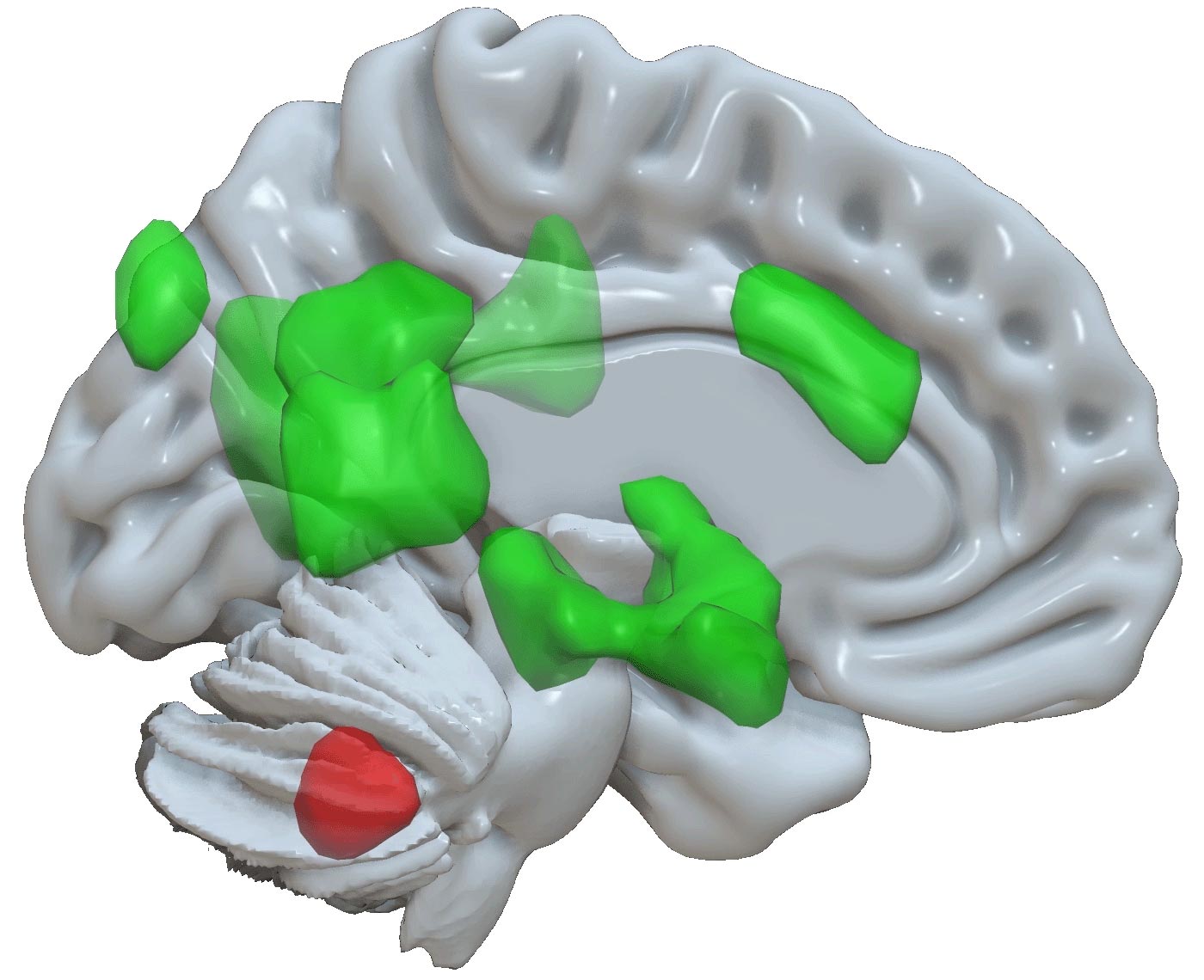
The cerebellum is known primarily for the regulation of movement. Scientists at the University of Basel have now discovered that the cerebellum also plays an important role in remembering emotional experiences.
Both positive and negative emotional experiences are stored particularly well in human memory. This phenomenon is important to our survival, since we need to remember dangerous situations in order to avoid them in the future. Previous studies have shown that a brain structure called the amygdala, which is important in the processing of emotions, plays a central role in this phenomenon. Emotions activate the amygdala, which in turn facilitates the storage of information in various areas of the cerebrum.
The cerebellum (Latin for “little brain”) is the portion of the brain in the back of the head between the cerebrum and the brain stem. Among other functions, the cerebellum plays an important role in motor control, regulating balance for walking and standing, and other complex motor functions.
The current research investigates the role of the cerebellum in storing emotional experiences. In a large-scale study, the investigators showed 1,418 participants emotional and neutral images and recorded the subjects’ brain activity using magnetic resonance imaging. The study was led by Professor Dominique de Quervain and Professor Andreas Papassotiropoulos at the University of Basel. It was published on October 3 in the Proceedings of the National Academy of Sciences (PNAS).
In a memory test conducted later, the positive and negative images were remembered by the participants much better than the neutral images. The improved storage of emotional images was linked with an increase in brain activity in the areas of the cerebrum already known to play a part. However, the team also identified increased activity in the cerebellum.
The Cerebellum in Communication With the Cerebrum
The scientists were also able to demonstrate that the cerebellum shows stronger communication with various areas of the cerebrum during the process of enhanced storage of the emotional images. It receives information from the cingulate gyrus – a region of the brain that is important in the perception and evaluation of feelings. Furthermore, the cerebellum sends out signals to various regions of the brain, including the amygdala and hippocampus. The latter plays a central role in memory storage.
“These results indicate that the cerebellum is an integral component of a network that is responsible for the improved storage of emotional information,” says de Quervain. Although an improved memory for emotional events is a crucial mechanism for survival, it does have its downsides: in the case of very negative experiences, it can lead to recurring anxiety. This means that the findings, which have now been released, may also be relevant in understanding psychiatric conditions such as post-traumatic stress disorder.
Basel Research on Emotions and Memory
The current study forms part of a large-scale research project conducted by the Research Platform Molecular and Cognitive Neurosciences (MCN) at the University of Basel and the University Psychiatric Clinics (UPK) Basel. The aim of this project is to gain a better understanding of emotional and cognitive processes and to transfer results from basic research to clinical projects.
Reference: “Human cerebellum and corticocerebellar connections involved in emotional memory enhancement” by Matthias Fastenrath, Klara Spalek, David Coynel, Eva Loos, Annette Milnik, Tobias Egli, Nathalie Schicktanz, Léonie Geissmann, Benno Roozendaal, Andreas Papassotiropoulos and Dominique J.-F. de Quervain, 3 October 2022, Proceedings of the National Academy of Sciences.
DOI: 10.1073/pnas.2204900119
Never miss a breakthrough: Join the SciTechDaily newsletter.
Follow us on Google and Google News.
2 Comments
Hi, My name is Ashley and I currently am the caretaker for my mother whom has cerebral attacksi. Its been a generational thing this far, that has affected multiple family members on my mothers side. Her mom. Her mom’s mom. Her aunt’s and 2 uncle’s (They were twins). As it stands now my mom was a litter later in actually succumbing to the physical affects of this disease. I guess my main objective for this email is to find out. If possible. How I can be proactive and prevenitive with my particular fate. I have 2 older siblings and we are not close so, so I have no idea,their medical history. Or current one of any. Is there a testing I can undergo now or some literature I can be directed to to read on it? Early onsets? Signs? Is there any clinical trial happening for this particular condition? Any help would be appreciated
Neurologically Nervous. Ashleigh
This article is great from a scientific view point but most of us want to hear more on what new procedures you can do on the cerabellum of people who are cursed with this disease. How far away are you and what can you tell us on how you can restore the cerabellum. How much research is being done on Ataxia so we can look forward in improving our lives. Is there any drugs to take to help with balance and coordination.