

A daily cycle in brain temperature has been linked in a new study to survival after traumatic brain injury.
According to recent studies, the average human brain temperature changes far more than thought previously. This might be an indication of healthy brain activity. Whereas oral temperature is normally less than 37°C (98.6°F) in healthy men and women, average brain temperature is 38.5°C (101.3°F), with deeper brain areas often reaching 40°C (104°F), particularly in women throughout the day.
In the past, investigations on the temperature of the human brain have depended on data gathered from patients in critical care with brain injuries, where direct brain monitoring is often necessary. More recently, a method for scanning the brain known as magnetic resonance spectroscopy (MRS) has allowed researchers to detect brain temperature in healthy individuals without the need for any invasive procedures. However, until recently, MRS has not been used to investigate how the brain’s temperature changes during the day or to take into account how a person’s “body clock” affects this.
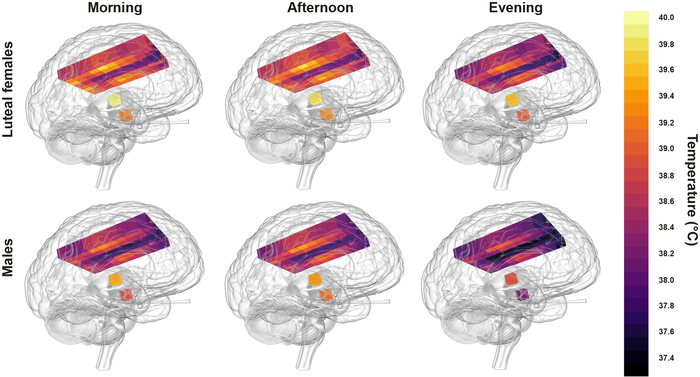
The new study has created the first 4D map of a healthy human brain’s temperature. It was directed by scientists from the Medical Research Council (MRC) Laboratory for Molecular Biology in Cambridge, UK. By demonstrating the astonishing degree to which brain temperature varies by brain region, age, sex, and time of day, this map disproves numerous preconceived notions. Importantly, these results also contradict the commonly held assumption that body temperature and brain temperature are the same.
The study, which was recently published in the journal Brain, also examined data from individuals who had had traumatic brain injuries and found a strong correlation between survival and the presence of daily brain temperature cycles. These discoveries could help in the diagnosis, prognosis, and treatment of brain damage.
Striking Brain Temperature Variation in Health
To study the healthy brain, the researchers recruited 40 volunteers, aged 20-40 years, to be scanned in the morning, afternoon, and late evening over one day, at the Edinburgh Imaging Facility, Royal Infirmary of Edinburgh.
Crucially, they also gave the participants a wrist-worn activity monitor, allowing genetic and lifestyle differences in the timing of each person’s body clock, or circadian rhythm, to be taken into account. For both ‘night owls’ and ‘morning larks’, knowing the biological time of day that each brain temperature measurement was taken at allowed differences between each volunteer’s body clock to be factored into the analysis.
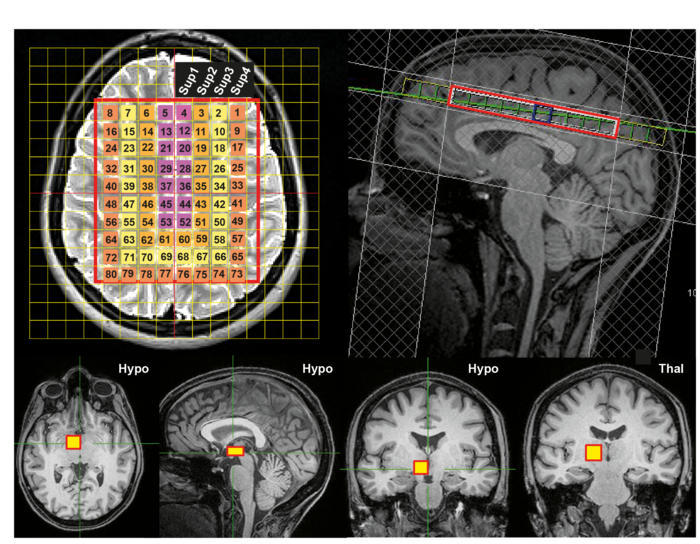
In healthy participants, the average brain temperature was 38.5°C (101.3°F), more than two degrees warmer than that measured under the tongue. The study also found that brain temperature varied depending on:
- time of day,
- brain region,
- sex and menstrual cycle,
- and age.
While the brain surface was generally cooler, deeper brain structures were frequently warmer than 40°C (104°F); with the highest observed brain temperature being 40.9°C (105.6°F). Across all individuals, brain temperature showed consistent time-of-day variation by nearly 1°C (1.8°F), with the highest brain temperatures observed in the afternoon, and the lowest at night.
On average, female brains were around 0.4°C (0.7°F) warmer than male brains. This sex difference was most likely driven by the menstrual cycle since most females were scanned in the post-ovulation phase of their cycle, and their brain temperature was around 0.4°C (0.7°F) warmer than that of females scanned in their pre-ovulation phase.
The results also showed that brain temperature increased with age over the 20-year range of the participants, most notably in deep brain regions, where the average increase was 0.6°C (1.1°F). The researchers propose that the brain’s capacity to cool down may deteriorate with age and further work is needed to investigate whether there is linked with the development of age-related brain disorders.
Dr. John O’Neill, Group Leader at the MRC Laboratory for Molecular Biology, said:
“To me, the most surprising finding from our study is that the healthy human brain can reach temperatures that would be diagnosed as fever anywhere else in the body. Such high temperatures have been measured in people with brain injuries in the past, but had been assumed to result from the injury.”
“We found that brain temperature drops at night before you go to sleep and rises during the day. There is good reason to believe this daily variation is associated with long-term brain health—something we hope to investigate next.”
Temperature Rhythms in Injured Brains

To explore the clinical implications of data obtained from healthy volunteers, the researchers analyzed temperature data collected continuously from the brain of 114 patients who had suffered from moderate to severe traumatic brain injury (TBI). The patients’ average brain temperature was 38.5°C (101.3°F), but it varied even more widely, from 32.6°C (90.7°F) to 42.3°C (108.1°F).
Of 100 patients for whom there was enough data to test for daily rhythms, only a quarter had a daily rhythm in brain temperature. Focusing on predictors of survival in intensive care, the researchers found that absolute brain temperature measurements were of limited use, but daily brain temperature variation was strongly linked with survival—indeed, of TBI patients with a daily brain temperature rhythm only 4% died in intensive care, versus 27% who had no such rhythm.
The researchers caution that larger studies are needed to validate this association and that the link between brain temperature and survival is correlative only, meaning that daily brain temperature rhythms cannot be assumed to directly increase survival. However, the observed link means that monitoring daily brain temperature cycles in TBI patients might be a promising tool to predict survival and would benefit from further research.
Together with the data from healthy people, the findings of this work raise important questions about the use of interventions to modify or control patient temperature in the clinic.
Dr. Nina Rzechorzek, MRC Clinician Scientist Fellow from the MRC Laboratory for Molecular Biology who led the study, said:
“Using the most comprehensive exploration to date of normal human brain temperature, we’ve established ‘HEATWAVE’ – a 4D temperature map of the brain. This map provides an urgently-needed reference resource against which patient data can be compared, and could transform our understanding of how the brain works. That a daily brain temperature rhythm correlates so strongly with survival after TBI suggests that round-the-clock brain temperature measurement holds great clinical value.”
“Our work also opens a door for future research into whether disruption of daily brain temperature rhythms can be used as an early biomarker for several chronic brain disorders, including dementia.”
Reference: “A daily temperature rhythm in the human brain predicts survival after brain injury ” by Nina M Rzechorzek, Michael J Thrippleton, Francesca M Chappell, Grant Mair, Ari Ercole, Manuel Cabeleira, The CENTER-TBI High Resolution ICU (HR ICU) Sub-Study Participants and Investigators, Jonathan Rhodes, Ian Marshall and John S O’Neill, 13 June 2022, Brain.
DOI: 10.1093/brain/awab466
Never miss a breakthrough: Join the SciTechDaily newsletter.
Follow us on Google and Google News.
1 Comment
Like