
Close Menu
    Facebook X (Twitter) Instagram
    SciTechDaily
    • Biology
    • Chemistry
    • Earth
    • Health
    • Physics
    • Science
    • Space
    • Technology
    Facebook X (Twitter) Pinterest YouTube RSS
    SciTechDaily
    Home»Space»Significant Progress in NASA’s Lucy Spacecraft Solar Array Deployment Fix
    Space

    Significant Progress in NASA’s Lucy Spacecraft Solar Array Deployment Fix

    By Erin Morton, NASAJuly 4, 2022No Comments2 Mins Read
    Facebook Twitter Pinterest Telegram LinkedIn WhatsApp Email Reddit
    Share
    Facebook Twitter LinkedIn Pinterest Telegram Email Reddit
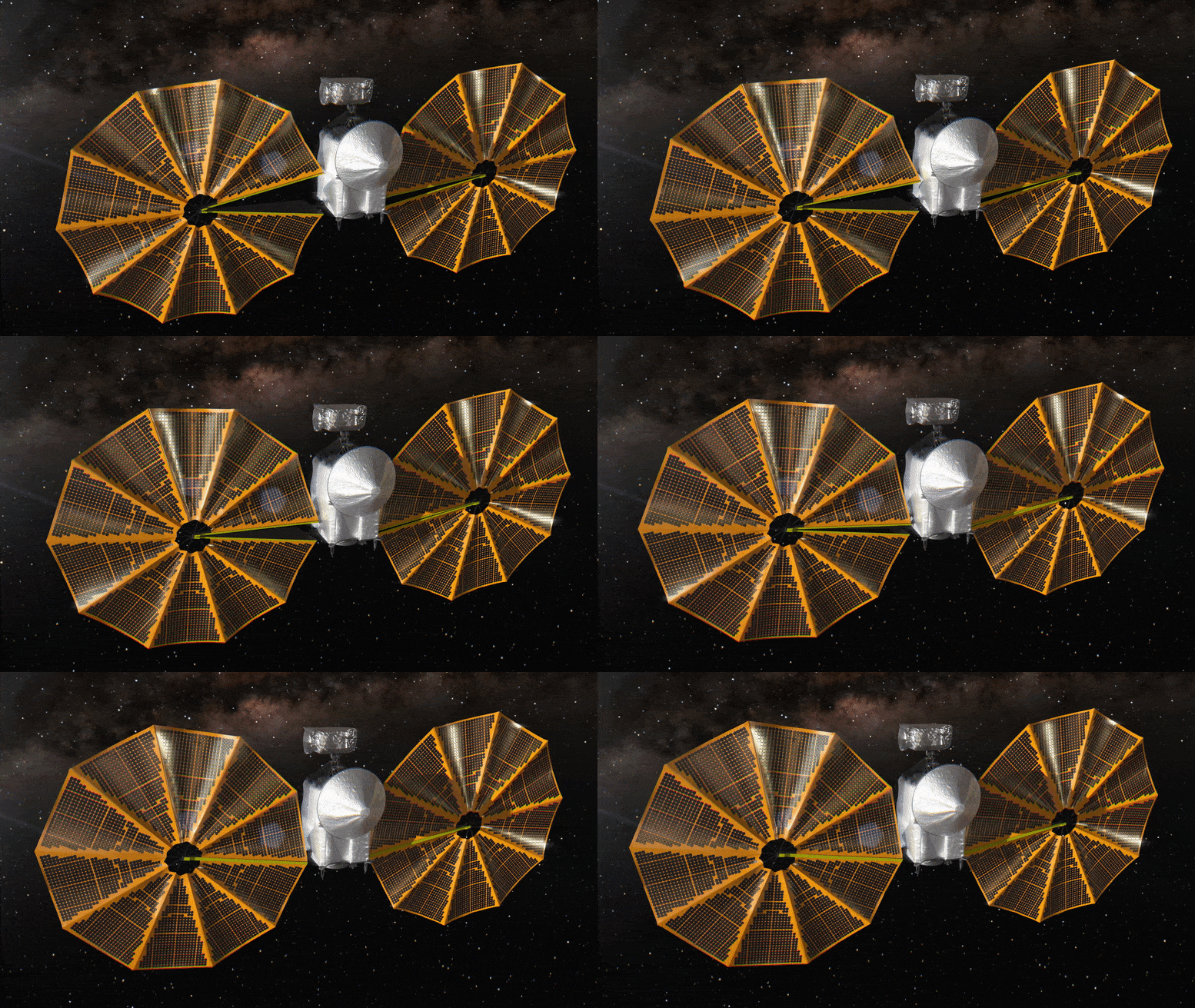
    Lucy Deployment
    NASA’s Lucy spacecraft deploying its solar arrays. Credit: NASA’s Goddard Space Flight Center

    Beginning on May 6 and continuing through June 16, NASA’s Lucy mission team carried out a multi-stage effort intended to further deploy the spacecraft’s unlatched solar array.Throughout the meticulous process, the team commanded the spacecraft to operate the array’s deployment motor for limited periods of time, allowing them to closely monitor the spacecraft’s response.

    As a consequence of this work, the mission succeeded in further deploying the array and now estimates that the solar array is between 353 degrees and 357 degrees open (out of 360 total degrees for a fully deployed array). Furthermore, the array is under considerably more tension, giving it substantially more stabilization. Because of this, the mission team is increasingly optimistic the solar array will successfully meet the mission’s requirements in its current tensioned and stabilized state.

    For now, further deployment attempts will be paused as the Lucy spacecraft enters a planned period of limited communications. Due to thermal constraints caused by the relative positions of the Earth, spacecraft, and Sun, the spacecraft will be unable to communicate with the Earth via its high-gain antenna for several months. Throughout this period, the spacecraft will use its low-gain antenna remain in contact with Lucy’s ground team.

    After its Earth gravity assist maneuver on October 16, the spacecraft will emerge from this partial communications blackout. At that time, the mission team will have more opportunities to attempt further deployment efforts if deemed necessary.

    On June 21, the spacecraft successfully carried out a trajectory correction maneuver, which is the second in a series of maneuvers to prepare the spacecraft for its Earth flyby.


    Launched on October 16, 2021, Lucy will be the first space mission to explore the Trojan asteroids, a population of small bodies that are left over from the formation of the solar system. In their orbit around the Sun, they lead or follow Jupiter and may tell us about the origins of organic materials on Earth. Lucy will fly by and carry out remote sensing on six different Trojan asteroids and will investigate surface geology, surface color, and composition, asteroid interiors/bulk properties, and will observe the satellites and rings of the Trojans. Credit: NASA’s Goddard Space Flight Center

    Never miss a breakthrough: Join the SciTechDaily newsletter.
    Follow us on Google and Google News.

    Lucy Mission NASA Popular
    Share. Facebook Twitter Pinterest LinkedIn Email Reddit

    Related Articles

    NASA’s Lucy Spacecraft Snaps First Images of Asteroid Dinkinesh on Its 12-Year Voyage of Discovery

    Lucy in the Sky With Asteroids: NASA’s Mission Reveals First Images of Jupiter’s Trojans

    NASA’s Record-Breaking Lucy Spacecraft Has a New Asteroid Target

    Never Tell Me the Odds: NASA’s Lucy To Fly Past Thousands of Objects for Earth Gravity Assist

    NASA’s Lucy Spacecraft About To Sling-Shot Past Earth

    Moon Discovered Around Asteroid Polymele by NASA’s Lucy Team

    NASA Troubleshoots Asteroid-Bound Lucy Spacecraft From Millions of Miles Away

    NASA’s Lucy Mission Continues Work on Solar Array Deployment Fix

    NASA’s Lucy Spacecraft Observes Lunar Eclipse From 64 Million Miles Away

    Leave A Reply Cancel Reply

    • Facebook
    • Twitter
    • Pinterest
    • YouTube

    Don't Miss a Discovery

    Subscribe for the Latest in Science & Tech!

    Trending News

    Scientists Discover Game-Changing New Way To Treat High Cholesterol

    This Small Change to Your Exercise Routine Could Be the Secret to Living Longer

    Scientists Discover 430,000-Year-Old Wooden Tools, Rewriting Human History

    AI Could Detect Early Signs of Alzheimer’s in Under a Minute – Far Before Traditional Tests

    What if Dark Matter Has Two Forms? Bold New Hypothesis Could Explain a Cosmic Mystery

    This Metal Melts in Your Hand – and Scientists Just Discovered Something Strange

    Beef vs. Chicken: Surprising Results From New Prediabetes Study

    Alzheimer’s Breakthrough: Scientists Discover Key Protein May Prevent Toxic Protein Clumps in the Brain

    Follow SciTechDaily
    • Facebook
    • Twitter
    • YouTube
    • Pinterest
    • Newsletter
    • RSS
    SciTech News
    • Biology News
    • Chemistry News
    • Earth News
    • Health News
    • Physics News
    • Science News
    • Space News
    • Technology News
    Recent Posts
    • Researchers Discover Unknown Beetle Species Just Steps From Their Lab
    • Jellyfish Caught Feasting on Exploding Sea Worms for the First Time
    • Ancient “Spaghetti” in Dogs’ Hearts Reveals Heartworm’s Shocking Origins
    • Milk Nanoparticles Could Revolutionize Treatment for Deadly Bile Duct Cancer
    • Largest-Ever Study Finds Medicinal Cannabis Ineffective for Anxiety, Depression, PTSD
    Copyright © 1998 - 2026 SciTechDaily. All Rights Reserved.
    • Science News
    • About
    • Contact
    • Editorial Board
    • Privacy Policy
    • Terms of Use

    Type above and press Enter to search. Press Esc to cancel.