
Close Menu
    Facebook X (Twitter) Instagram
    SciTechDaily
    • Biology
    • Chemistry
    • Earth
    • Health
    • Physics
    • Science
    • Space
    • Technology
    Facebook X (Twitter) Pinterest YouTube RSS
    SciTechDaily
    Home»Space»NASA’s Lucy Mission Continues Work on Solar Array Deployment Fix
    Space

    NASA’s Lucy Mission Continues Work on Solar Array Deployment Fix

    By Erin Morton, NASAJune 10, 2022No Comments4 Mins Read
    Facebook Twitter Pinterest Telegram LinkedIn WhatsApp Email Reddit
    Share
    Facebook Twitter LinkedIn Pinterest Telegram Email Reddit
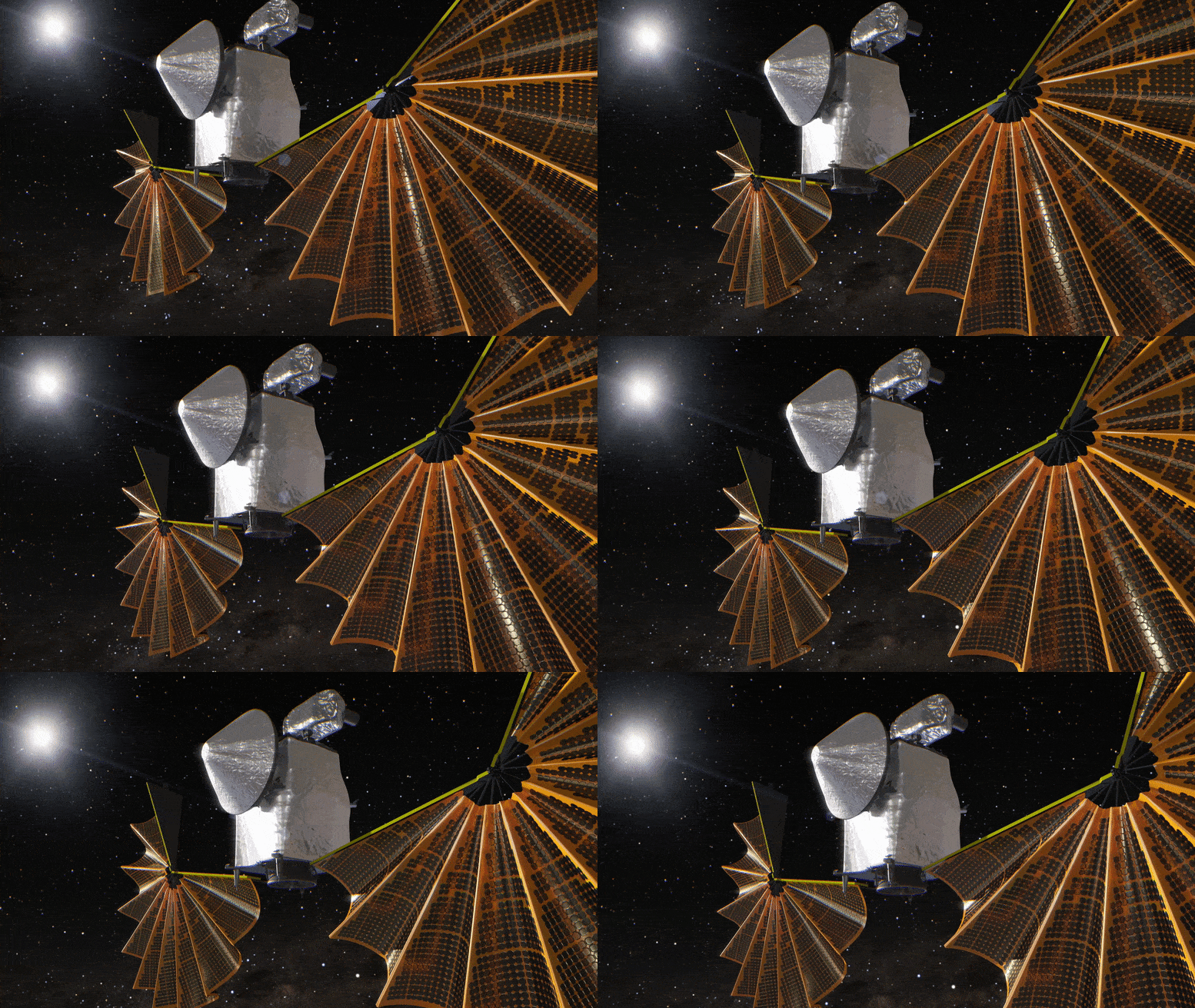
    Lucy Solar Array Deployment
    Lucy will explore the Jupiter Trojan asteroids – thought to be “fossils of planet formation.” Credit: NASA’s Goddard Space Flight Center

    Lucy’s solar array didn’t fully deploy, prompting NASA to conduct multiple torque adjustments. Though the array hasn’t latched, it’s increasingly stable, allowing the mission to continue with planned maneuvers.

    NASA’s Lucy mission launched on October 16, 2021, aboard a United Launch Alliance Atlas V rocket. Initially, everything seemed fine — Lucy was on its daring mission to explore Jupiter’s Trojan asteroids.

    However, they soon hit a snag. Although both solar arrays deployed, one didn’t quite open all the way and latch in the fully deployed position. While the solar arrays are producing plenty of power, NASA is concerned that a main engine burn in the present configuration could damage the array. Therefore, the team decided to move forward with a plan to fix the problem.

    NASA’s Lucy mission team is in the midst of that multi-stage effort to further deploy the spacecraft’s unlatched solar array. On May 9, the team commanded the spacecraft to operate the array’s deployment motor using both the primary and backup motor windings simultaneously to generate more torque, i.e. a harder pull. The motor operated as expected, further reeling in the lanyard that pulled the solar array open. After running the motor for a series of short intervals to avoid overheating, the team paused to analyze the results. Data from the spacecraft showed that the deployment was proceeding similarly to engineering ground tests, allowing the team to move forward with the second stage of the attempt. Analysis of the data also suggested that there was still additional lanyard to be retracted. The team sent the same commands again on May 12. Although this series of commands did not latch the solar array fully open, it did advance the deployment enough to increase the tension that stabilizes the arrays as was hoped.
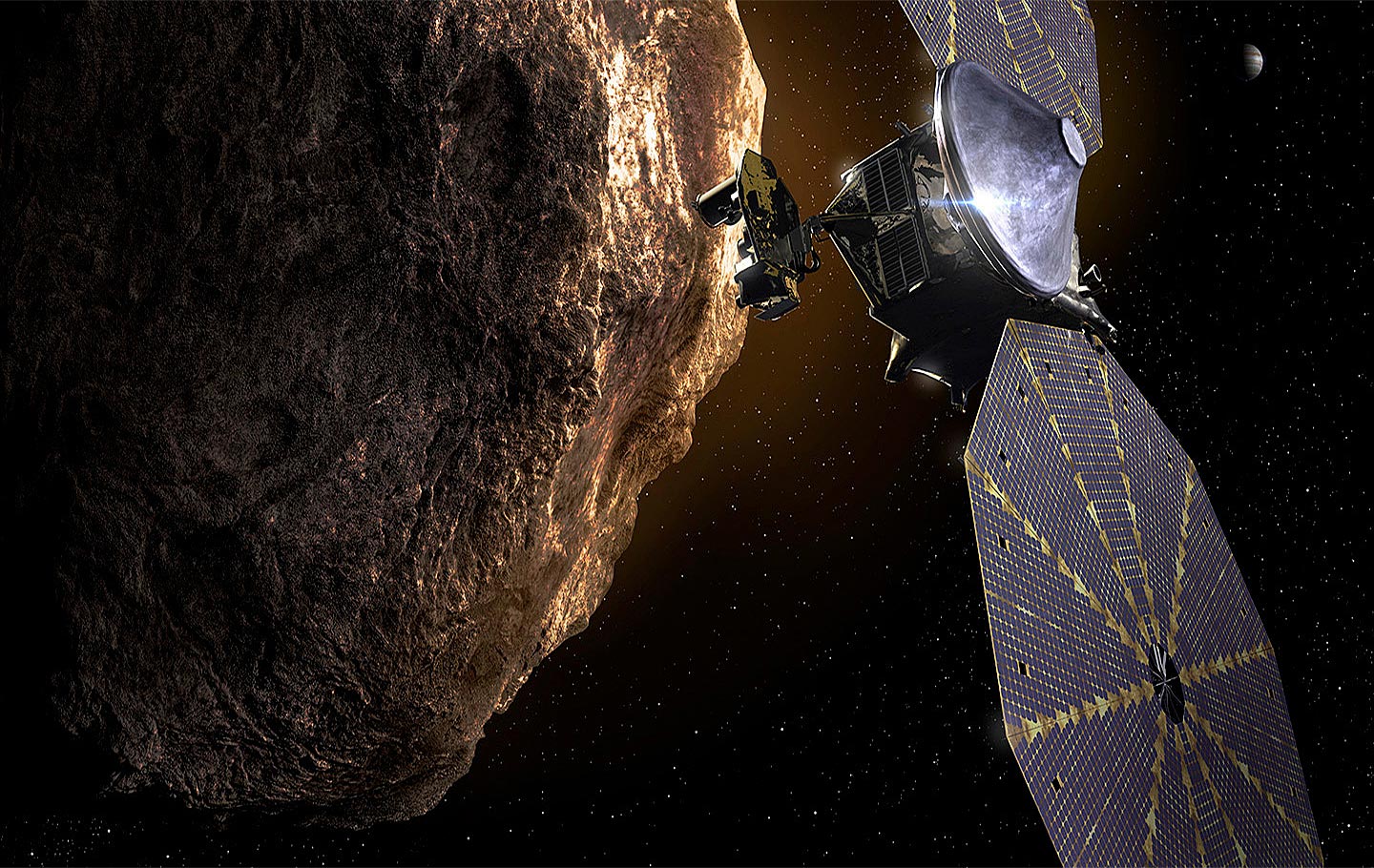
    Lucy Spacecraft Near Large Asteroid
    Illustration of the Lucy spacecraft near a large asteroid with Jupiter visible in the distant background. Credit: Southwest Research Institute

    On May 26, the spacecraft was again commanded to deploy the solar array. As in the first two attempts, both motor windings were operated simultaneously for short periods of time to avoid overheating. Afterward, the team again analyzed the data from the event, which again showed that the array was continuing to open. The team repeated the deployment command sequence a fourth time on June 2. While the array still did not latch, the data indicates that it continued to further deploy and stiffen throughout the attempt.

    The team has several more opportunities to repeat these deployment commands. While there is no guarantee that additional attempts will latch the array, there is strong evidence that the process is putting the array under more tension, further stabilizing it. Even if the array does not ultimately latch, the additional stiffening may be enough to fly the mission as planned.

    The spacecraft completed a trajectory correction maneuver on June 7. This was the first in a series of maneuvers the spacecraft will take in preparation for the mission’s first Earth gravity assist scheduled for October 16, 2022.


    Launched on October 16, 2021, Lucy is the first space mission that will explore the Trojan asteroids. These are a population of small bodies that are left over from the formation of the solar system. They lead or follow Jupiter in their orbit around the Sun, and may tell us about the origins of organic materials on Earth. Lucy will fly by and carry out remote sensing on six different Trojan asteroids and will study surface geology, surface color, and composition, asteroid interiors/bulk properties, and will look at the satellites and rings of the Trojans. Credit: NASA’s Goddard Space Flight Center

    Never miss a breakthrough: Join the SciTechDaily newsletter.
    Follow us on Google and Google News.

    Lucy Mission NASA Popular
    Share. Facebook Twitter Pinterest LinkedIn Email Reddit

    Related Articles

    NASA’s Lucy Spacecraft Snaps First Images of Asteroid Dinkinesh on Its 12-Year Voyage of Discovery

    Lucy in the Sky With Asteroids: NASA’s Mission Reveals First Images of Jupiter’s Trojans

    NASA’s Record-Breaking Lucy Spacecraft Has a New Asteroid Target

    Never Tell Me the Odds: NASA’s Lucy To Fly Past Thousands of Objects for Earth Gravity Assist

    NASA’s Lucy Spacecraft About To Sling-Shot Past Earth

    Moon Discovered Around Asteroid Polymele by NASA’s Lucy Team

    NASA Troubleshoots Asteroid-Bound Lucy Spacecraft From Millions of Miles Away

    Significant Progress in NASA’s Lucy Spacecraft Solar Array Deployment Fix

    NASA’s Lucy Spacecraft Observes Lunar Eclipse From 64 Million Miles Away

    Leave A Reply Cancel Reply

    • Facebook
    • Twitter
    • Pinterest
    • YouTube

    Don't Miss a Discovery

    Subscribe for the Latest in Science & Tech!

    Trending News

    Scientists Discover Game-Changing New Way To Treat High Cholesterol

    This Small Change to Your Exercise Routine Could Be the Secret to Living Longer

    Scientists Discover 430,000-Year-Old Wooden Tools, Rewriting Human History

    AI Could Detect Early Signs of Alzheimer’s in Under a Minute – Far Before Traditional Tests

    What if Dark Matter Has Two Forms? Bold New Hypothesis Could Explain a Cosmic Mystery

    This Metal Melts in Your Hand – and Scientists Just Discovered Something Strange

    Beef vs. Chicken: Surprising Results From New Prediabetes Study

    Alzheimer’s Breakthrough: Scientists Discover Key Protein May Prevent Toxic Protein Clumps in the Brain

    Follow SciTechDaily
    • Facebook
    • Twitter
    • YouTube
    • Pinterest
    • Newsletter
    • RSS
    SciTech News
    • Biology News
    • Chemistry News
    • Earth News
    • Health News
    • Physics News
    • Science News
    • Space News
    • Technology News
    Recent Posts
    • Milk Nanoparticles Could Revolutionize Treatment for Deadly Bile Duct Cancer
    • Largest-Ever Study Finds Medicinal Cannabis Ineffective for Anxiety, Depression, PTSD
    • Scientists Reveal Why a Common Drug Causes Birth Defects and Autism
    • A Medieval Japanese Diary Just Helped Scientists Detect a Dangerous Solar Event
    • Humans Returned to Britain 500 Years Earlier Than Scientists Thought
    Copyright © 1998 - 2026 SciTechDaily. All Rights Reserved.
    • Science News
    • About
    • Contact
    • Editorial Board
    • Privacy Policy
    • Terms of Use

    Type above and press Enter to search. Press Esc to cancel.