
Close Menu
    Facebook X (Twitter) Instagram
    SciTechDaily
    • Biology
    • Chemistry
    • Earth
    • Health
    • Physics
    • Science
    • Space
    • Technology
    Facebook X (Twitter) Pinterest YouTube RSS
    SciTechDaily
    Home»Space»Polarized Shockwaves Shake the Universe’s Cosmic Web
    Space

    Polarized Shockwaves Shake the Universe’s Cosmic Web

    By International Centre for Radio Astronomy ResearchMarch 8, 20231 Comment4 Mins Read
    Facebook Twitter Pinterest Telegram LinkedIn WhatsApp Email Reddit
    Share
    Facebook Twitter LinkedIn Pinterest Telegram Email Reddit
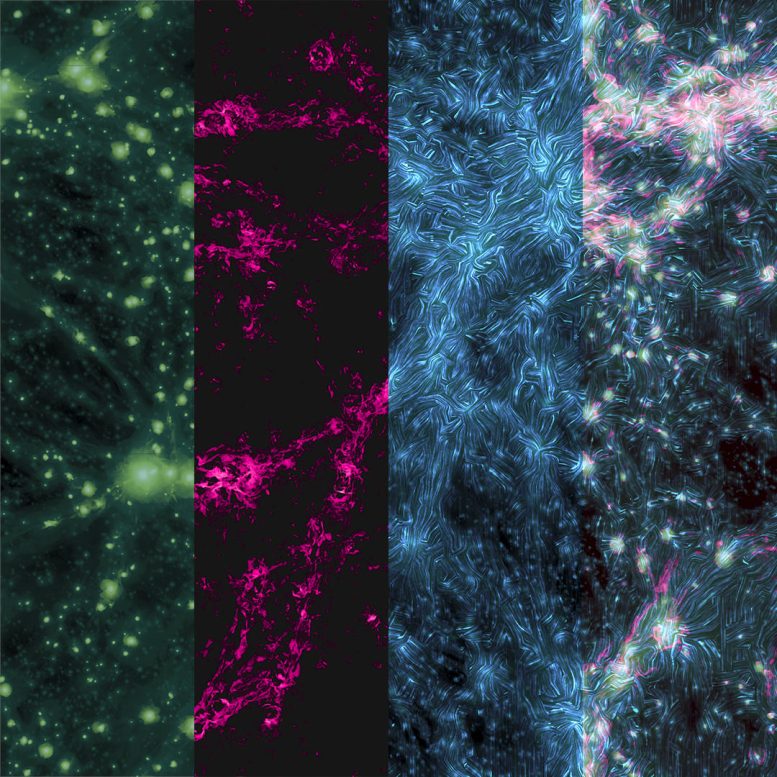
    Cosmic Web – Composite Slides
    A composite image of 3 different observations of the cosmic web (gas, radio, and magnetic) accompanied by a composite image. Credit: F. Vazza, D. Wittor and J. West, Composition by K. Brown

    Researchers at ICRAR have uncovered tantalizing evidence of magnetic fields in the universe’s largest cosmic structures.

    The cosmic web, a network of interconnecting filaments and clusters containing gases, galaxies, and winding around cosmic voids that span millions of light-years, represents the largest scale of the universe. Predicted by astrophysicists in the 1960s, computer modeling in the 1980s provided a visual representation of this vast network.

    In recent decades, astronomers have made significant progress in mapping the Cosmic Web, which has opened up new avenues for answering some of the most significant questions in the field. One area of particular interest is the study of magnetic fields at a cosmic scale and their role in shaping both galactic and cosmic structures.

    New research published in Science Advances and led by the International Centre for Radio Astronomy Research (ICRAR) in partnership with CSIRO, Australia’s national science agency, is helping us to further understand these cosmic magnetic fields.

    Dr. Tessa Vernstrom from The University of Western Australia’s (UWA) node of ICRAR, is the lead author of the research and describes magnetism as a fundamental force in nature.
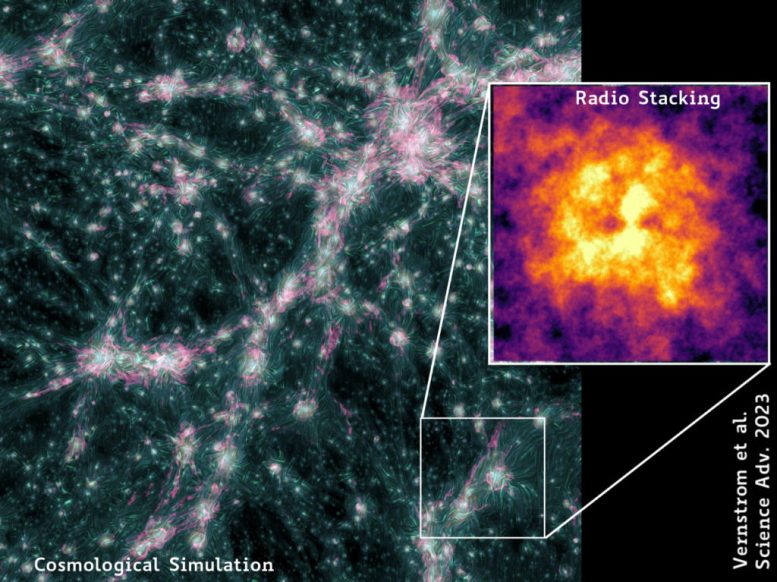
    Magnetic Fields of the Cosmic Web
    A composite image showing the magnetic fields of the cosmic web, featuring a pull out of how radio data was stacked. Credit: Vernstrom et al. 2023

    “Magnetic fields pervade the universe – from planets and stars to the largest spaces in-between galaxies. However, many aspects of cosmic magnetism are not yet fully understood, especially at the scales seen in the cosmic web.” When matter merges in the universe, it produces a shockwave which accelerates particles, amplifying these intergalactic magnetic fields,” said Dr. Vernstrom.

    Her research has recorded radio emissions coming from the cosmic web – the first observational evidence of strong shockwaves.

    This phenomenon had previously only been observed in the universe’s largest galaxy clusters and was predicted to be the ‘signature’ of matter collisions throughout the cosmic web.

    “These shockwaves give off radio emissions which should result in the cosmic web ‘glowing’ in the radio spectrum, but it had never really been conclusively detected due to how faint the signals are.”
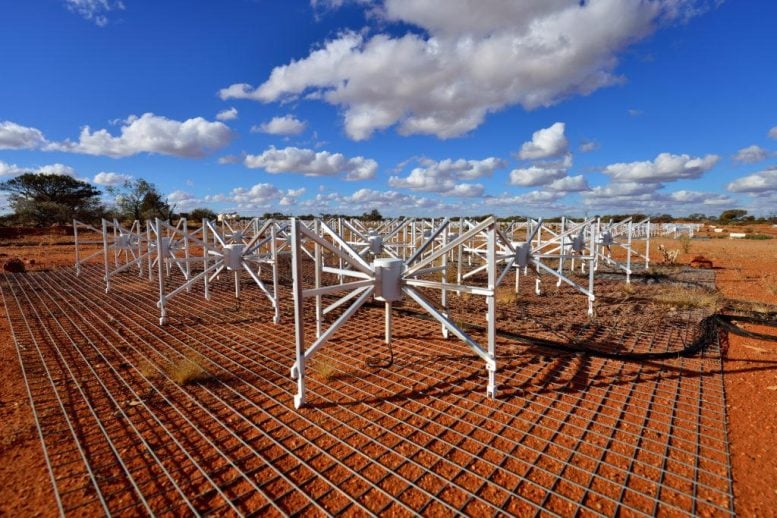
    Murchison Widefield Array (MWA) Radio Telescope
    Data from the Murchison Widefield Array (MWA) radio telescope in Western Australia provided all-sky radio maps for the research. Credit: Dragonfly Media

    Dr. Vernstrom’s team began searching for the cosmic web’s ‘radio glow’ in 2020 and initially found signals which could be attributed to these cosmic waves.

    However, as these initial signals could have included emissions from galaxies and celestial objects other than the shockwaves, Vernstrom opted for a different signal type with less background ‘noise’ – polarised radio light.

    “As very few sources emit polarised radio light, our search was less prone to contamination and we have been able to provide much stronger evidence that we are seeing emissions from the shockwaves in the largest structures in the universe, which helps to confirm our models for the growth of this large-scale structure.”
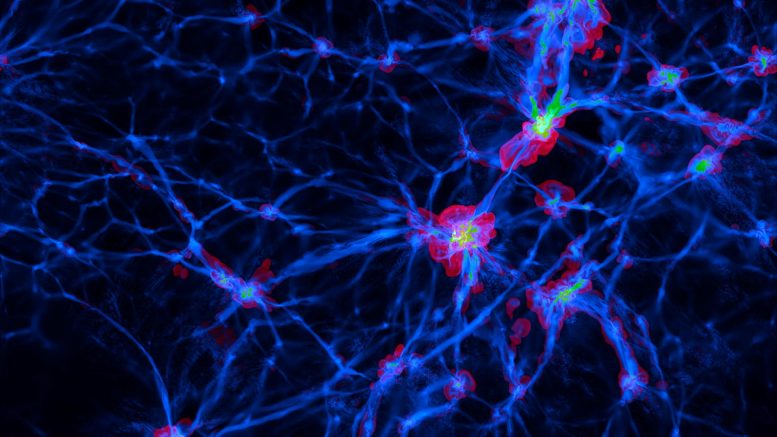
    Extracted Still From Simulation of the Cosmic Web’s Magnetic Field Video
    An extracted still from Simulation of the Cosmic Web’s magnetic field video. The blue and green colors give the (growing) strength of magnetic fields in the simulation, while the red color marks the gas temperature. Credit: Vazza F; ENZO; Piz-Daint CSCS (Lugano)

    The research utilized data and all-sky radio maps from the Global Magneto-Ionic Medium Survey, the Planck Legacy Archive, the Owens Valley Long Wavelength Array, and the Murchison Widefield Array, stacking the data over the known clusters and filaments in the cosmic web.

    The stacking method helps to strengthen the faint signal above the image noise, which was then compared to state-of-the-art cosmological simulations generated through the Enzo Project.

    These simulations are the first of their kind to include predictions of the polarised radio light from the cosmic shockwaves observed as part of this research.

    Our understanding of these magnetic fields could be used to expand and refine our theories on how the universe grows and has the potential to help us solve the mystery of the origins of cosmic magnetism.

    Reference: “Polarized accretion shocks from the cosmic web” by Tessa Vernstrom, Jennifer West, Franco Vazza, Denis Wittor, Christopher John Riseley and George Heald, 15 February 2023, Science Advances.
    DOI: 10.1126/sciadv.ade7233

    Never miss a breakthrough: Join the SciTechDaily newsletter.
    Follow us on Google and Google News.

    Astronomy International Centre for Radio Astronomy Research (ICRAR) Magnetic Fields Radio Astronomy
    Share. Facebook Twitter Pinterest LinkedIn Email Reddit

    Related Articles

    Giant Galactic Explosion Reveals Cosmic Pollution Dynamics

    Unveiling the Magnetic Mysteries of Black Holes: How Does “MAD” Accretion Form Around a Black Hole?

    Astronomers Find Mysterious Stellar Object Blasting Out Radio Waves Every 22 Minutes

    Quantum Metamorphosis: Unveiling the Puzzling Phenomenon of Magnetar X-Rays

    Unlocking the Secrets of the Early Universe: Scientists Double Sensitivity of HERA Radio Telescope

    Spiral Pattern Provides New Clues Into How High-Mass Stars Form

    Revealing the Secrets of Magnetars – Researchers Test “Anti-Glitch” Theory

    New Record for Strongest Magnetic Field in Universe: More Than 1.6 Billion Tesla

    The Sun Is Spinning Round Again: Solving Part of the “Solar Problem”

    1 Comment

    1. xABBAAA on March 12, 2023 10:28 am

      … a large, old galaxy that should not exist … shook it more…

      Reply
    Leave A Reply Cancel Reply

    • Facebook
    • Twitter
    • Pinterest
    • YouTube

    Don't Miss a Discovery

    Subscribe for the Latest in Science & Tech!

    Trending News

    One of the Universe’s Largest Stars May Be Getting Ready To Explode

    Scientists Discover Enzyme That Could Supercharge Ozempic-Like Weight Loss Drugs

    Popular Sweetener Linked to DNA Damage – “It’s Something You Should Not Be Eating”

    Ancient “Rock” Microbes May Reveal How Complex Life Began

    Researchers Capture Quantum Interference in One of Nature’s Rarest Atoms

    “A Plague Is Upon Us”: The Mass Death That Changed an Ancient City Forever

    Scientists Discover Game-Changing New Way To Treat High Cholesterol

    This Small Change to Your Exercise Routine Could Be the Secret to Living Longer

    Follow SciTechDaily
    • Facebook
    • Twitter
    • YouTube
    • Pinterest
    • Newsletter
    • RSS
    SciTech News
    • Biology News
    • Chemistry News
    • Earth News
    • Health News
    • Physics News
    • Science News
    • Space News
    • Technology News
    Recent Posts
    • Natural Compounds Boost Bone Implant Success While Killing Bacteria and Cancer Cells
    • After 60 Years, Scientists Uncover Unexpected Brain Effects of Popular Diabetes Drug Metformin
    • New Research Uncovers Hidden Side Effects of Popular Weight-Loss Drugs
    • Scientists Rethink Extreme Warming After Surprising Ocean Discovery
    • The Surprising Role of Asteroids in the Origin of Life
    Copyright © 1998 - 2026 SciTechDaily. All Rights Reserved.
    • Science News
    • About
    • Contact
    • Editorial Board
    • Privacy Policy
    • Terms of Use

    Type above and press Enter to search. Press Esc to cancel.