
Close Menu
    Facebook X (Twitter) Instagram
    SciTechDaily
    • Biology
    • Chemistry
    • Earth
    • Health
    • Physics
    • Science
    • Space
    • Technology
    Facebook X (Twitter) Pinterest YouTube RSS
    SciTechDaily
    Home»Space»Finding Neverland’s Parameters: Astronomers Discover How Long-Lived Peter Pan Disks Evolve
    Space

    Finding Neverland’s Parameters: Astronomers Discover How Long-Lived Peter Pan Disks Evolve

    By Queen Mary University of LondonJune 10, 2020No Comments3 Mins Read
    Facebook Twitter Pinterest Telegram LinkedIn WhatsApp Email Reddit
    Share
    Facebook Twitter LinkedIn Pinterest Telegram Email Reddit
    Peter Pan Disk
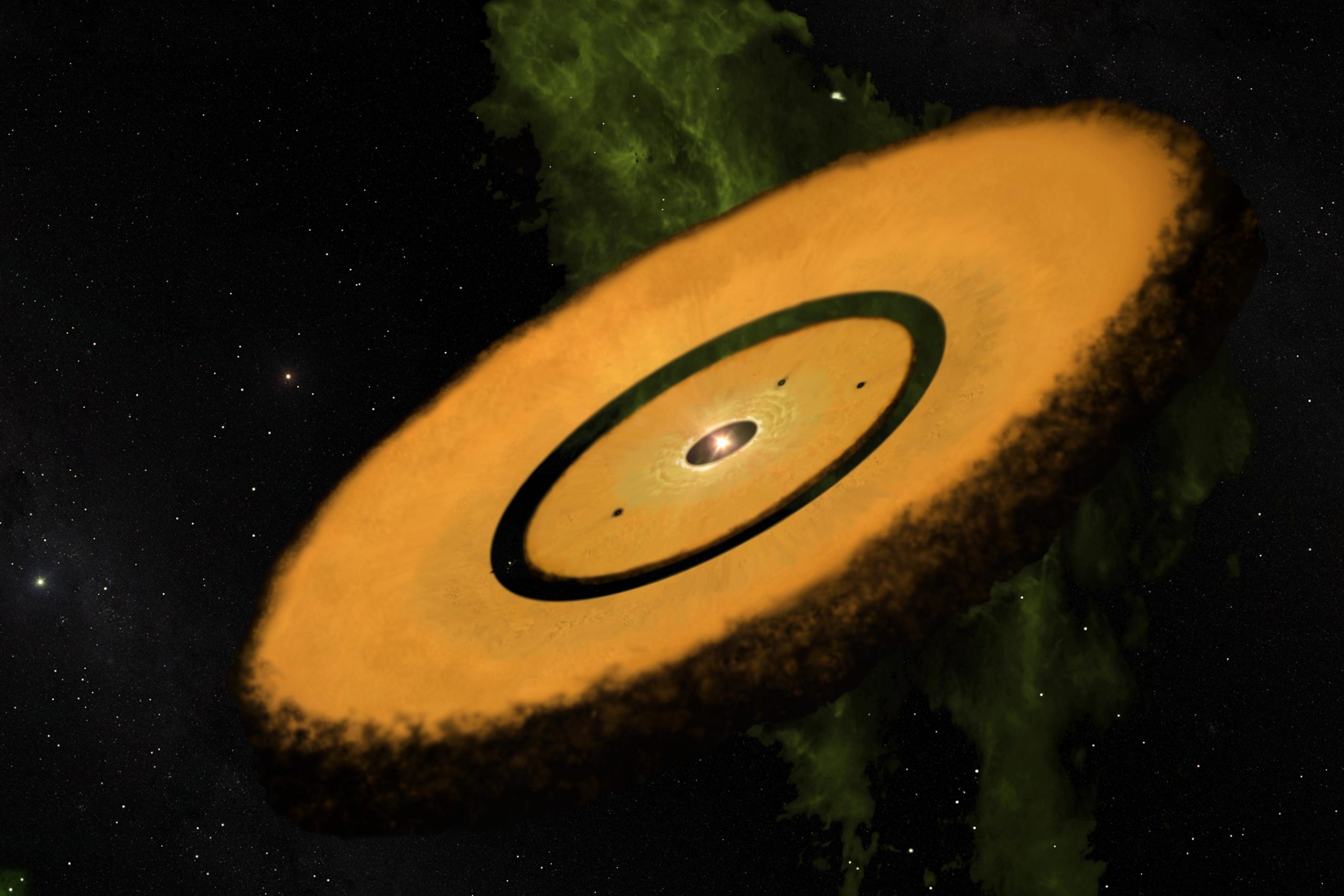
    Artist’s concept of a Peter Pan disk. Credit: Jonathan Holden/NASA

    New research from scientists at Queen Mary University of London has revealed how long-lived Peter Pan disks form, which could provide new insights into how planets arise.

    Planet-forming, or protoplanetary, disks are giant disks of gas and dust found circling young stars. The recently discovered Peter Pan disks received their name as like their fictional counterpart they are thought to “never grow up,” living around 5-10 times longer than other typical protoplanetary disks.

    Whilst astronomers have been aware of the existence of Peter Pan disks since 2016, questions around how and why these disks live so long and the implications for how planets form, have been left unanswered.

    In this study, the scientists used computer simulations to look at a range of possible starting configurations and ways in which the disk evolves to reveal the combination of conditions needed to form Peter Pan disks, which they termed ‘Neverland’s parameters.’ They found these disks only form in lonely environments, away from other stars, and that they need to start out much larger than normal disks.

    Dr. Gavin Coleman, first author of the study and postdoctoral researcher at Queen Mary, said: “Most stars form in big groups containing around 100,000 stars however it seems that Peter Pan disks can’t form in these environments. They need to be much more isolated from their stellar neighbors as the radiation from other stars would blow these disks away. They also need to start out massive, so they have more gas to lose and are therefore able to live for much longer.”

    Until the discovery of long-lived Peter Pan disks, scientists thought that all disks had a lifetime of a few million years and faded away by 10 million years, suggesting that the planets within them must form quickly.

    Dr. Thomas Haworth, a Dorothy Hodgkin Fellow at Queen Mary, said: “The existence of these long-lived disks was really surprising, and finding out why these disks can survive longer than expected could be critical for helping us understand more about disk evolution and planet formation in general. A particularly interesting point is that Peter Pan disks have so far only been found around low mass stars, and these low mass stars are generally being found to host lots of planets. The large disk masses that we need to end up with Peter Pan disks could be an important ingredient that allows these planets to exist.”

    Due to the specific environment needed for the formation of these disks, it is expected that they are very rare. So far, seven Peter Pan disks have been discovered as the result of a citizen science collaboration between NASA and Zooniverse, known as the Disk Detective project.

    Dr. Coleman, said: “It’s great that the findings of a citizen science project are now fuelling novel scientific research into these unique disks, and could even help us to better understand planet formation, one of the key problems in astrophysics.”

    Reference: “Peter Pan Discs: Finding Neverland’s Parameters” by Gavin A. L. Coleman and Thomas J. Haworth, 11 June 2020, Monthly Notices of the Royal Astronomical Society.
    DOI: 10.1093/mnrasl/slaa098

    Never miss a breakthrough: Join the SciTechDaily newsletter.
    Follow us on Google and Google News.

    Astronomy Astrophysics Popular Queen Mary University of London
    Share. Facebook Twitter Pinterest LinkedIn Email Reddit

    Related Articles

    New Measurements Show We May Live in a Giant “Cosmic Void”

    Scientists Think This Star Could Be the Next Supernova

    What If the Big Bang Wasn’t the Beginning? Supercomputers Search for Clues

    NASA’s Webb Telescope Discovers 300 Mysterious Objects That Shouldn’t Exist

    Brightest Radio Flash Ever Detected Lights Up Nearby Galaxy

    Rare Supernova Defies Textbooks and Reveals Inner Layers of a Dying Star

    Webb’s Mysterious “Little Red Dots” May Be the Cradle of the First Black Holes

    Astronomers Capture the “Eye of Sauron” Beaming at Earth

    Webb Telescope Spots Oldest Black Hole, Shattering Cosmic Records

    Leave A Reply Cancel Reply

    • Facebook
    • Twitter
    • Pinterest
    • YouTube

    Don't Miss a Discovery

    Subscribe for the Latest in Science & Tech!

    Trending News

    Scientists Uncover Promising New Strategy To Stop Parkinson’s in Its Tracks

    Experts Reveal the Surprising Cancer Link Behind a Common Vitamin

    This Strange “Golden Orb” Found 2 Miles Deep Stumped Scientists for Years

    Giant “Last Titan” Dinosaur Discovered in Thailand Was Bigger Than 9 Elephants

    This “Longevity Gene” May Protect the Brain From Aging and Dementia

    Common Cleaning Chemical Could Triple Your Risk of a Dangerous Liver Disease

    Scientists Discover Bizarre 100-Million-Year-Old Insect With Giant Claws

    Scientists Discover “Good” Gut Microbes That Could Protect Against Autism and ADHD

    Follow SciTechDaily
    • Facebook
    • Twitter
    • YouTube
    • Pinterest
    • Newsletter
    • RSS
    SciTech News
    • Biology News
    • Chemistry News
    • Earth News
    • Health News
    • Physics News
    • Science News
    • Space News
    • Technology News
    Recent Posts
    • Tea or Coffee? Your Daily Choice Could Affect Osteoporosis Risk
    • Scientists Discover Brain Pathway That May Slow Parkinson’s Disease – but Only in Women
    • Vitamin C May Fight Cancer in a Surprising Way
    • Light-Matter Particles Could Revolutionize AI Computing
    • Scientists Warn Many Insects May Not Survive a Warming World
    Copyright © 1998 - 2026 SciTechDaily. All Rights Reserved.
    • Science News
    • About
    • Contact
    • Editorial Board
    • Privacy Policy
    • Terms of Use

    Type above and press Enter to search. Press Esc to cancel.