
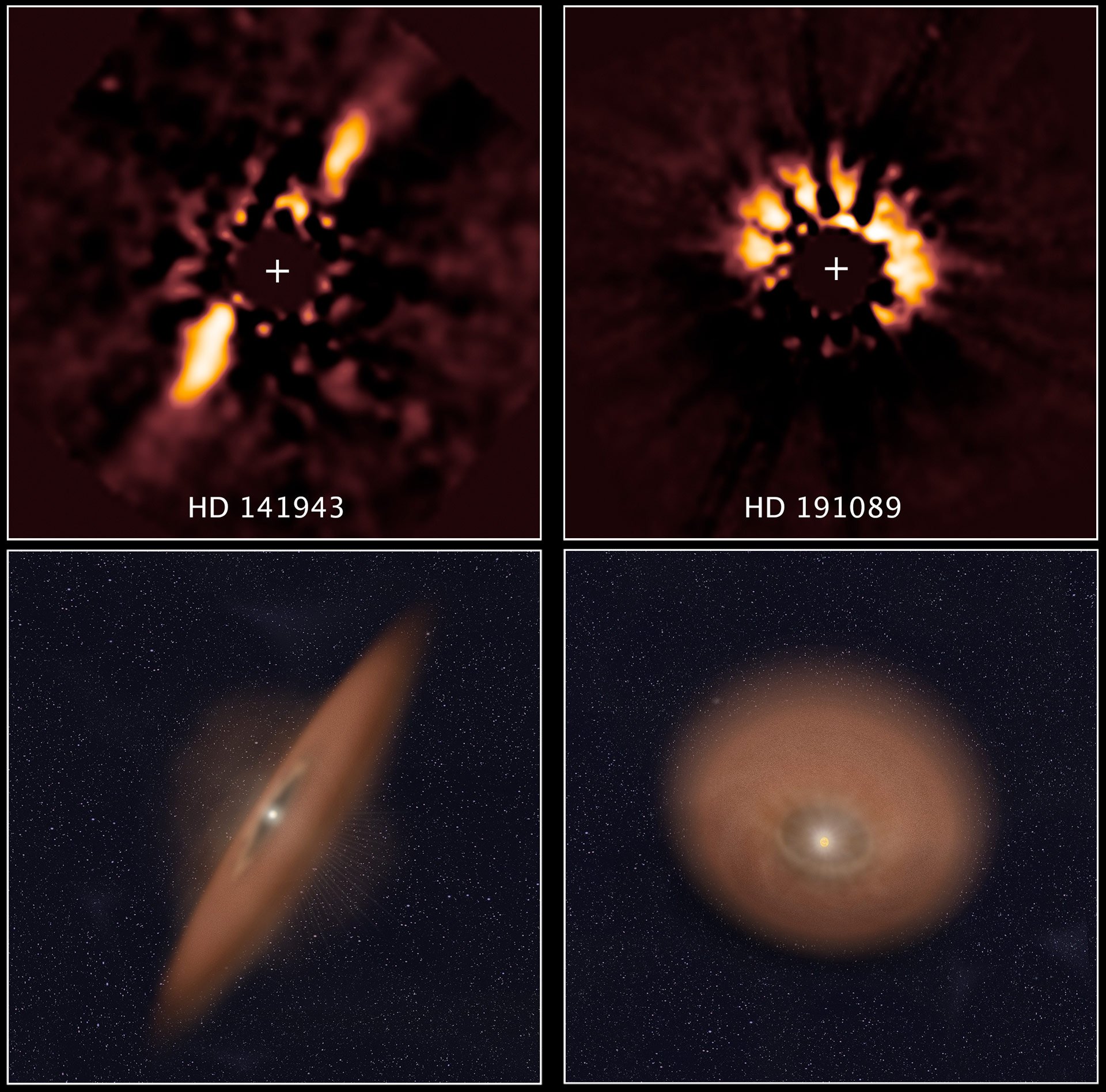
By applying new image processing techniques, astronomers uncovered images of debris disks hidden away in Hubble infrared data taken over a decade ago.
With the Hubble Space Telescope, if astronomers missed seeing something once in their data, they haven’t missed it forever. Thanks to the wealth of information stored in the Hubble data archive, and given enough time to come up with more clever ways of scientific analysis, they can revisit existing observations and make new discoveries not caught initially.
Such is the case with four disks of planetary debris uncovered in images of young stars that astronomers retrieved from the Barbara A. Mikulski Archive for Space Telescopes (MAST). A fifth disk image, which was an unpublished borderline detection by Hubble from 2007, was also recovered. These disks are telltale evidence for newly formed planets.
This is an astronomical forensics story of revisiting earlier data with new image processing techniques — and of some tenacious astronomers. Rémi Soummer, of the Space Telescope Science Institute (STScI) in Baltimore, Maryland, led the team on an Indiana Jones hunt for hidden Hubble treasures.
The stars were initially targeted with Hubble’s Near Infrared Camera and Multi-Object Spectrometer (NICMOS) based on unusual heat signatures obtained from NASA space-based telescopes, including IRAS (Infrared Astronomical Satellite) and the Spitzer Space Telescope. The previous data provided interesting clues that dusty disks might exist around these stars. Such disks might be seen in scattered light from small dust particles. But when Hubble first viewed the stars between 1999 and 2006, no visible-light disks were detected in the NICMOS pictures.
Recently, with improvements in image processing — including algorithms used for face-recognition software — Soummer and his team reanalyzed the archived images. This time, they could unequivocally see the debris disks, and they could even determine their shapes.
“These findings increase the number of debris disks seen in scattered light from 18 to 23. By significantly adding to the known population, and by showing the variety of shapes in these new disks, Hubble can help astronomers learn more about how planetary systems form and evolve,” said Soummer.
The dust in the disks is hypothesized to be produced by collisions between small planetary bodies such as asteroids. The debris disks are composed of dust particles formed from these grinding collisions. The tiniest particles are constantly blown outward by radiation pressure from the star. This means they must be replenished continuously through more collisions. This game of bumper cars was common in the solar system 4.5 billion years ago. Earth’s moon and the satellite system around Pluto are considered to be collisional byproducts.
“One star that is particularly interesting is HD 141943,” said Christine Chen, debris disk expert and team member. “It is an exact twin of our Sun during the epoch of terrestrial planet formation in our own solar system.” Hubble found that the star exhibits an asymmetrical, edge-on disk. This asymmetry could be evidence the disk is being gravitationally sculpted by the tug of one or more unseen planets.
The NICMOS instrument, which began taking data in 1997, was so cutting-edge that ground-based technology is only now beginning to match its power. Because Hubble has been in operation for 24 years, it provides a long baseline of high-quality archival observations. “Now, with such new technologies in image processing, we can go back to the archive and conduct research more precisely than previously possible with NICMOS data,” said Dean Hines of STScI.
Once Soummer’s team began to apply the new algorithm to the old data, the disks immediately started appearing. “I remember we tried it, and we thought, ‘It’s not possible. We’ve done something wrong!’ The disks popped out immediately,” explained Soummer. “It worked so well, and the results came up so quickly, that at first we didn’t believe them.”
“Being able to see these disks now also has let us plan further observations to study them in even more detail using other Hubble instruments and large telescopes on the ground,” added Marshall Perrin of STScI.
“We are also working to implement the same techniques as a standard processing method for the upcoming James Webb Space Telescope,” said STScI teammate Laurent Pueyo. “These disks will also be prime targets for the Webb Telescope.”
Soummer’s team has just begun its work. They will next search for structures in the disks that suggest the presence of planets.
The Space Telescope Science Institute in Baltimore, Maryland, conducts Hubble Space Telescope (HST) science operations. HST is a project of international cooperation between NASA and the European Space Agency. NASA’s Goddard Space Flight Center in Greenbelt, Md., manages the telescope. STScI is operated by the Association of Universities for Research in Astronomy, Inc., in Washington, D.C.
The Mikulski Archive for Space Telescopes, located at STScI, is a NASA-funded project to support and provide the astronomical community a variety of astronomical data archives, with the primary focus on scientifically related data sets in the optical, ultraviolet, and near-infrared parts of the spectrum.
Reference: “Five Debris Disks Newly Revealed in Scattered Light from the Hubble Space Telescope NICMOS Archive” by Rémi Soummer, Marshall D. Perrin, Laurent Pueyo, Élodie Choquet, Christine Chen, David A. Golimowski, J. Brendan Hagan, Tushar Mittal, Margaret Moerchen, Mamadou N’Diaye, Abhijith Rajan, Schuyler Wolff, John Debes, Dean C. Hines and Glenn Schneider, 24 April 2014, The Astrophysical Journal Letters.
DOI:10.1088/2041-8205/786/2/L23
arXiv:1404.5614
Never miss a breakthrough: Join the SciTechDaily newsletter.
Follow us on Google and Google News.
2 Comments
There is no such animal as a ‘planetary disk’, it’s either a ‘protoplanetary disk’, a ‘debris disk’ an ‘accretion disk’ or a ‘planetary nebula’, and each of these are different.
Thanks for catching that…The typo has been corrected.