

Astronomers using the Atacama Large Millimeter/submillimeter Array (ALMA) have found striking orbital geometries in protoplanetary disks around binary stars. While disks orbiting the most compact binary star systems share very nearly the same plane, disks encircling wide binaries have orbital planes that are severely tilted. These systems can teach us about planet formation in complex environments.
In the last two decades, thousands of planets have been found orbiting stars other than our Sun. Some of these planets orbit two stars, just like Luke Skywalker’s home Tatooine. Planets are born in protoplanetary disks – we now have wonderful observations of these thanks to ALMA – but most of the disks studied so far orbit single stars. ‘Tatooine’ exoplanets form in disks around binary stars, so-called circumbinary disks.
Studying the birthplaces of ‘Tatooine’ planets provides a unique opportunity to learn about how planets form in different environments. Astronomers already know that the orbits of binary stars can warp and tilt the disk around them, resulting in a circumbinary disk misaligned relative to the orbital plane of its host stars. For example, in a 2019 study led by Grant Kennedy of the University of Warwick, UK, ALMA found a striking circumbinary disk in a polar configuration.
“With our study, we wanted to learn more about the typical geometries of circumbinary disks,” said astronomer Ian Czekala of the University of California at Berkeley. Czekala and his team used ALMA data to determine the degree of alignment of nineteen protoplanetary disks around binary stars. “The high resolution ALMA data was critical for studying some of the smallest and faintest circumbinary disks yet,” said Czekala.
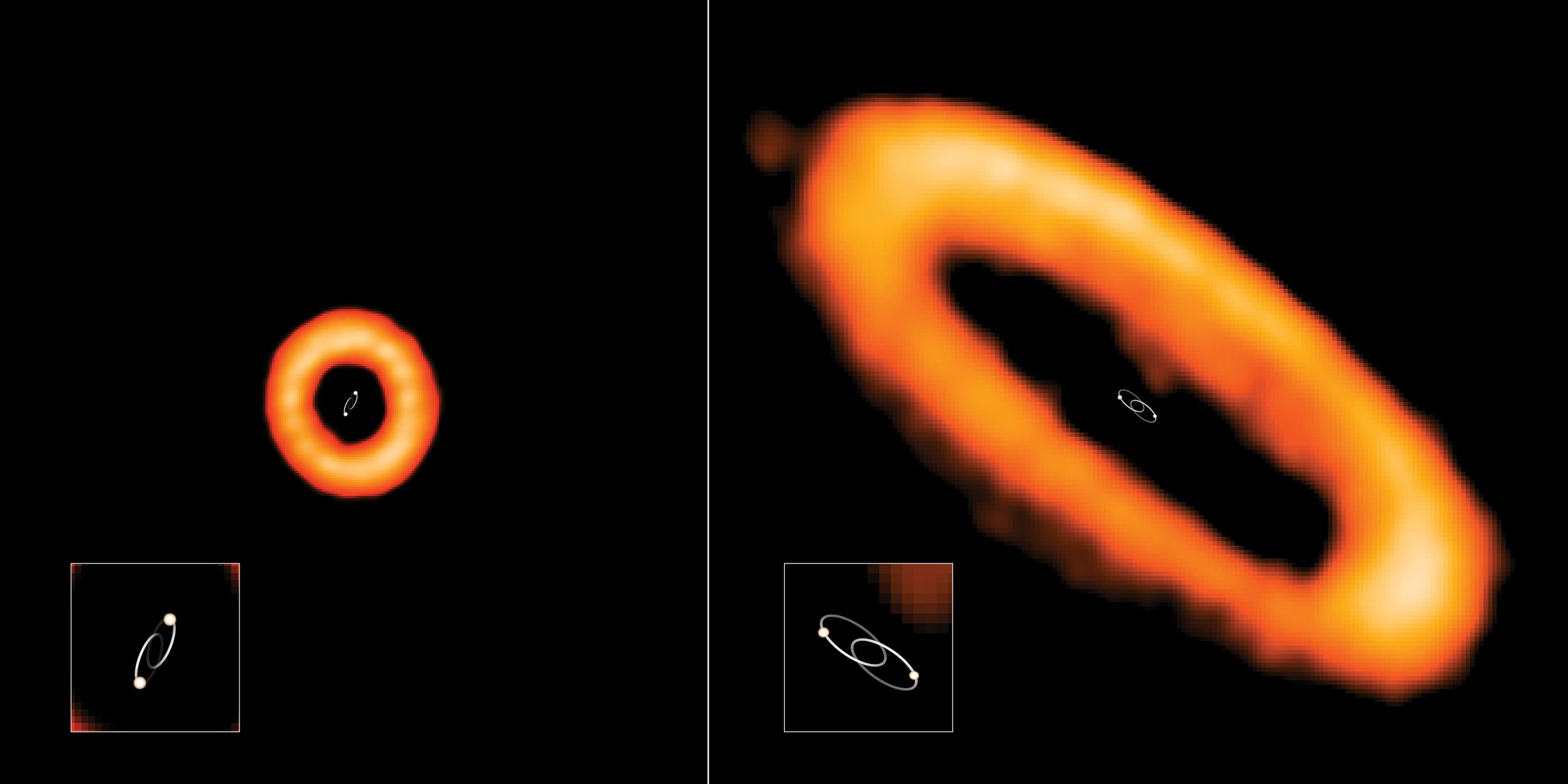
The astronomers compared the ALMA data of the circumbinary disks with the dozen ‘Tatooine’ planets that have been found with the Kepler space telescope. To their surprise, the team found that the degree to which binary stars and their circumbinary disks are misaligned is strongly dependent on the orbital period of the host stars. The shorter the orbital period of the binary star, the more likely it is to host a disk in line with its orbit. However, binaries with periods longer than a month typically host misaligned disks.
“We see a clear overlap between the small disks, orbiting compact binaries, and the circumbinary planets found with the Kepler mission,” Czekala said. Because the primary Kepler mission lasted 4 years, astronomers were only able to discover planets around binary stars that orbit each other in fewer than 40 days. And all of these planets were aligned with their host star orbits. A lingering mystery was whether there might be many misaligned planets that Kepler would have a hard time finding. “With our study, we now know that there likely isn’t a large population of misaligned planets that Kepler missed, since circumbinary disks around tight binary stars are also typically aligned with their stellar hosts,” added Czekala.
Still, based on this finding, the astronomers conclude that misaligned planets around wide binary stars should be out there and that it would be an exciting population to search for with other exoplanet-finding methods like direct imaging and microlensing. (NASA’s Kepler mission used the transit method, which is one of the ways to find a planet.)
Czekala now wants to find out why there is such a strong correlation between disk (mis)alignment and the binary star orbital period. “We want to use existing and coming facilities like ALMA and the next generation Very Large Array to study disk structures at exquisite levels of precision,” he said, “and try to understand how warped or tilted disks affect the planet formation environment and how this might influence the population of planets that form within these disks.”
“This research is a great example of how new discoveries build on previous observations,” said Joe Pesce, National Science Foundation Program Officer for NRAO and ALMA. “Discerning trends in the circumbinary disk population was only made possible by building on the foundation of archival observational programs undertaken by the ALMA community in previous cycles.”
The National Radio Astronomy Observatory is a facility of the National Science Foundation, operated under cooperative agreement by Associated Universities, Inc.
Never miss a breakthrough: Join the SciTechDaily newsletter.
Follow us on Google and Google News.