
Close Menu
    Facebook X (Twitter) Instagram
    SciTechDaily
    • Biology
    • Chemistry
    • Earth
    • Health
    • Physics
    • Science
    • Space
    • Technology
    Facebook X (Twitter) Pinterest YouTube RSS
    SciTechDaily
    Home»Space»Gravitational Wave Events With A Dual Identity
    Space

    Gravitational Wave Events With A Dual Identity

    By Avi Vajpeyi, OzGravJune 22, 2022No Comments3 Mins Read
    Facebook Twitter Pinterest Telegram LinkedIn WhatsApp Email Reddit
    Share
    Facebook Twitter LinkedIn Pinterest Telegram Email Reddit
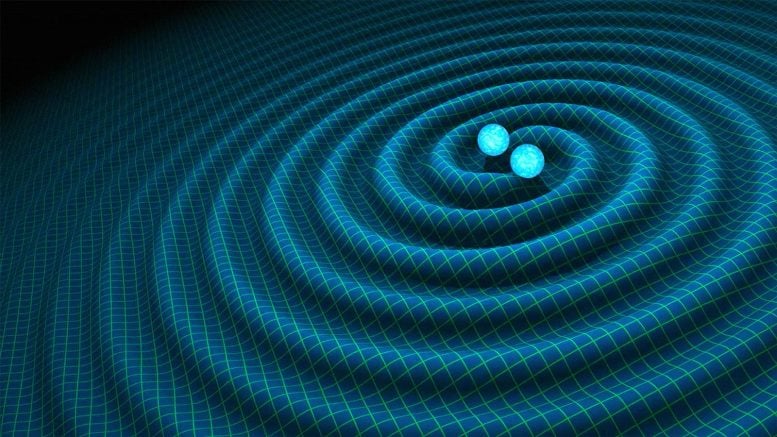
    Gravitational Waves Generated by Binary Neutron Stars
    An artist’s impression of gravitational waves generated by binary neutron stars. Credit: R. Hurt/Caltech-JPL

    Deep Follow-up of GW151226 — an ordinary binary or a low-mass ratio merger?

    Now that we’ve been detecting gravitational waves (GWs), we’d like to better understand the systems that generate GWs. The GWs found so far have been from collisions of celestial bodies, like black holes and neutron stars. Once we have detected a GW, we use “Bayesian Inference” to deduce the masses and spins of the objects that shot off the GW (to understand inference, check this video by 3blue1brown). Then we can use our mass and spin deductions to answer: where do these bodies exist in the Universe? Are these colliding bodies huddled together in galaxies or isolated in space? But, it gets tricky to answer such questions if our deductions of the masses and spins are incorrect! So, in my recent study, I have built a “deep follow-up” tool to determine which masses and spins better describe a given GW event.
     
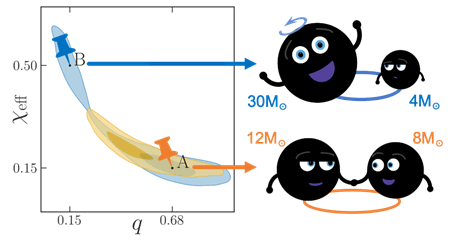
    I have used this deep follow-up tool to study the “boxing-day” gravitational wave, GW151226. Initial work deduced that this GW was from the merger of two black holes (BHs), both with standard masses and spins (case A). However, recent work has deduced that the GW might have originated from a strange system: one BH could be much larger than the other and with a faster spin (case B)! A diagram representing these cases can be seen below on the right side of Figure 1.
    GW151226 Two Personalities
    Figure 1: GW151226’s two personalities. (Left) The initial and new Bayesian inference results are plotted in orange and blue, respectively. We perform a deep follow-up on the pinned points, cases A and B. (Right) Illustrative versions of what cases A and B represent. Note: black hole cartoons inspired by NASA’s Field guide to black holes. Credit: OzGrav

    Exploring GW151226’s Dual-Identity

    The “deep follow-up” method involves drilling into these cases to determine which binary BH system better describes the GW. First, we pin down some deduced properties of the merging black hole system, such as the mass-ratio q (the ratio of smaller BH mass divided by the bigger BH mass) and xeff (the effective spin of the binary in the z-direction). The pinned value for the initial and new results is on the left side of Figure 1. We then use Bayesian inference at these pinned values. The output allows us to compare case A and case B. We find that both the standard (case A) and irregular (case B) black hole pairs can describe GW151226, giving the event something like a dual-identity!

    This dual-identity gives GW151226 much more character than initially considered. For example, we initially believed that GW151226 came from an isolated black hole pair. However, a BH pair from case B is more likely to be found at the center of an active galaxy! So, finally, I wonder: are there other GW events with dual identities? Hopefully, our deep follow-up method will be able to settle these questions.

    Written by OzGrav researcher Avi Vajpeyi, Monash University.

    Never miss a breakthrough: Join the SciTechDaily newsletter.
    Follow us on Google and Google News.

    Astrophysics Gravitational Waves Monash University OzGrav
    Share. Facebook Twitter Pinterest LinkedIn Email Reddit

    Related Articles

    Searching for Cosmic X-Ray Signposts of Elusive Continuous Gravitational Waves

    Bayesian Inference for Gravitational Waves From Binary Neutron Star Mergers in 3G Observatories

    Dancing Stars and Black Holes in a Cosmic Cloud of Gas: Investigating the “Common Envelope Phase”

    Massive, Never-Before-Seen Star System Puzzles Scientists

    Supercomputer Simulations of Core-Collapse Supernovae Reveal Complicated Physics of Exploding Massive Stars

    New Possible Explanation of Strange Black Hole Merger Revealed

    Future Gravitational Wave Detectors to Detect Millions of Black Holes & the Evolution of the Universe

    Radio and Gravitational Wave Signatures of Double Neutron Stars – Accurate Clocks to Test Einstein’s Theory of General Relativity

    Precise Measurement of a Neutron Star Moves Astronomers Closer to Proving Gravitational Waves

    Leave A Reply Cancel Reply

    • Facebook
    • Twitter
    • Pinterest
    • YouTube

    Don't Miss a Discovery

    Subscribe for the Latest in Science & Tech!

    Trending News

    Once-in-a-Century Impact: NASA Just Found a Massive New Crater on the Moon

    Anak Krakatau Just Blasted Ash 50,000 Feet Into the Sky

    NASA’s Chandra Reveals Galaxies Being Torn Apart, Blasted by Black Holes, and Reborn in Stars

    Ozempic’s Active Ingredient Shows Surprising Anti-Aging Effects

    Scientists Discover Canada’s First Dinosaur Tracks From a Rarely Documented Cretaceous Age

    Astronomers Just Caught a Giant Planet in the Act of Forming

    Two Dead Stars Are Racing Around Each Other Every 6.2 Minutes

    Natural Compound May Help Protect the Brain and Heart From Excess Salt

    Follow SciTechDaily
    • Facebook
    • Twitter
    • YouTube
    • Pinterest
    • Newsletter
    • RSS
    SciTech News
    • Biology News
    • Chemistry News
    • Earth News
    • Health News
    • Physics News
    • Science News
    • Space News
    • Technology News
    Recent Posts
    • Losing the Same Weight Didn’t Produce the Same Health Benefits
    • Feeling Lonely Could Take Nearly 6 Years From Your Healthy Lifespan
    • Hidden Artery Plaque Found in 1 in 13 Adults Before Age 30
    • Can Species Evolve Fast Enough To Survive Climate Change?
    • Scientists Solve a Decades-Old Stick Insect Mystery
    Copyright © 1998 - 2026 SciTechDaily. All Rights Reserved.
    • Science News
    • About
    • Contact
    • Editorial Board
    • Privacy Policy
    • Terms of Use

    Type above and press Enter to search. Press Esc to cancel.