
Close Menu
    Facebook X (Twitter) Instagram
    SciTechDaily
    • Biology
    • Chemistry
    • Earth
    • Health
    • Physics
    • Science
    • Space
    • Technology
    Facebook X (Twitter) Pinterest YouTube RSS
    SciTechDaily
    Home»Space»Supercomputer Simulations of Core-Collapse Supernovae Reveal Complicated Physics of Exploding Massive Stars
    Space

    Supercomputer Simulations of Core-Collapse Supernovae Reveal Complicated Physics of Exploding Massive Stars

    By OzGravMay 21, 2020No Comments3 Mins Read
    Facebook Twitter Pinterest Telegram LinkedIn WhatsApp Email Reddit
    Share
    Facebook Twitter LinkedIn Pinterest Telegram Email Reddit
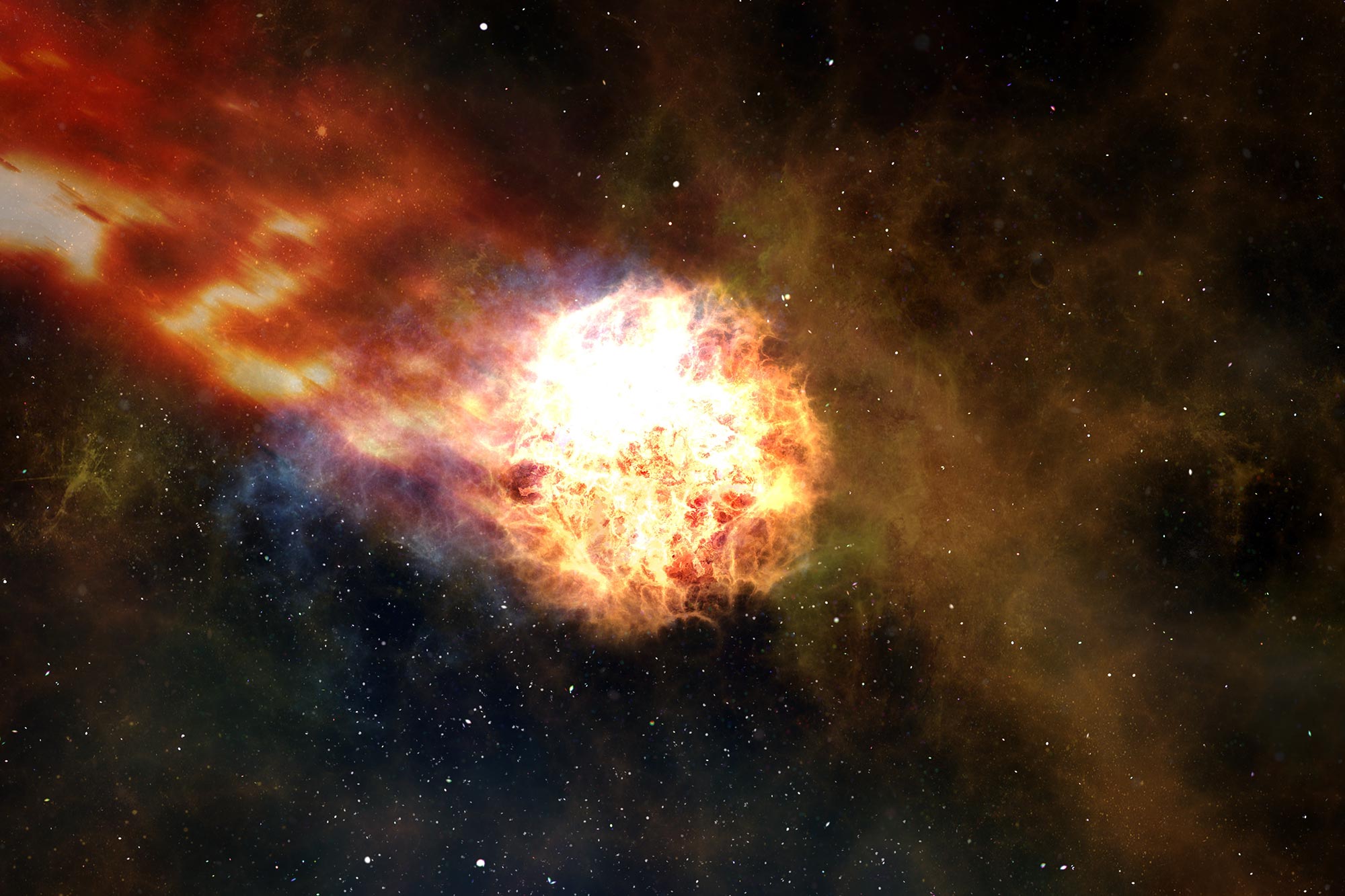
    Supernova Artist Impression
    Artist’s impression of a supernova.

    In a study recently published in the Monthly Notices of the Royal Astronomical Society, researchers Dr. Jade Powell and Dr. Bernhard Mueller from the ARC Centre of Excellence for Gravitational Wave Discovery (OzGrav) simulated three core-collapse supernovae using supercomputers from across Australia, including the OzSTAR supercomputer at Swinburne University of Technology. The simulation models—which are 39 times, 20 times, and 18 times more massive than our Sun— revealed new insights into exploding massive stars and the next generation of gravitational-wave detectors.

    Core-collapse supernovae are the explosive deaths of massive stars at the end of their lifetime. They are some of the most luminous objects in the Universe and are the birthplace of black holes and neutron stars. The gravitational waves—ripples in space and time—detected from these supernovae, help scientists better understand the astrophysics of black holes and neutron stars.

    Future advanced gravitational-wave detectors, engineered to be more sensitive, could possibly detect a supernova—a core-collapse supernova could be the first object to be observed simultaneously in electromagnetic light, neutrinos and gravitational waves.
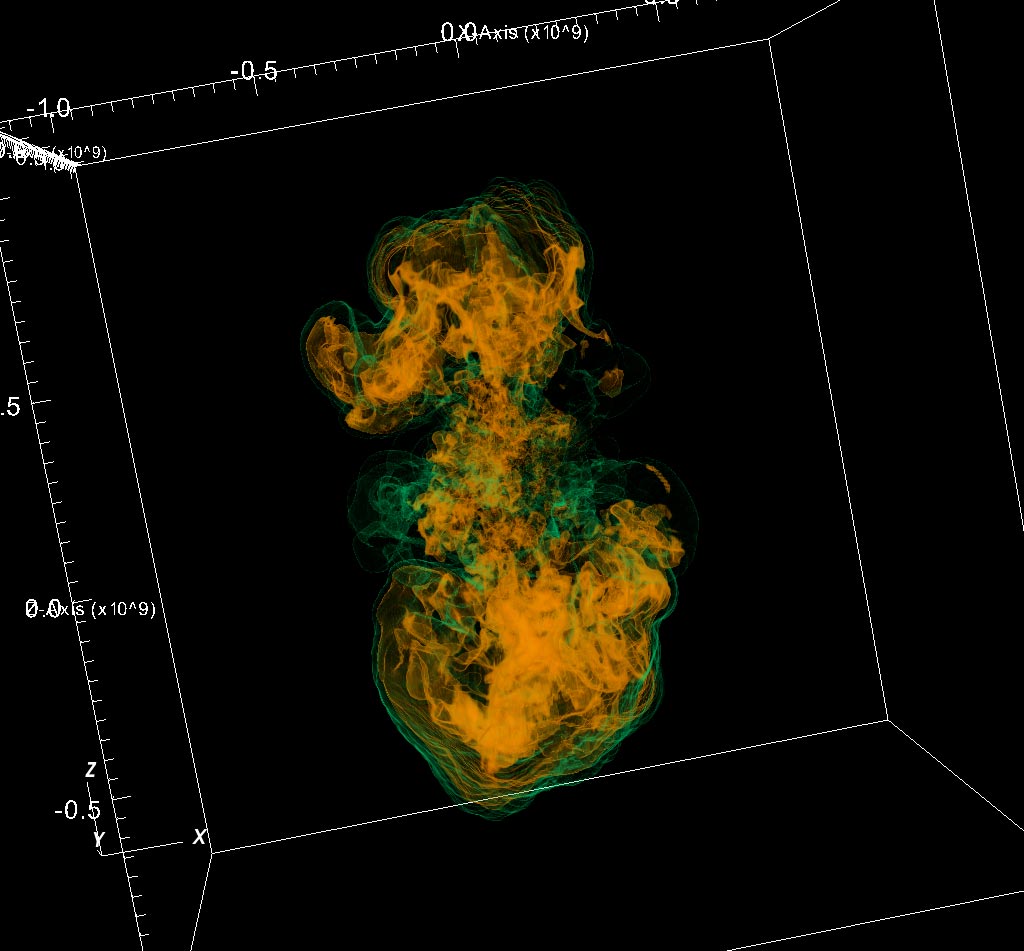
    3D-Volume Render of a Core-Collapse Supernova
    A 3D-volume render of a core-collapse supernova. Credit: Bernhard Mueller, Monash University

    To detect a core-collapse supernova in gravitational waves, scientists need to predict what the gravitational wave signal will look like. Supercomputers are used to simulate these cosmic explosions to understand their complicated physics. This allows scientists to predict what the detectors will see when a star explodes and its observable properties.

    In the study, the simulations of three exploding massive stars follow the operation of the supernova engine over a long duration—this is important for accurate predictions of the neutron star masses and observable explosion energy.

    OzGrav postdoctoral researcher Jade Powell says: “Our models are 39 times, 20 times, and 18 times more massive than our Sun. The 39-solar mass model is important because it’s rotating very rapidly, and most previous long duration core-collapse supernova simulations do not include the effects of rotation.”

    The two most massive models produce energetic explosions powered by the neutrinos, but the smallest model did not explode. Stars that do not explode emit lower amplitude gravitational waves, but the frequency of their gravitational waves lies in the most sensitive range of gravitational wave detectors.

    “For the first time, we showed that rotation changes the relationship between the gravitational-wave frequency and the properties of the newly-forming neutron star,” explains Powell.

    The rapidly rotating model showed large gravitational-wave amplitudes that would make the exploding star detectable almost 6.5 million light years away by the next generation of gravitational-wave detectors, like the Einstein Telescope.

    Reference: “Three-dimensional core-collapse supernova simulations of massive and rotating progenitors” by Jade Powell and Bernhard Müller, 24 April 2020, Monthly Notices of the Royal Astronomical Society.
    DOI: 10.1093/mnras/staa1048

    Never miss a breakthrough: Join the SciTechDaily newsletter.
    Follow us on Google and Google News.

    Astronomy Astrophysics Gravitational Waves OzGrav Popular Supernova
    Share. Facebook Twitter Pinterest LinkedIn Email Reddit

    Related Articles

    Cosmic Ripples in Space and Time: Largest Number of Gravitational Wave Detections to Date

    The Aftermath of Binary Neutron Star Mergers: What Remains Behind?

    Astrophysicists Explain Puzzling Results From Gravitational Wave Observatories

    Pulsar Timing Array Explores Mystery Gravitational Waves From Supermassive Black Holes

    Blistering Stars in the Universe: Rare Insights Into How Violent Supernova Explosions Affect Nearby Stars

    Spinning Neutron Stars Reveal New Insights Into Elusive Continuous Gravitational Waves

    Gravitational-Wave Scientists’ Brilliant New Method To Refine the Hubble Constant – The Expansion and Age of the Universe

    Massive Stellar Triples Leading to Sequential Binary Black-Hole Mergers

    Ripples in the Fabric of Space and Time Offer New Clues to the Shape of Black Holes

    Leave A Reply Cancel Reply

    • Facebook
    • Twitter
    • Pinterest
    • YouTube

    Don't Miss a Discovery

    Subscribe for the Latest in Science & Tech!

    Trending News

    Scientists Discover 132-Million-Year-Old Dinosaur Tracks on South Africa’s Coast

    Scientists Uncover the Secret Ingredient Behind the Spark That May Have Started Life on Earth

    Physicists Observe Matter in Two Places at Once in Mind-Bending Quantum Experiment

    Stanford Scientists Discover Hidden Brain Circuit That Fuels Chronic Pain

    New Study Reveals Why Ozempic Works Better for Some People Than Others

    Climate Change Is Altering a Key Greenhouse Gas in a Way Scientists Didn’t Expect

    New Study Suggests Gravitational Waves May Have Created Dark Matter

    Scientists Discover Why the Brain Gets Stuck in Schizophrenia

    Follow SciTechDaily
    • Facebook
    • Twitter
    • YouTube
    • Pinterest
    • Newsletter
    • RSS
    SciTech News
    • Biology News
    • Chemistry News
    • Earth News
    • Health News
    • Physics News
    • Science News
    • Space News
    • Technology News
    Recent Posts
    • The Ideal Temperature for Storing Mangoes Isn’t What You Think
    • Groundbreaking Enzyme Atlas Rewrites Decades of Biology Research
    • New “Nanozyme Hypothesis” Could Rewrite the Story of Life’s Origins
    • Anatomy Isn’t Finished: The Human Body Still Holds Secrets
    • Researchers Discover Long-Lost Words of Ancient Greek Philosopher After 2,000 Years
    Copyright © 1998 - 2026 SciTechDaily. All Rights Reserved.
    • Science News
    • About
    • Contact
    • Editorial Board
    • Privacy Policy
    • Terms of Use

    Type above and press Enter to search. Press Esc to cancel.