
Close Menu
    Facebook X (Twitter) Instagram
    SciTechDaily
    • Biology
    • Chemistry
    • Earth
    • Health
    • Physics
    • Science
    • Space
    • Technology
    Facebook X (Twitter) Pinterest YouTube RSS
    SciTechDaily
    Home»Technology»New Spatial Plasma-Fueled Engine for More Efficient, Longer Space Missions
    Technology

    New Spatial Plasma-Fueled Engine for More Efficient, Longer Space Missions

    By Charles III University of MadridMay 21, 2020No Comments3 Mins Read
    Facebook Twitter Pinterest Telegram LinkedIn WhatsApp Email Reddit
    Share
    Facebook Twitter LinkedIn Pinterest Telegram Email Reddit
    Plasma Engine U Shaped Ionization Chamber
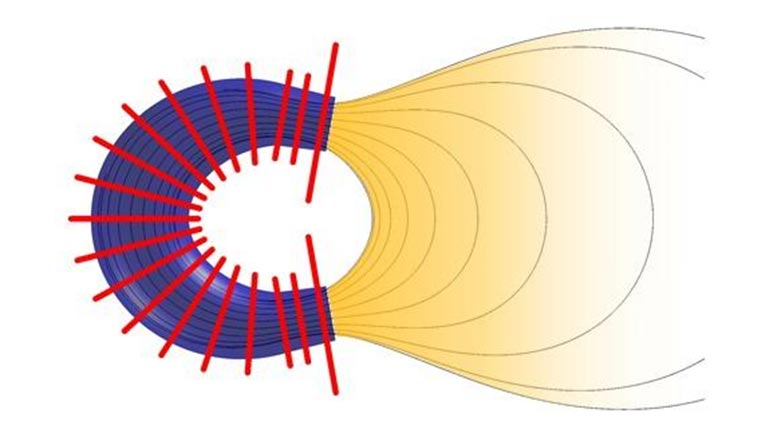
    Researchers have patented a new plasma-fueled engine for satellite and spacecraft propulsion, designed to minimize wall erosion, increase efficiency and durability, and eliminate operating restrictions. Credit: UC3M

    Researchers at Charles III University of Madrid (Universidad Carlos III de Madrid / UC3M) have patented a new spatial plasma-fueled engine capable of satellite and spacecraft propulsion, with magnetic field geometry and configuration that would minimize losses on walls and their erosion, thereby resolving issues of efficiency, durability, and operating restrictions of engines that are currently in orbit.

    The plasma engines of today consume less propellant than chemical combustion rockets, enabling them to carry out lighter space missions, and as such, less costly ones. However, there have complexity and durability problems: in order to operate they need metallic electrodes in contact with the plasma, which over time erode to the point that the device stops working. “This limits its efficiency and flexibility, since modifying the point of operation without affecting the electrodes is very complex,” explained Mario Merino, researcher from the UC3M Department of Bioengineering and Aerospace Engineering.

    Recently a new family of electrodeless plasma engines has been designed to solve part of these problems.  Nevertheless, as an incipient technology, it brings some other issues with it. “These engines have a cylindrical ionization chamber that is open on one side, where the plasma accelerates due to an applied magnetic field. The drawback is that the magnetic field also thrusts part of the plasma against the back wall of the ionization chamber, leading to losses in efficiency,” Merino pointed out.

    The new engine patented by UC3M solves this problem by modifying its design: instead of having a cylindrical chamber, it has a U-shaped ionization chamber and a magnetic field designed in concordance with it, which would minimize the losses of plasma on walls.  “The two sides of the “U” expel streams of plasma in a shape we have baptized as a “dual magnetic nozzle,” Merino continued.

    This engine would resolve the efficiency and durability problems of the space engines that currently exist, and would provide greater flexibility to the mission by deflecting the plasma stream magnetically, without the need to use mobile parts. Additionally, it would meet the needs for propulsion in carrying out space missions in different earth orbits, such as that of the Moon, or Mars, in a less costly, more efficient and durable way.

    Reference: “Motor espacial de plasma sin electrodos con geometría en U” by M. Merino, PCT patent ES2733773 (2019), Spanish Patent Office.
    Patent ES2733773A1

    Never miss a breakthrough: Join the SciTechDaily newsletter.
    Follow us on Google and Google News.

    Engine
    Share. Facebook Twitter Pinterest LinkedIn Email Reddit

    Related Articles

    “Considered Impossible Until Now” – Scientists Develop Micro Heat Engine That Challenges the Carnot Limit

    New Rotating Detonation Engine Could Enable Cheaper, Lighter Spacecraft

    MIT Startup LiquidPiston Develops a More Efficient Rotary Engine

    New Nuclear Engine Will Allow Deep Space Exploration

    Leave A Reply Cancel Reply

    • Facebook
    • Twitter
    • Pinterest
    • YouTube

    Don't Miss a Discovery

    Subscribe for the Latest in Science & Tech!

    Trending News

    Dark Matter May Be Leaving a Signal in Earth’s Atmosphere

    Scientists Discover a 300-Million-Year-Old Geological Time Capsule Inside Fossilized Wood

    Oral Weight Loss Pill Helps Patients Lose up to 12% of Body Weight

    Scientists Find Two New Ways To Break Down “Forever Chemicals” in Water

    Pesticide Exposure May Carry a Serious Neurological Risk Years Later

    Ozempic Could Fight Addiction Too – Scientists Finally Know How

    Two Mysterious ‘Ghost’ Ancestors Are Hiding in Our DNA

    This Widely Used Plastic Could Be Harming Your Liver

    Follow SciTechDaily
    • Facebook
    • Twitter
    • YouTube
    • Pinterest
    • Newsletter
    • RSS
    SciTech News
    • Biology News
    • Chemistry News
    • Earth News
    • Health News
    • Physics News
    • Science News
    • Space News
    • Technology News
    Recent Posts
    • Schizophrenia’s Brain Damage May Start in One Key Region
    • A Simple Treatment Could Save Extremely Premature Babies From Blindness
    • Low-Protein “Longevity Diet” Linked to Fat Loss, Muscle Preservation, and Healthy Aging
    • Discovery of Three Forgotten Kings Rewrites Assyria’s Royal History
    • How Prehistoric Poop Changed Earth’s Ecosystems Forever
    Copyright © 1998 - 2026 SciTechDaily. All Rights Reserved.
    • Science News
    • About
    • Contact
    • Editorial Board
    • Privacy Policy
    • Terms of Use

    Type above and press Enter to search. Press Esc to cancel.