
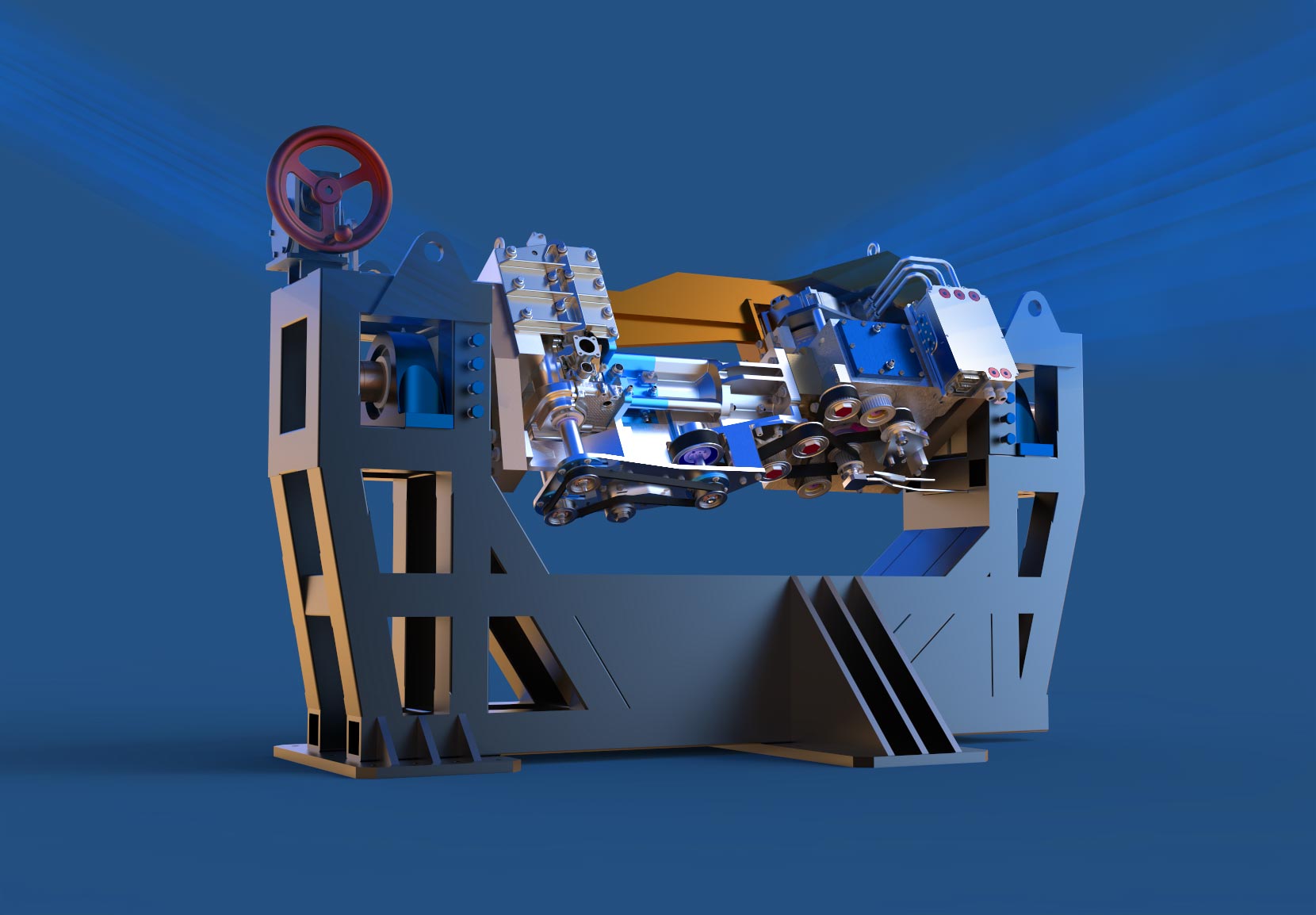
In the quest for advanced vehicles with higher energy efficiency and ultra-low emissions, Oak Ridge National Laboratory researchers are accelerating a research engine that gives scientists and engineers an unprecedented view inside the atomic-level workings of combustion engines in real time.
The new capability is an engine built specifically to run inside a neutron beam line. This neutronic engine provides a unique sample environment that allows investigation of structural changes in new alloys designed for the environment of a high-temperature, advanced combustion engine operating in realistic conditions.
ORNL first unveiled the capability in 2017, when researchers successfully evaluated a small, prototype engine with a cylinder head cast from a new high-temperature aluminum-cerium alloy created at the lab. The experiment was the world’s first in which a running engine was analyzed by neutron diffraction, using the VULCAN neutron diffractometer at the Department of Energy’s Spallation Neutron Source, or SNS, at ORNL.
The results of the research, published in the Proceedings of the National Academy of Sciences, not only proved the hardiness of the unique alloy, but also demonstrated the value of using non-destructive methods such as neutrons to analyze new materials.

Neutrons are deeply penetrating even through dense metals. When neutrons scatter off atoms in a material, they provide researchers with a wealth of structural information down to the atomic scale. In this case, scientists determined how the alloys perform in operating conditions such as high heat and extreme stress or tension to identify even the smallest defects.
The experiment’s success has prompted ORNL to design a purpose-built research engine at industry-relevant scale for use in VULCAN. The capability is based on a two-liter, four-cylinder automotive engine, modified to operate on one cylinder to conserve sample space on the beamline. The engine platform can be rotated around the cylinder axis to give maximum measurement flexibility. The engine is custom designed for neutron research, including the use of fluorocarbon-based coolant and oil, which improves visibility into the combustion chamber.
The capability will provide researchers with the experimental results they need to quickly and accurately vet new materials and improve high-fidelity computational models of engine designs.
“Around the world, industry, national labs and academia are looking at the interface between turbulent combustion that happens in the engine, and the heat transfer process that happens through the solid components,” said Martin Wissink, lead of the project at ORNL. “Understanding and optimizing that process is really key to improving the thermal efficiency of engines.”
“But currently, most of these models have almost no in situ validation data,” he added. “The objective is to fully resolve stress, strain, and temperature in the entire domain over all the metal parts in the combustion chamber.”
The engine has been designed to ORNL specs and is currently undergoing final development with the Southwest Research Institute, and will be commissioned at DOE’s National Transportation Research Center, or NTRC, at ORNL before its first use at SNS, which is expected by late 2021. Both the NTRC and SNS are DOE scientific user facilities, providing access to the most advanced tools of modern science to researchers around the world.
The VULCAN instrument at the SNS is ideal for the research, as it accommodates larger structures, said Ke An, lead scientist for the instrument. VULCAN is designed for deformation, phase transformation, residual stress, texture and microstructure studies. According to An, they are preparing the platform for the neutronic engine with a new exhaust system and other retrofits, including a new control interface for the engine.
“This is what will get people excited, producing results on a larger, state-of-the-art engine,” An said. The neutronic engine “will provide even more options to users seeking to validate their models to resolve issues like stress, strain and temperature. It shows the direct value of neutrons to an important manufacturing sector.”
Measurements from the neutronic engine will be fed into high-performance computing, or HPC, models being developed by scientists to speed breakthroughs for advanced combustion engines.
Researchers are interested in creating accurate predictions of phenomena such as heat losses, flame quenching and evaporation of fuel injected into the cylinder, especially during cold-start engine operations when emissions are often highest. The data from the neutronic engine are expected to provide new understanding of how the temperature of metal engine components changes throughout the engine over the course of the engine cycle.
The resulting high-fidelity models can be quickly run on supercomputers such as Summit, the nation’s fastest and most AI-capable computer. Summit is housed at ORNL as part of the Oak Ridge Leadership Computing Facility, also a DOE scientific user facility.
“We’re bridging these fundamental science capabilities to applications and making measurements in real engineering devices and systems,” Wissink said. “The full measurement of strains and temperatures in engine components is something that has not been possible before. It’s crucial to have these data as either a validation or as a boundary condition for the HPC models that can be shared with researchers in the automotive industry.”
The neutronic engine augments existing capabilities at ORNL and other national labs in the work to create more energy-efficient and ultra-clean engines, said Robert Wagner, director of ORNL’s Buildings and Transportation Science Division.
“The ability to operate an engine in the neutron beamlines enables us to make unprecedented measurements under realistic engine conditions,” Wagner said. This capability adds to the one-of-a-kind resources that the national laboratories bring to advance the efficiency and emissions of combustion engines, such as the optical engine research at Sandia National Laboratories and with the Advanced Photon Source at Argonne National Laboratory.
The power of these unique resources is currently being aligned to solve the most challenging problems through a six-laboratory consortium called Partnership to Advance Combustion Engines, led out of the DOE Vehicle Technologies Office.
“What sets us apart here at ORNL is the portfolio of science available,” Wagner said. “We are making use of the world’s most powerful neutron source, the nation’s fastest supercomputer, and world-class materials science in coordination with our expertise in transportation to take on the grand challenges of a more sustainable energy future.”
Reference: “Operando measurement of lattice strain in internal combustion engine components by neutron diffraction” by Martin L. Wissink, Yan Chen, Matthew J. Frost, Scott J. Curran, Orlando Rios, Zachary C. Sims, David Weiss, Eric T. Stromme and Ke An, 21 December 2020, Proceedings of the National Academy of Sciences.
DOI: 10.1073/pnas.2012960117
The neutronic engine research is primarily supported by DOE’s Office of Energy Efficiency and Renewable Energy (EERE) Vehicle Technologies Office. Access to the SNS is supported by DOE’s Office of Science. The research on the aluminum-cerium alloy was sponsored by DOE’s Critical Materials Institute, which is supported by DOE EERE’s Advanced Manufacturing Office, along with Eck Industries, which helped develop and test the alloy and has licensed the material.
Never miss a breakthrough: Join the SciTechDaily newsletter.
Follow us on Google and Google News.