
Close Menu
    Facebook X (Twitter) Instagram
    SciTechDaily
    • Biology
    • Chemistry
    • Earth
    • Health
    • Physics
    • Science
    • Space
    • Technology
    Facebook X (Twitter) Pinterest YouTube RSS
    SciTechDaily
    Home»Health»Riding the Deadly Tide: Fentanyl and Stimulants Lead the Fourth Wave in U.S. Overdose Crisis
    Health

    Riding the Deadly Tide: Fentanyl and Stimulants Lead the Fourth Wave in U.S. Overdose Crisis

    By Society for the Study of AddictionSeptember 22, 2023No Comments4 Mins Read
    Facebook Twitter Pinterest Telegram LinkedIn WhatsApp Email Reddit
    Share
    Facebook Twitter LinkedIn Pinterest Telegram Email Reddit
    Opioid Addiction USA
    New research in the scientific journal Addiction highlights a concerning trend: US overdose deaths involving both fentanyl and stimulants have risen over 50-fold since 2010. By 2021, stimulants dominated fentanyl-linked overdose cases in all US states. This ‘fourth wave’ in the opioid overdose crisis presents numerous challenges for medical professionals, especially with the limited effectiveness of the common antidote, naloxone.

    A new study reveals a 50-fold rise in US fentanyl-stimulant overdoses since 2010, marking a challenging ‘fourth wave’ in the opioid crisis, with racial disparities and regional variances in drug combinations.

    New research published in the scientific journal Addiction has found that the proportion of US overdose deaths involving both fentanyl and stimulants has increased more than 50-fold since 2010, from 0.6% (235 deaths) in 2010 to 32.3% (34,429 deaths) in 2021.  By 2021, stimulants (such as cocaine and methamphetamine) had become the most common drug class found in fentanyl-involved overdoses in every US state.  This rise in fentanyl/stimulant fatalities constitutes the ‘fourth wave’ in the US’s long-running opioid overdose crisis –the death toll of which, continues to rise precipitously.

    Expert Insights

    “We’re now seeing that the use of fentanyl together with stimulants is rapidly becoming the dominant force in the US overdose crisis,” says lead author Dr. Joseph Friedman, of the University of California, Los Angeles.  “Fentanyl has ushered in a polysubstance overdose crisis, meaning that people are mixing fentanyl with other drugs, like stimulants, but also countless other synthetic substances. This poses many health risks and new challenges for healthcare providers. We have data and medical expertise about treating opioid use disorders, but comparatively little experience with the combination of opioids and stimulants together, or opioids mixed with other drugs. This makes it hard to stabilize people medically who are withdrawing from polysubstance use.”
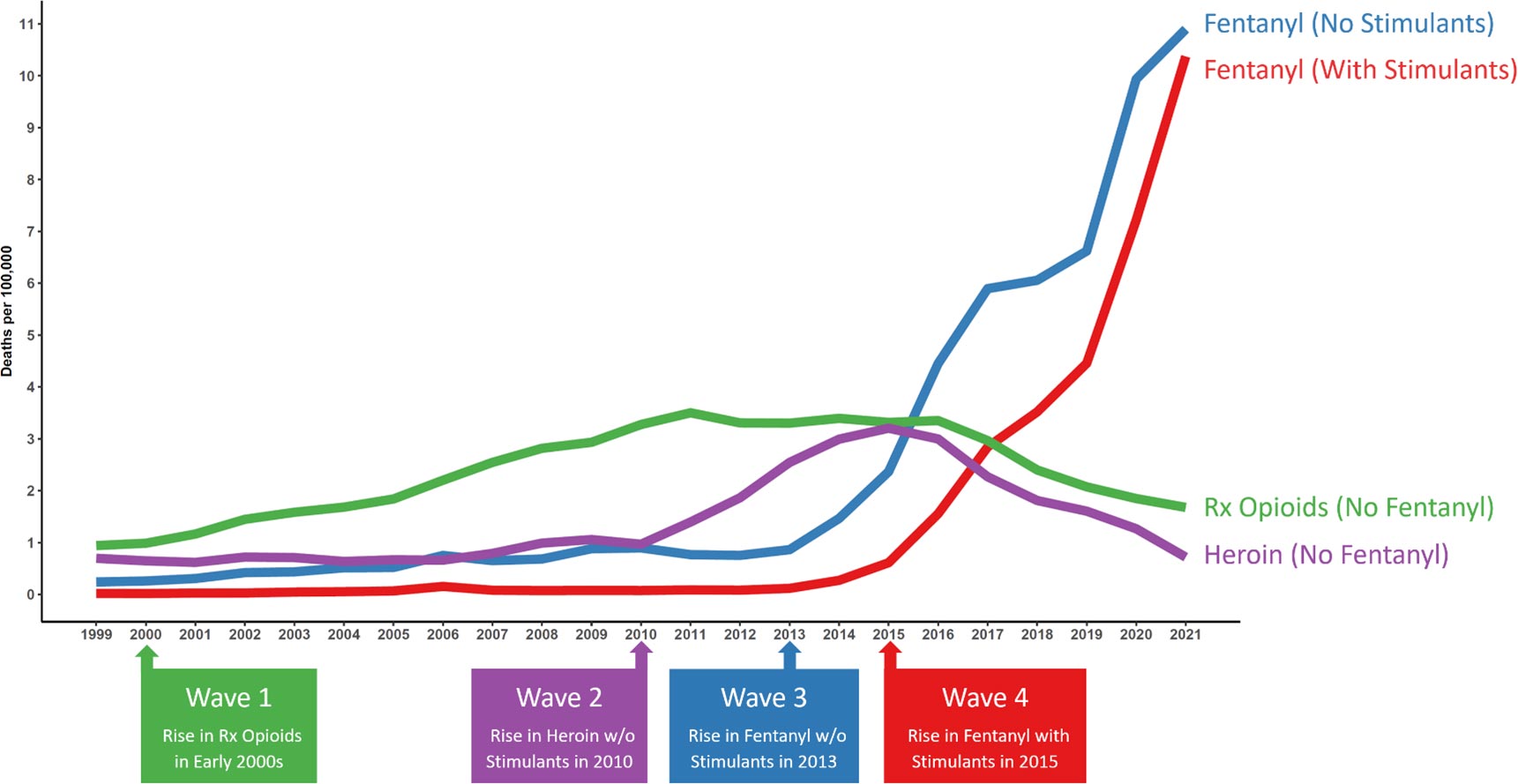
    Four Waves of Overdose Mortality
    A simplified schema of the four waves of the US overdose mortality crisis. Waves 1 and 2 include deaths involving commonly prescribed opioids, and heroin, respectively, but excluding fentanyl co-involved deaths. Wave 3 and Wave 4 show fentanyl deaths not involving, and involving, stimulants respectively as distinct trends. Data from CDC WONDER. Credit: Friedman and Shover, 2023, doi: 10.1111/add.16318

    People consuming multiple substances may also be at increased risk of overdose, and many substances being mixed with fentanyl are not responsive to naloxone, the antidote to an opioid overdose.

    Demographic Disparities

    The authors also found that fentanyl/stimulant overdose deaths disproportionately affect racial/ethnic minority communities in the US, including Black and African American people and Native American people. For instance, in 2021, the prevalence of stimulant involvement in fentanyl overdose deaths was 73% among 65 to 74-year-old Non-Hispanic Black or African-American women living in the western US and 69% among 55 to 65-year-old Black or African-American men living in the same area.  The rate among the general US population in 2021 was 49%.

    Geographical Drug Preferences

    There are also geographical patterns to fentanyl/stimulant use.  In the northeast US, fentanyl tends to be combined with cocaine; in the southern and western US, it appears most commonly with methamphetamine.  Friedman says, “We suspect this pattern reflects the rising availability of, and preference for, low-cost, high-purity methamphetamine throughout the US, and the fact that the Northeast has a well-entrenched pattern of illicit cocaine use that has so far resisted the complete takeover by methamphetamine seen elsewhere in the country.”

    The analysis illustrates how the US opioid crisis began with an increase in deaths from prescription opioids (wave 1) in the early 2000s and heroin (wave 2) in 2010.  Around 2013, an increase in fentanyl overdoses signaled the third wave.  The fourth wave – fentanyl overdoses with stimulants – began in 2015 and continues to grow.

    Reference: “Charting the fourth wave: Geographic, temporal, race/ethnicity and demographic trends in polysubstance fentanyl overdose deaths in the United States, 2010–2021” by Joseph Friedman and Chelsea L. Shover, 13 September 2023, Addiction.
    DOI: 10.1111/add.16318

    The research was supported in part by the National Institute on Drug Abuse of the National Institutes of Health under award number K01DA050771. The content is solely the responsibility of the authors and does not necessarily represent the official views of the National Institutes of Health.

    Never miss a breakthrough: Join the SciTechDaily newsletter.
    Follow us on Google and Google News.

    Addiction Fentanyl Mortality
    Share. Facebook Twitter Pinterest LinkedIn Email Reddit

    Related Articles

    4th Wave in U.S. Overdose Crisis: 50x Surge in Deaths From Fentanyl Laced Stimulants

    A Safer Opioid? Scientists Use Sodium To Reduce Harmful Effects of Fentanyl

    Compound Created That Can Reverse Effects of Potentially Deadly Drugs Like Meth and Fentanyl

    Fentanyl Vaccine Breakthrough – Potential “Game Changer” for Opioid Epidemic

    Fentanyl Has Been Shown To Cause Autism-Like Behavior in a Harvard-Funded Study

    Dangerous Trend: Growing Number of Pills Containing Fentanyl Seized by Law Enforcement

    Call for Expanded Fentanyl Testing by Hospitals After Drug Tops Fatal Overdose List

    A Lethal Dose for $1 – Fentanyl’s Risk on the ‘Darknet’

    Young, White, Daily Opioid Users More Likely to Prefer Fentanyl

    Leave A Reply Cancel Reply

    • Facebook
    • Twitter
    • Pinterest
    • YouTube

    Don't Miss a Discovery

    Subscribe for the Latest in Science & Tech!

    Trending News

    The Universe Is Expanding Too Fast and Scientists Can’t Explain Why

    “Like Liquid Metal”: Scientists Create Strange Shape-Shifting Material

    Early Warning Signals of Esophageal Cancer May Be Hiding in Plain Sight

    Common Blood Pressure Drug Shows Surprising Power Against Deadly Antibiotic-Resistant Superbug

    Scientists Uncover Dangerous Connection Between Serotonin and Heart Valve Disease

    Scientists Discover a “Protector” Protein That Could Help Reverse Hair Loss

    Bone-Strengthening Discovery Could Reverse Osteoporosis

    Scientists Uncover Hidden Trigger Behind Stem Cell Aging

    Follow SciTechDaily
    • Facebook
    • Twitter
    • YouTube
    • Pinterest
    • Newsletter
    • RSS
    SciTech News
    • Biology News
    • Chemistry News
    • Earth News
    • Health News
    • Physics News
    • Science News
    • Space News
    • Technology News
    Recent Posts
    • A Common Diabetes Drug May Hold the Key to Stopping HIV From Coming Back
    • Ancient “Syphilis-Like” Disease in Vietnam Challenges Key Scientific Assumptions
    • Drinking Alcohol To Cope in Your 20s Could Damage Your Brain for Life
    • Scientists Crack Alfalfa’s Chromosome Mystery After Decades of Debate
    • Ancient Ant-Plant Alliance Collapses As Predatory Wasps Move In
    Copyright © 1998 - 2026 SciTechDaily. All Rights Reserved.
    • Science News
    • About
    • Contact
    • Editorial Board
    • Privacy Policy
    • Terms of Use

    Type above and press Enter to search. Press Esc to cancel.