
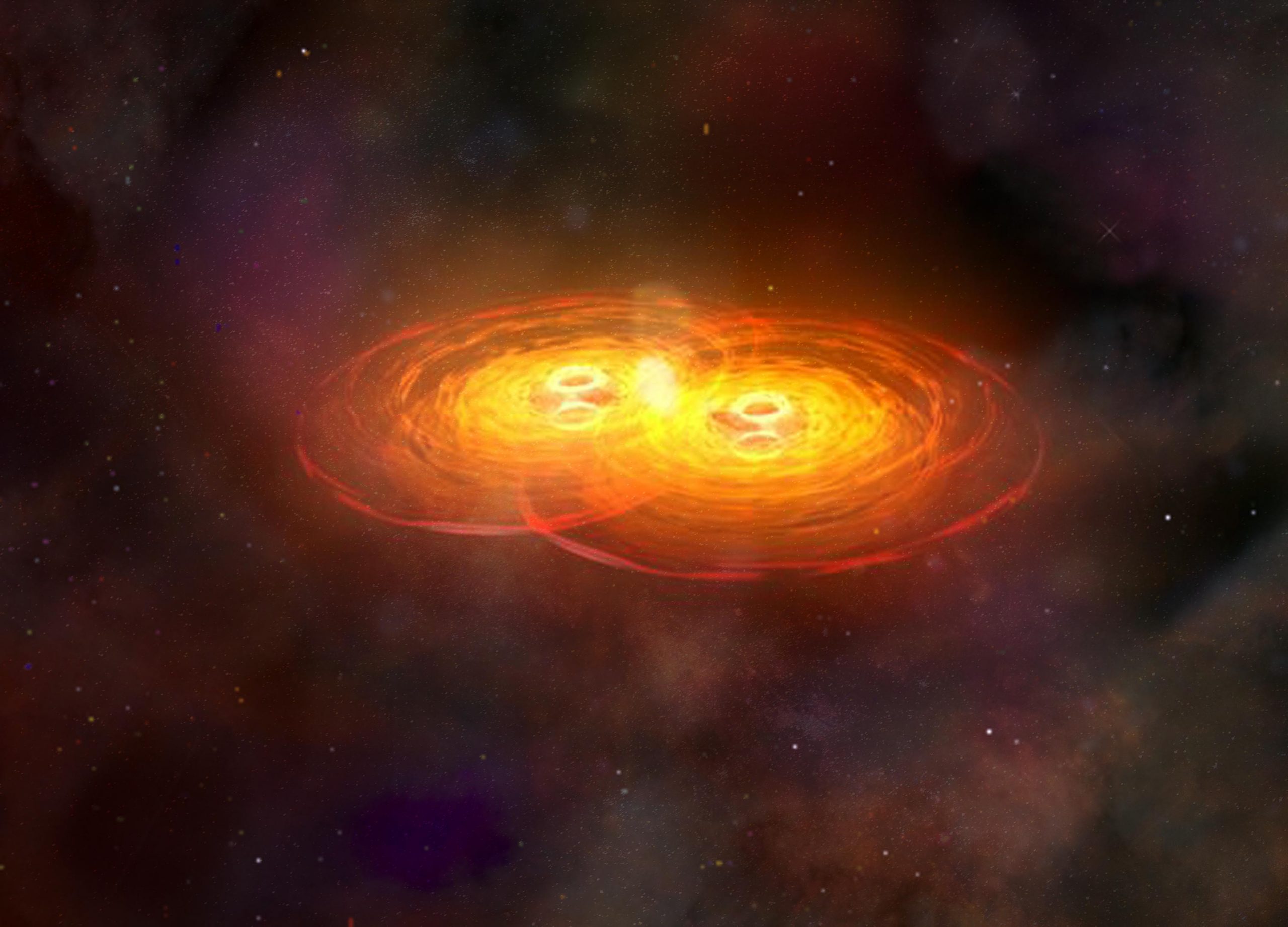
Scientists from the ARC Centre of Excellence for Gravitational Wave Discovery (OzGrav) reveal an alternative explanation of the recently announce black hole merger. The paper was just accepted by Astrophysical Journal Letters.
On the 12th of April 2019, the LIGO and Virgo observatories detected gravitational waves—ripples in space and time—from an unusual cosmic event of two black holes merging. Unlike the ten previously reported black hole mergers, in which the two black holes may have had equal or nearly-equal masses, this event, called GW190412, definitely had two very unequal black holes, with the heavier one possibly three or four times more massive than the lighter one.
In addition, the discovery paper (released in Australia on April 19, 2020) reported that at least one of the merging black holes had to be spinning: rotating around its axis. However, gravitational waves do not allow accurate measurement of individual spins. Only a specific spin combination can be measured. Therefore, to infer individual spins, assumptions must be made based on scientific models. The LIGO and Virgo collaborations assumed that the heavier, first-born black hole could be spinning, and reported that it had a moderate spin in the gravitational-wave discovery paper.
Within 24 hours of the discovery’s announcement, OzGrav Chief Investigator Ilya Mandel, from Monash University, and collaborator Tassos Fragos, from the University of Geneva, wrote a follow-up paper which has just been accepted by Astrophysical Journal Letters. Motivated by the best current models of the evolution of massive stars in binaries, Mandel and Fragos argued that the more massive, or ‘heavier’, black hole in the event is very slowly spinning; whereas the ‘lighter’ black hole is spinning very fast, in the same direction as the orbital motion.
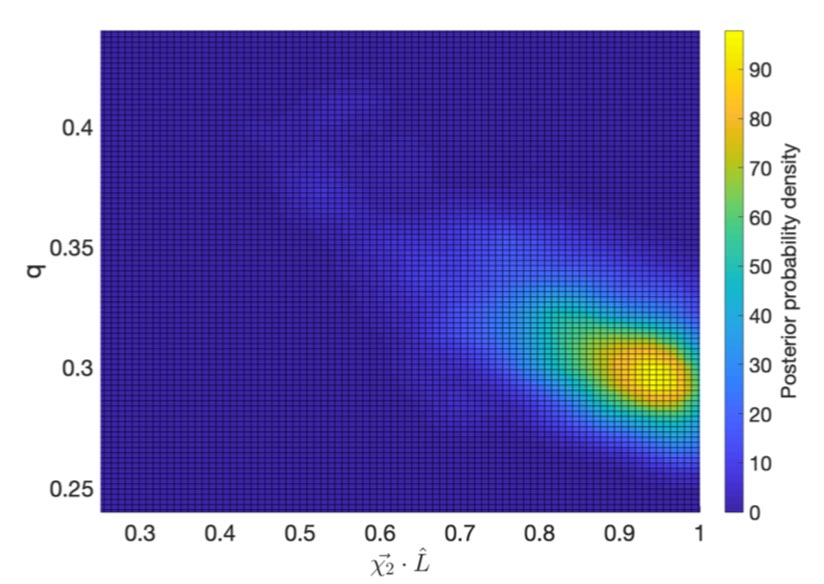
Mandel and Fragos state that if isolated pairs of stars orbiting around each other give birth to merging black holes, they naturally make first-born, heavier black holes that spin very slowly. Before a star forms a black hole, it evolves into a giant with a gaseous envelope. When it does so, it slows down, like a spinning figure skater extending her arms. When this envelope is stripped off by extreme tidal forces exerted by the other star in the binary, a slowly rotating central core is left behind, which ultimately collapses into a slowly spinning black hole.
The same process should typically apply to the second-born, lighter star, which eventually collapses into the lighter black hole. However, when the second star loses its gaseous envelope, the binary separation can be sufficiently small enough to allow the naked star core to spin up through ‘tidal locking’.
Mandel explains: ‘Tidal locking occurs when tides from an orbiting companion forces an object’s period of rotation—the time it takes it to spin around its axis—to equal the time it takes for a full orbit of the binary system. For example, tidal locking of the Moon to the Earth sets the Moon to rotate the same 28 days equal to its orbital period around the Earth. This explains why we never get to see the dark side of the Moon—except when listening to Pink Floyd.’
So, sometimes the second black hole can spin up and rapidly rotate. Mandel and Fragos find this to be the case in the GW190412 event. Such systems should also merge soon after their formation, since tidal locking will only happen in very tight binaries.
Although it’s difficult to confirm this interpretation, future detections of black hole mergers will allow for more accurate testing of this model.
References: “An alternative interpretation of GW190412 as a binary black hole merger with a rapidly spinning secondary” by Ilya Mandel and Tassos Fragos, 27 May 2020, The Astrophysical Journal Letters.
DOI: 10.3847/2041-8213/ab8e41
arXiv: 2004.09288
Never miss a breakthrough: Join the SciTechDaily newsletter.
Follow us on Google and Google News.
1 Comment
It says: “Mandel and Fragos argued that the more massive, or ‘heavier’, black hole in the event is very slowly spinning; whereas the ‘lighter’ black hole (BHs) is spinning very fast, in the same direction as the orbital motion.”
Q-FFF Theory assumption says: : New physics says: String Black Holes have no spin ( because it has a massless nucleus by a compact string knot without Fermions)
If there are two BHs, then only the Fermion plasma disc is spinning as it did around the collapsing ( BH) star.
The larger black hole is much older or even already merged with other BHs. So it has a less spinning disc.
see: “Rigid String Cosmology with a Massless Axion-Higgs Oscillating Photon Vacuum Lattice and massive Quantum Knots.”
https://vixra.org/pdf/1611.0031v3.pdf