
Hunt for Continuous Gravitational Waves
In the last few years, astronomers have achieved an incredible milestone: the detection of gravitational waves, vanishingly weak ripples in the fabric of space and time emanating from some of the most cataclysmic events in the Universe, including collisions between black holes and neutron stars. So far there have been over 90 gravitational-wave detections of such events, observable for only ~0.1 to 100 seconds. However, there may be other sources of gravitational waves, and astronomers are still on the hunt for continuous gravitational waves.
Continuous gravitational waves should be easier to detect since they are much longer in duration compared to signals from compact-object collisions. A possible source of continuous waves is neutron stars, which are stellar “corpses” left over from supernova explosions of massive stars. After the initial explosion, the star collapses in on itself, crushing atoms down into a super-dense ball of subatomic particles called “neutrons” — hence the name “neutron star.” The continuous wave signal is related to how fast the neutron star is spinning, so precise measurements of the spin frequency using more conventional telescopes would greatly improve the chance of detection of these elusive waves.
In a recent study, led by OzGrav PhD student Shanika Galaudage from Monash University, scientists aimed to determine neutron stars’ spin frequencies to help detect continuous gravitational waves.
Possible Sources of Continuous Gravitational Waves
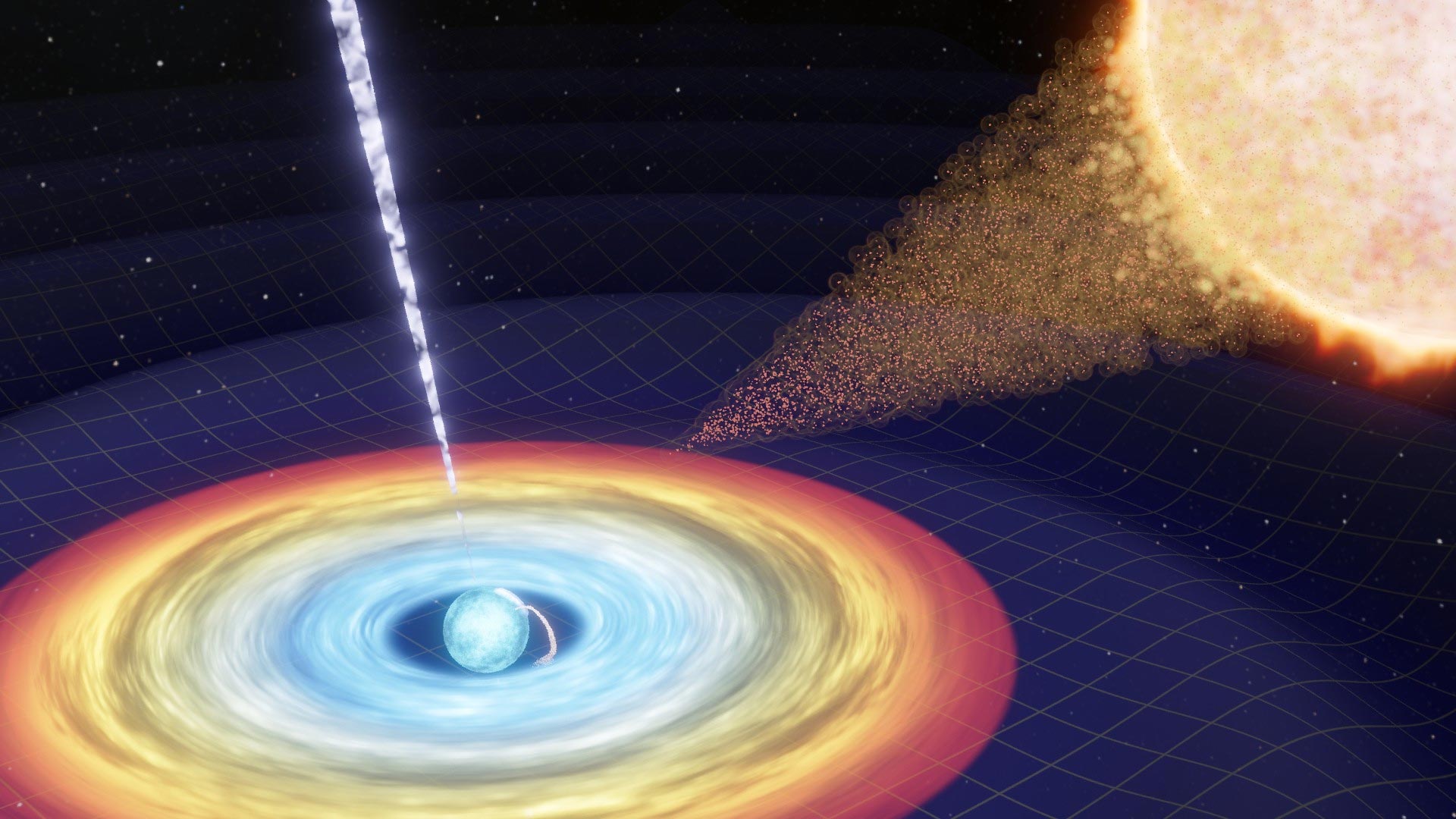
In this study, scientists hypothesized that continuous gravitational waves indirectly come from the gradual accumulation of matter onto a neutron star from a low-mass companion star–these binary systems of a neutron star and companion star are called low-mass X-ray binaries (LMXBs).
If the neutron star can maintain an accumulated “mountain” of matter, (even if only a few centimeters in height!), it will produce continuous waves. The frequency of these waves relates to how fast the neutron star is spinning. The faster you accumulate this matter, the bigger the “mountain,” producing larger continuous waves. Systems that accumulate this matter more quickly are also brighter in X-ray light. Therefore the brightest LMXBs are the most promising targets for detecting continuous waves.
Scorpius X-1 (Sco X-1) and Cygnus X-1 (Cyg X-2) are two of the brightest LMXB systems–Sco X-1 ranks second in X-ray brightness compared to the Sun. In addition to their extreme brightness, scientists know a lot about these two LMXB systems, making them ideal sources of continuous waves to study. But, their spin frequencies are still unknown.
“A way we can determine how fast these neutron stars are spinning is by searching for X-ray pulsations,” says study lead Shanika Galaudage. “X-ray pulsations from neutron stars are like cosmic lighthouses. If we can time the pulse we would immediately be able to reveal their spin frequency and get closer to detecting the continuous gravitational-wave signal.”
“Sco X-1 is one of the best prospects we have for making a first detection of continuous gravitational waves, but it’s a very hard data analysis problem,” says OzGrav researcher and study co-author Karl Wette, from The Australian National University. “Finding a spin frequency in the X-ray data would be like shining a spotlight on the gravitational wave data: ‘Here, this is where we should be looking’. Sco X-1 would then be a red-hot favorite to detect continuous gravitational waves.”
Searching for X-Ray Pulsations
The team performed a search for X-ray pulsations from Sco X-1 and Cyg X-2. They processed over 1000 hours of X-ray data collected by the Rossi X-ray Timing Explorer instrument. The search used a total of ~500 hours of computational time on the OzSTAR supercomputer!
Unfortunately, the study did not find any clear evidence of pulsations from these LMXB sources. There are a number of reasons why this could be: the LMXB could have weak magnetic fields which are not powerful enough to support detectable pulsations. Or it could be that the pulsations come and go over time, which would make them hard to detect. In the case of Sco X-1, it could possibly be a black hole, which we would not expect to produce X-ray pulsations.
The study does find the best limits on how bright these X-ray pulsations could be if they did occur; these results could mean that neutron stars cannot sustain mountains of matter under their strong gravity. Future research can build on this study by employing better search techniques and more sensitive data.
Written by OzGrav researcher Shanika Galaudage (Monash University)
Never miss a breakthrough: Join the SciTechDaily newsletter.
Follow us on Google and Google News.