
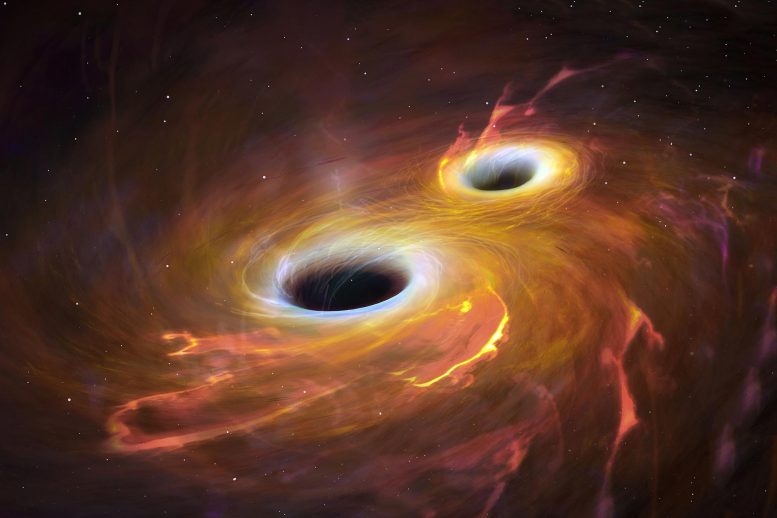
Record-Breaking Discovery of Gravitational Waves
A team of international scientists, including researchers from The Australian National University (ANU), have unveiled the largest number of gravitational waves ever detected.
The discoveries will help solve some of the most complex mysteries of the Universe, including the building blocks of matter and the workings of space and time.
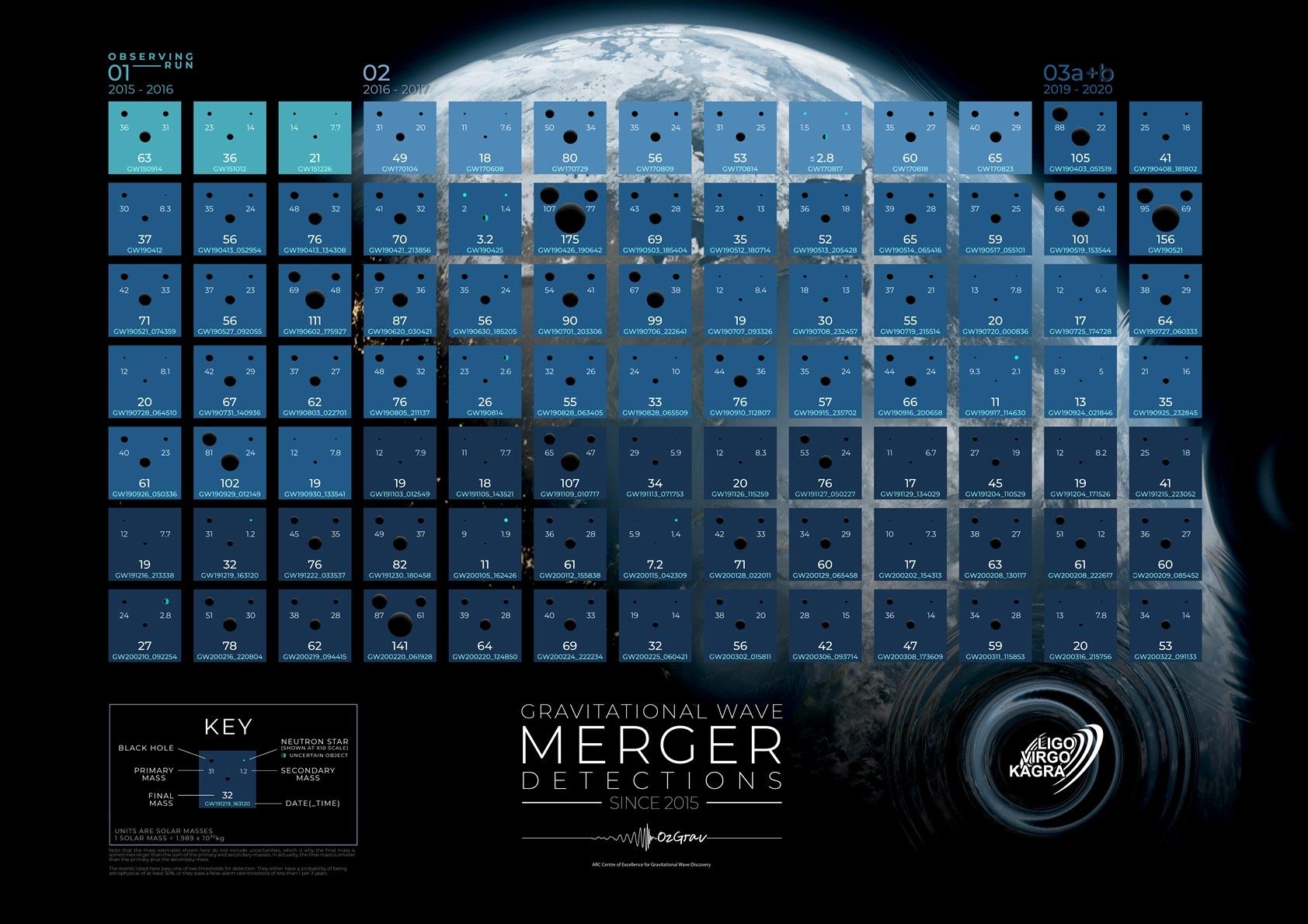
The global team’s study, published on November 8, 2021, on ArXiv, made 35 new detections of gravitational waves caused by pairs of black holes merging or neutron stars and black holes smashing together, using the LIGO and Virgo observatories between November 2019 and March 2020.
This brings the total number of detections to 90 after three observing runs between 2015 and 2020.
The new detections are from massive cosmic events, most of them billions of light years away, which hurl ripples through space-time. They include 32 black hole pairs merging, and likely three collisions between neutron stars and black holes.
ANU is one of the key players in the international team making the observations and developing the sophisticated technology to hunt down elusive gravitational waves across the vast expanse of the Universe.
Distinguished Professor Susan Scott, from the ANU Centre for Gravitational Astrophysics, said the latest discoveries represented “a tsunami” and were a “major leap forward in our quest to unlock the secrets of the Universe’s evolution.”
“These discoveries represent a tenfold increase in the number of gravitational waves detected by LIGO and Virgo since they started observing,” Distinguished Professor Scott said.
Rapid Acceleration in Cosmic Discoveries
“We’ve detected 35 events. That’s massive! In contrast, we made three detections in our first observing run, which lasted four months in 2015-16.
“This really is a new era for gravitational wave detections and the growing population of discoveries is revealing so much information about the life and death of stars throughout the Universe.
“Looking at the masses and spins of the black holes in these binary systems indicates how these systems got together in the first place.
“It also raises some really fascinating questions. For example, did the system originally form with two stars that went through their life cycles together and eventually became black holes? Or were the two black holes thrust together in a very dense dynamical environment such as at the center of a galaxy?”
Distinguished Professor Scott, who is also a Chief Investigator of the ARC Centre of Excellence for Gravitational Wave Discovery (OzGrav), said the continual improvement of gravitational wave detector sensitivity was helping drive an increase in detections.
“This new technology is allowing us to observe more gravitational waves than ever before,” she said.
“We are also probing the two black hole mass gap regions and providing more tests of Einstein’s theory of general relativity.
“The other really exciting thing about the constant improvement of the sensitivity of the gravitational wave detectors is that this will then bring into play a whole new range of sources of gravitational waves, some of which will be unexpected.”
Never miss a breakthrough: Join the SciTechDaily newsletter.
Follow us on Google and Google News.
11 Comments
What they detected was a spilled basket of Newtonian apples.
How do you determine the mass of a massive tsunami of detections, and how is a detections tsunami caused – by a measurement earthquake? Everything about that phrase is wrong. Nice scienceing there, sciencers.
The turn of a phrase has nothing to do with the science.
Yes, there was a lot of nice “scienceing” in the 3 papers – you should read them.
You are absolutely right, the absurdity of the nonsensical headline has nothing to do with the content of the article. However, it is my opinion that one must have standards and not just say crazy things that don’t make sense, especially in the presentation of scientific fact. Just my opinion, that’s all. I know other people feel differently.
As long as you don’t blame scientists for media headlines.
They now have som many observations that they start to see cosmological trends!
The black hole merger ratios track the star formation rate as they go towards higher redshift, further back in time when stars formed at a higher rate.
The tests of general relativity becomes many, extended and improved, and they can set a lowered mass limit on the graviton that is better than we can observe locally by solar system dynamics.
The Hubble rate estimates are extended from the multimessenger “light” binary neutron star merger with addition of “dark” black hole mergers where they can assign distance estimates from nearby galaxy distances in the localization patch. (The strip where they can put the merger event with the use of 3 observatories.) In addition to the pivotal “light” event a “dark” event happened to occur against a fairly small and less populated patch, which gave another pivot point, and the Hubble rate estimate peak moved towards the Planck Hubble rate estimate.
When the next data collection starts in 2022 with the upgraded observatories and now joined by KAGRA, the 4th observatory, it will be a veritable tsunami season!
I will add, the Gravity fluctuating means time travel is possible in near future as the waves come in from the rain.
If an event of this type were near enough to us, couldn’t we ‘surf’ the wave in the appropriate/applicable/presenting trough and thereby alter the relationships of planets, moons, suns, etc to each other for an observable period of time? Would this be a radiative periodicity event? A soliton-type?
Gravity is non-linear and it is known that gravitational waves, which are linear phenomena, can in theory affect space and its object – gravitational interactions may have “a memory” [ https://en.wikipedia.org/wiki/Gravitational_memory_effect ].
But we are talking femtometer displacements for these merger events, at least when we observe them millions or more light years away.