
Close Menu
    Facebook X (Twitter) Instagram
    SciTechDaily
    • Biology
    • Chemistry
    • Earth
    • Health
    • Physics
    • Science
    • Space
    • Technology
    Facebook X (Twitter) Pinterest YouTube RSS
    SciTechDaily
    Home»Science»Acoustic Sensors Pinpoint Shooter’s Location in Urban Setting
    Science

    Acoustic Sensors Pinpoint Shooter’s Location in Urban Setting

    By Acoustical Society of AmericaMay 23, 2022No Comments3 Mins Read
    Facebook Twitter Pinterest Telegram LinkedIn WhatsApp Email Reddit
    Share
    Facebook Twitter LinkedIn Pinterest Telegram Email Reddit
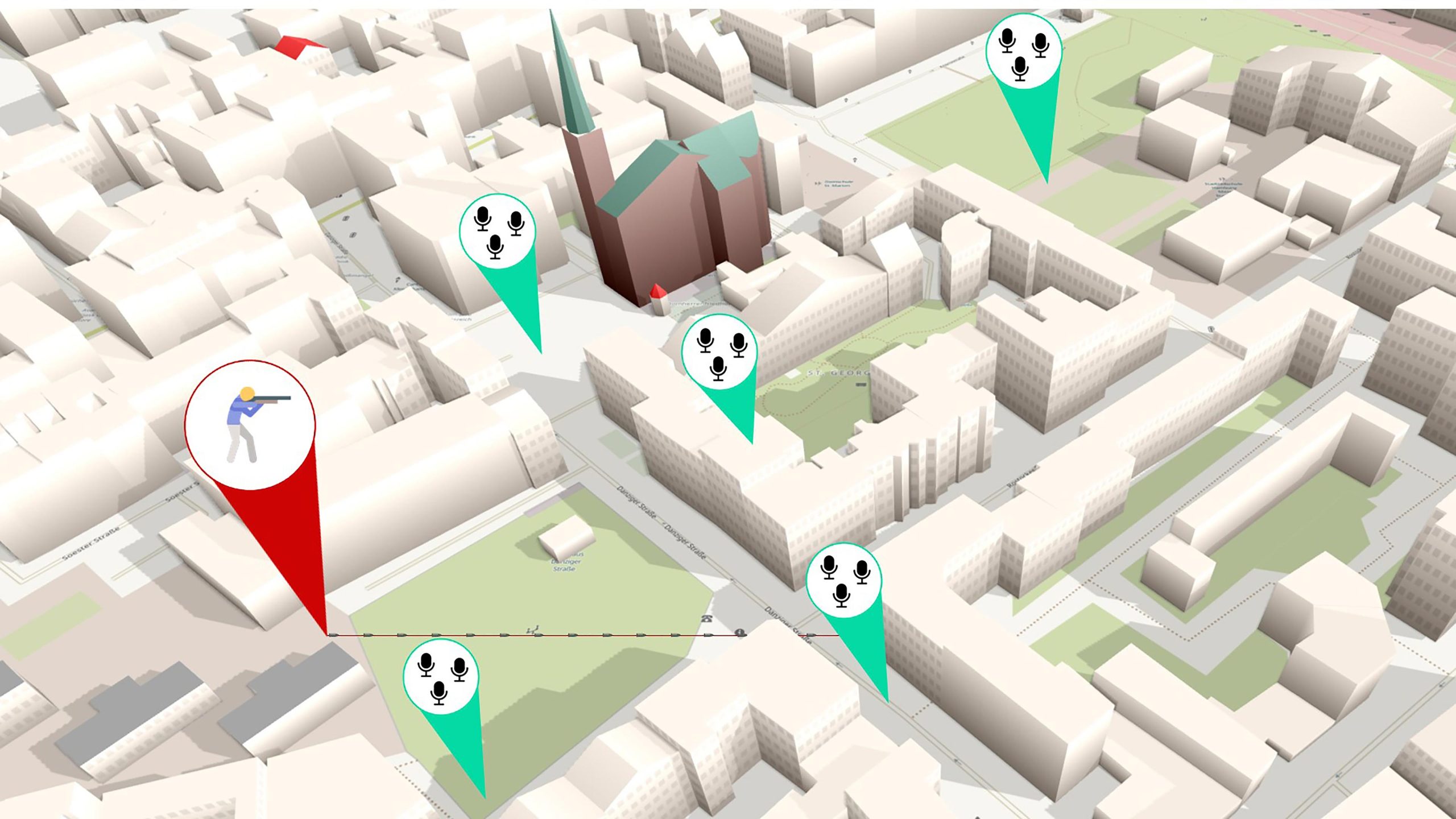
    Determining Shooter Localization
    Luisa Still, of Sensor Data and Information Fusion, will discuss the important factors in determining shooter localization accuracy at the 182nd ASA Meeting. Credit: Luisa Still

    Modeling and optimizing sensor networks for a specific environment to help missions home in on shooter locations.

    During a gunshot, two sound events occur — the muzzle blast and the supersonic shock wave. Acoustic sensors, such as single or arrays of microphones, can capture these sounds and use them to approximate the shooter’s location.

    Luisa Still, of Sensor Data and Information Fusion, will discuss the important factors in determining shooter localization accuracy as part of the 182nd Meeting of the Acoustical Society of America at the Sheraton Denver Downtown Hotel. Her presentation, “Prediction of shooter localization accuracy in an urban environment,” will take place on May 23, 2022, at 12:45 p.m. EDT.

    In an urban setting, buildings or other obstacles can reflect, refract, and absorb sound waves. The combination of these effects can severely impact the accuracy of shooter localization. Preemptively predicting this accuracy is crucial for mission planning in urban environments, because it can inform the necessary number of sensors and their requirements and positions.

    Modeling Acoustic Measurements for Improved Accuracy

    Still and her team used geometric considerations to model acoustic sensor measurements. This modeling, combined with information on sensor characteristics, the sensor-to-shooter geometry, and the urban environment, allowed them to calculate a prediction of localization accuracy.

    “In our approach, the prediction can be interpreted as an ellipse-shaped area around the true shooter location,” said Still. “The smaller the ellipse-shaped area, the higher the expected localization accuracy.”

    The group compared their accuracy prediction to experimental performance under various geometries, weapons, and sensor types. The localization accuracy depended significantly on the sensor-to-shooter geometry and the shooting direction with respect to the sensor network. The smaller the distance between the shooting line and a sensor, the more accurate they could be with their prediction of the source. Adding more sensors increased the accuracy but had diminishing returns after a certain point.

    Tailoring Sensor Setup Recommendations for Urban Settings

    “Each urban environment is too individual (e.g., in terms of layout, building types, vegetation) to make a general recommendation for a sensor set up,” said Still. “This is where our research comes in. We can use our approach to recommend the best possible setup with the highest accuracy for a given location or area.”

    Never miss a breakthrough: Join the SciTechDaily newsletter.
    Follow us on Google and Google News.

    Acoustical Society of America Acoustics
    Share. Facebook Twitter Pinterest LinkedIn Email Reddit

    Related Articles

    Who – or What – Was Speaking in the Ocean? The Strange Repeating Sounds of the South Fiji Basin

    Listening Like a Spider: The Future of Sound Technology

    Fire Hydrant Hydrophones Find Hidden Leaks in Water Distribution Networks

    Eavesdropping on the Universe: The Secrets of Extraterrestrial Sounds

    Sing On: Certain Face Masks Prevent COVID-19 Transmission Without Distorting Voice

    Understanding the Concept of Quietness: Measuring Quiet Sound Diversity

    Which COVID Face Masks Are Best for Speech Intelligibility and Student Comprehension?

    Eye Position Affects Your Auditory Spatial Attention – Where to Look to Improve “Cocktail Party” Listening

    Burps in “Rick and Morty” Analyzed for Latent Linguistic Meaning

    Leave A Reply Cancel Reply

    • Facebook
    • Twitter
    • Pinterest
    • YouTube

    Don't Miss a Discovery

    Subscribe for the Latest in Science & Tech!

    Trending News

    Scientists Built a Programmable Chip That Can Slow Light on Command

    The Backyard “Silly Sprinkler” That Cracked One of Physics’ Biggest Puzzles

    This Common Sleep Habit Could Be Making You Gain Weight

    Mathematician Offers New Solution to a Fundamental Cosmic Paradox

    Scientists Turn Plastic Waste Into Clean Hydrogen Fuel

    Long COVID Brain Scans Reveal Damage to Dopamine Neurons

    Scientists Warn a Silent Oxygen Crisis Is Spreading Through Earth’s Waters

    James Webb Telescope Discovers Hidden Giant Planet in Famous Star System

    Follow SciTechDaily
    • Facebook
    • Twitter
    • YouTube
    • Pinterest
    • Newsletter
    • RSS
    SciTech News
    • Biology News
    • Chemistry News
    • Earth News
    • Health News
    • Physics News
    • Science News
    • Space News
    • Technology News
    Recent Posts
    • Scientists Turn an Old Antibiotic Back Into a Superbug Killer
    • Scientists Discover Two Competing Memories in Matter
    • Quantum Heat Waves Spotted at Room Temperature for the First Time
    • Invisible Black Holes Could Be Triggering Supernovae
    • Scientists Test Natural Compounds Against Sarcoma: Which One Shows the Most Promise?
    Copyright © 1998 - 2026 SciTechDaily. All Rights Reserved.
    • Science News
    • About
    • Contact
    • Editorial Board
    • Privacy Policy
    • Terms of Use

    Type above and press Enter to search. Press Esc to cancel.