
Close Menu
    Facebook X (Twitter) Instagram
    SciTechDaily
    • Biology
    • Chemistry
    • Earth
    • Health
    • Physics
    • Science
    • Space
    • Technology
    Facebook X (Twitter) Pinterest YouTube RSS
    SciTechDaily
    Home»Space»Become a Jovian Vortex Hunter: Help NASA by Spotting Vortices on the Planet Jupiter
    Space

    Become a Jovian Vortex Hunter: Help NASA by Spotting Vortices on the Planet Jupiter

    By NASAJuly 10, 2022No Comments2 Mins Read
    Facebook Twitter Pinterest Telegram LinkedIn WhatsApp Email Reddit
    Share
    Facebook Twitter LinkedIn Pinterest Telegram Email Reddit
    Jupiter Vortex Pattern
    A giant storm on Jupiter. Credit: NASA/JPL-Caltech/SwRI/MSSS/Kevin M. Gill

    Jovian Vortex Hunter, a new NASA citizen science project, seeks your help spotting vortices – spiral wind patterns – and other phenomena in photos of the planet Jupiter.

    Junocam, another NASA citizen science project, seeks help from members of the public processing images from NASA’s Juno Mission and choosing targets for the spacecraft. However, since the new Jovian Vortex Hunter project provides images that have already been processed by the science team, it is quick and easy for anyone to lend a hand. Categorizing the images will help scientists understand the fluid dynamics and cloud chemistry on Jupiter, which create dazzling features like bands, spots, and “brown barges.”

    Citizen scientist Kevin M. Gill created this image (at the top of the article) using data from the spacecraft’s JunoCam imager. This stunningly detailed look at a cyclonic storm in Jupiter’s atmosphere was taken during its 23rd close flyby of the planet (also referred to as “perijove 23”). Juno observed this vortex in a region of Jupiter called the “north north north north temperate belt,” or NNNNTB, one of the gas giant planet’s many persistent cloud bands. These bands are formed by the prevailing winds at different latitudes. The vortex seen here is roughly 1,200 miles (2,000 kilometers) wide.
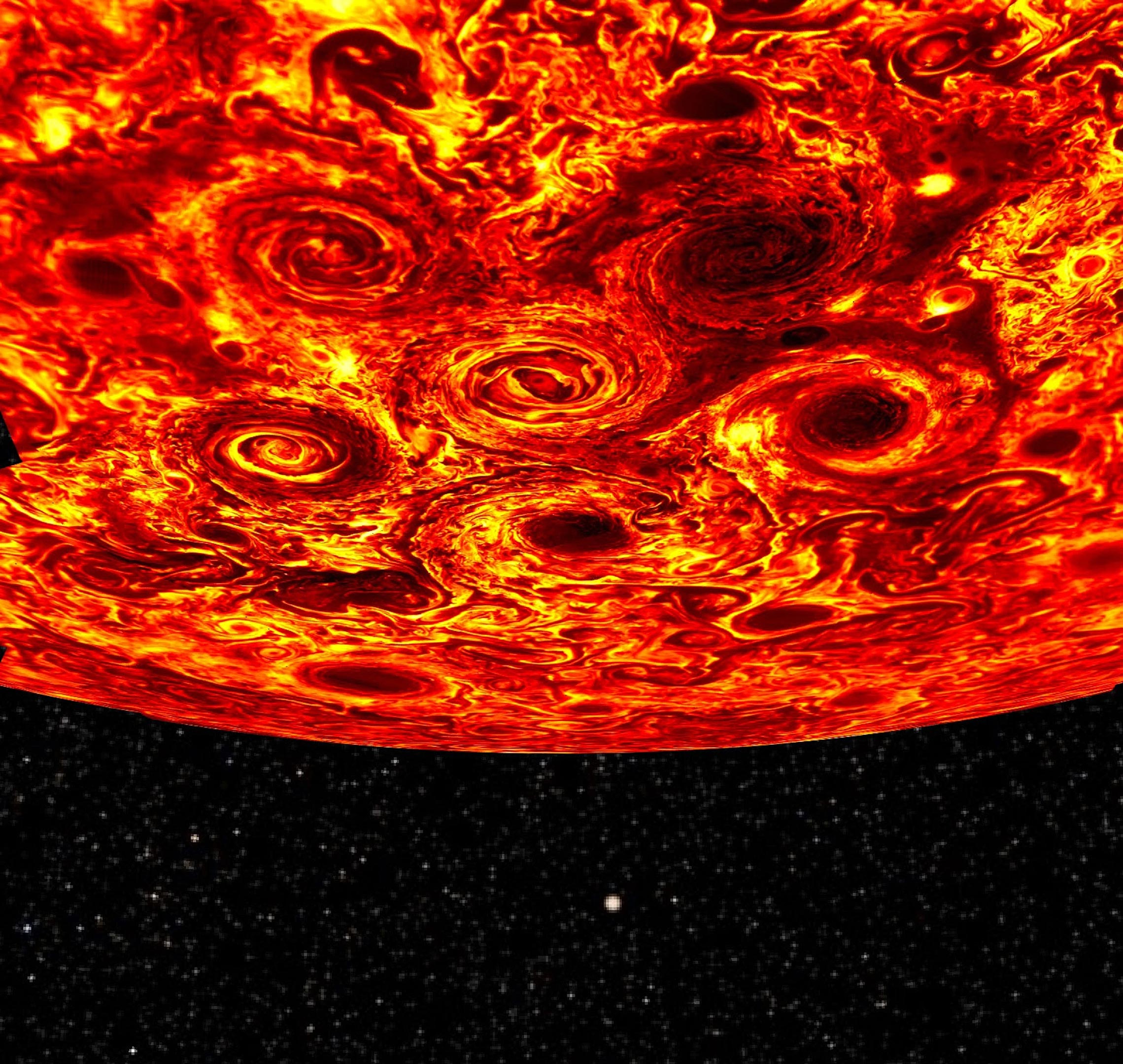
    Pentagon of Vortices Jupiter South Pole
    Pentagon of vortices. Mosaic of infrared images of Jupiter’s south pole. Credit: NASA/SWRI/JPL/ASI/INAF/IAPS

    Jupiter is the fifth planet from the Sun, orbiting between Mars and Saturn. It is a gas giant and with a mass more than 317 times that of Earth, it is by far the most massive planet in the Solar System. As a gas giant, which Jupiter is mostly made up of hydrogen and helium, much of which is in the gaseous state. The planet probably has a rocky core, but the vast majority of its radius is taken up by layers of metallic hydrogen, liquid hydrogen, and its atmosphere.

    Never miss a breakthrough: Join the SciTechDaily newsletter.
    Follow us on Google and Google News.

    Juno Spacecraft Jupiter NASA Planets
    Share. Facebook Twitter Pinterest LinkedIn Email Reddit

    Related Articles

    Breathtaking Majesty: NASA’s Juno Captures Jupiter’s Colorful Chaos in Stunning Detail

    “Clyde’s Spot” on Jupiter Has Morphed Into a Strange, Complex Structure

    Strange New Auroral Feature Discovered on Jupiter

    NASA’s Juno Mission Expands Into the Future – To Explore Jupiter and Its Rings and Moons

    Cyclones at Jupiter’s North Pole Appear As Swirls of Striking Colors

    Juno Spacecraft Captures Astonishing High-Altitude Hazes on Jupiter

    Amazing Look at Jupiter’s Incredible Storms Using Ground and Space Observations

    Jupiter Water Mystery Updated With Findings From NASA’s Juno Spacecraft

    Juno Spacecraft Completes First Trajectory Correction Maneuver

    Leave A Reply Cancel Reply

    • Facebook
    • Twitter
    • Pinterest
    • YouTube

    Don't Miss a Discovery

    Subscribe for the Latest in Science & Tech!

    Trending News

    The Secret to Healthy Aging May Be More Protein and More Exercise

    These 567-Million-Year-Old Fossils Are Rewriting the Story of Life on Earth

    The Spider-Like Creatures Helping Scientists Decode the Origins of Fatherhood

    Scientists Baffled by a Sudden Reversal Deep Inside Earth’s Core

    This Strange Sea Creature Can Survive Five Years Without Food – Scientists Finally Know Why

    New Quantum Sensor Opens a Window Into the Invisible Universe

    Stanford Scientists Reverse Age-Related Memory Loss by Targeting the Gut

    James Webb Uncovers the Atmosphere of a Hellish Lava World 41 Light-Years Away

    Follow SciTechDaily
    • Facebook
    • Twitter
    • YouTube
    • Pinterest
    • Newsletter
    • RSS
    SciTech News
    • Biology News
    • Chemistry News
    • Earth News
    • Health News
    • Physics News
    • Science News
    • Space News
    • Technology News
    Recent Posts
    • New Research Could Help Break China’s Rare Earth Magnet Monopoly
    • The Milky Way’s Black Hole Isn’t Tearing Everything Apart – New Observations Reveal a Surprise
    • Black Hole Shredded a Massive Star in the Most Powerful Stellar Explosion Ever Seen
    • Building the Brain Requires Millions of Dangerous DNA Breaks
    • The Future of Obesity Care Goes Far Beyond Ozempic, Wegovy, and Zepbound
    Copyright © 1998 - 2026 SciTechDaily. All Rights Reserved.
    • Science News
    • About
    • Contact
    • Editorial Board
    • Privacy Policy
    • Terms of Use

    Type above and press Enter to search. Press Esc to cancel.