
Close Menu
    Facebook X (Twitter) Instagram
    SciTechDaily
    • Biology
    • Chemistry
    • Earth
    • Health
    • Physics
    • Science
    • Space
    • Technology
    Facebook X (Twitter) Pinterest YouTube RSS
    SciTechDaily
    Home»Space»NASA’s Parker Solar Probe Discovers Something Unexpected Hidden in the Chaos of Space
    Space

    NASA’s Parker Solar Probe Discovers Something Unexpected Hidden in the Chaos of Space

    By University of TokyoNovember 4, 2026No Comments4 Mins Read
    Facebook Twitter Pinterest Telegram LinkedIn WhatsApp Email Reddit
    Share
    Facebook Twitter LinkedIn Pinterest Telegram Email Reddit
    Parker Solar Probe Reports Good Status After Close Solar Approach
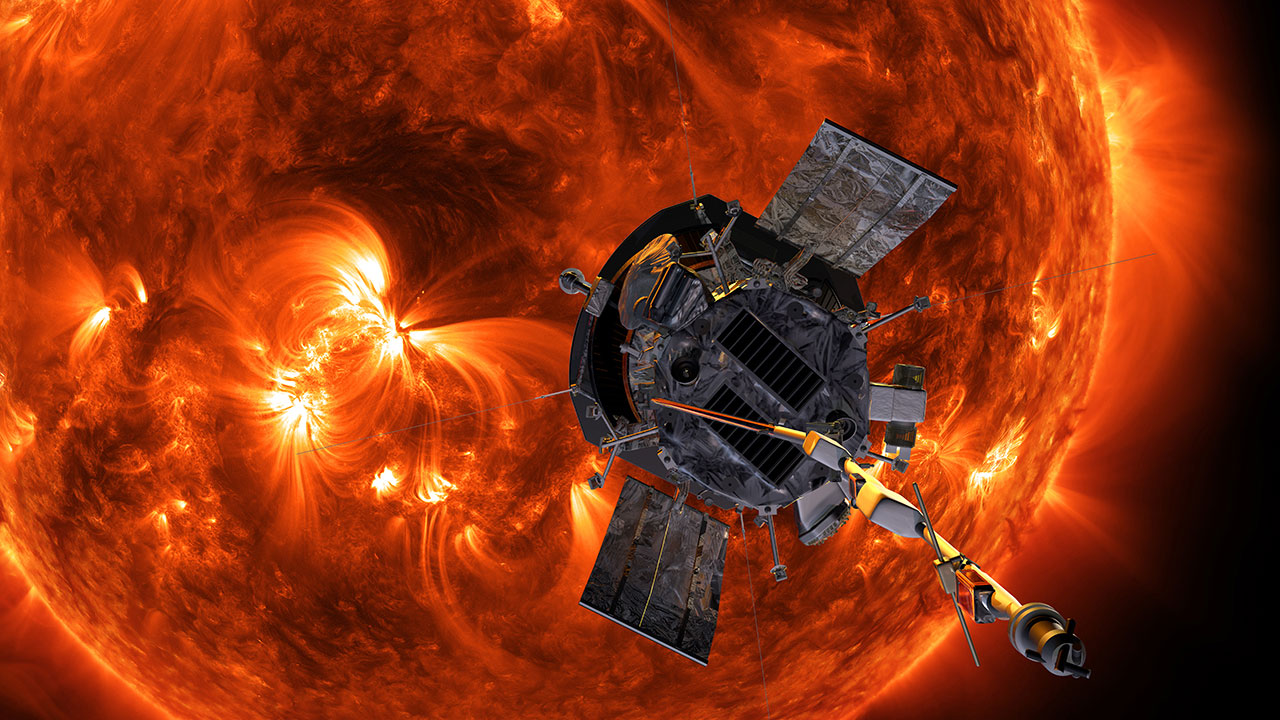
    Artist’s illustration of NASA’s “Parker Solar Probe” mission. Credit: NASA/Johns Hopkins APL/Steve Gribben

    NASA’s Parker Solar Probe has uncovered hidden order in space turbulence, a finding that could help scientists understand magnetic storms on Earth.

    Smoke rising from an incense stick can begin as a thin, steady stream before curling and spreading unpredictably. The smoke makes turbulence in the air visible. Turbulence also occurs in space, where the moving material is plasma, an ionized gas containing electrically charged particles. Electric and magnetic fields strongly influence how those particles move, making this turbulence different from the movements of ordinary air.

    Space plasma is also so dilute that its particles rarely collide, making it effectively collisionless. Physicists are still working to understand how turbulence develops under these conditions and how its energy is distributed. Measurements from NASA’s Parker Solar Probe have now revealed an organized pattern within that irregular activity.

    Magnetic fields reverse rotation at smaller scales

    At large scales, plasma behaves like a fluid, and turbulence develops through swirling motions called vortices and through electromagnetic waves. The fluctuations become random. At smaller scales, the dynamics of individual particles become important. These are different ways the same material behaves depending on the size of the disturbances being examined.

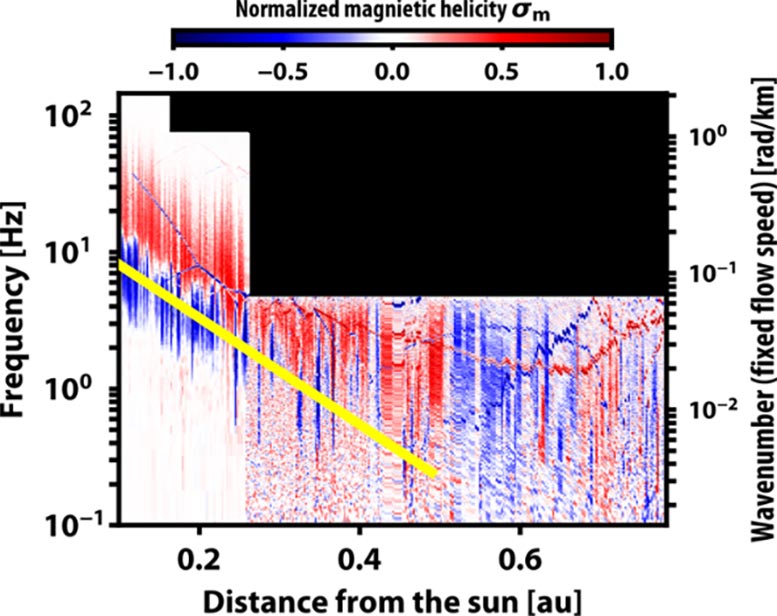
    Using high-precision magnetic field and particle data from Parker Solar Probe, an international research team directly demonstrated, for the first time, that turbulent magnetic fields reverse their preferred direction of rotation across this transition. Picture the magnetic field’s direction as an arrow that can turn as the field fluctuates. Viewed looking radially away from the Sun, the fields preferentially rotate counterclockwise at larger scales. At smaller scales, they rotate clockwise.
    Parker Solar Probe Magnetic Rotation Reversal Graph
    Reversal of the field rotation from left-handed rotation (blue) to right-handed rotation (red), plotted on the frequency spectrum (y axis) against distance from the Sun x axis). Analysis based on the data from the Parker Solar Probe. A low frequency corresponds to a long wavelength in the spectrum. Credit: Iizawa et al., Astrophys. J. Lett., 2026

    The reversal occurs at the wavelength, or spatial scale, where fluid-like behavior gives way to particle-like dynamics. Farther from the Sun, the reversal becomes more pronounced and shifts toward longer wavelengths, corresponding to larger spatial scales.

    “We see a clear structure in the spectrum, even though the turbulence represents unstructured motions,” says Dr. Masatomi Iizawa of Technische Universität Braunschweig (TU Braunschweig), the article’s first author.

    The study brought together researchers from the Institute of Theoretical Physics at TU Braunschweig and the University of Tokyo, in cooperation with Tohoku University, Kyushu University, Osaka University, and other research institutes. The collaboration spanned ten countries, and the results are published in The Astrophysical Journal Letters.

    Turbulence shapes space weather

    Dr. Yokoi of the University of Tokyo says, “The results are of great significance for both plasma physics and astrophysics.”

    Plasma turbulence plays an important role in the solar wind, solar eruptions, and interplanetary space, as well as in Earth’s magnetosphere, the region dominated by our planet’s magnetic field. It also matters in accretion disks, where material orbits and moves inward toward a central object. In interplanetary space, turbulence can influence the shock waves and magnetic clouds produced by solar eruptions, making it an important factor in predicting geomagnetic storms.

    Reference: “Nonlocal Evolution of Magnetic Helicity across the Magnetohydrodynamic–Kinetic Interface” by Masatomi Iizawa, Yasuhito Narita, Tommaso Alberti, Stuart D. Bale, Axel Brandenburg, Abraham C.-L. Chian, Horia Comişel, Shuichi Matsukiyo and Nobumitsu Yokoi, 13 October 2026, The Astrophysical Journal Letters.
    DOI: 10.3847/2041-8213/aea84b

    This work was funded by the Deutsche Forschungsgemeinschaft (DFG, German Research Foundation)—535057280 and also by the Japan Society for the Promotion of Science (JSPS) grants-in-Aid for Scientific Research JP23K25895 and JP26K00767.

    Never miss a breakthrough: Join the SciTechDaily newsletter.
    Follow us on Google and Google News.

    Parker Solar Probe Plasma Physics Solar Wind Space Weather University of Tokyo
    Share. Facebook Twitter Pinterest LinkedIn Email Reddit

    Related Articles

    Earth’s Magnetic Shield Is Rippling Unevenly – Scientists Have Uncovered the Cause

    The Solar Wind Is Hiding Strange Particles That Could Rewrite Space Weather

    Switchbacks in Space: Scientists Uncover How Solar Wind Gets Energy

    NASA’s Parker Solar Probe Plunges Into Fast Solar Wind and Discovers Its Mysterious Source

    Modeling Solar Winds: Simulations Reproduce Complex Fluctuations in Soft X-Ray Signal Detected by Satellites

    Scientists Discover New Physics Missing From Existing Models of Magnetic Reconnection

    Solar Cycle 25: The Sun Wakes Up

    New Model Advances the Understanding of How Solar Wind Works

    Magnetic Disturbances Sent Massive Solar Wind Earthward

    Leave A Reply Cancel Reply

    • Facebook
    • Twitter
    • Pinterest
    • YouTube

    Don't Miss a Discovery

    Subscribe for the Latest in Science & Tech!

    Trending News

    Earth’s Oceans Were Slowly Suffocating Millions of Years Before a Devastating Mass Extinction

    Why Are Men Twice As Likely To Develop Parkinson’s? Scientists Discover a Hidden Clue in the Brain

    Scientists Finally Identify Mysterious Creature Nearly 90 Years After It Was First Found

    Einstein’s Equations Reveal an Unusual New Way Space-Time Can Transfer Energy

    Scientists Say This Medication Could Be the Next “Wonder Drug”

    A Mysterious Explosion in Space Just Did Something Scientists Didn’t Expect

    A Nutrient Found in Red Meat Could Make Dangerous Inflammation Even Worse

    Scientists Discover How Dead Stars Could Break One of Physics’ Most Famous Limits

    Follow SciTechDaily
    • Facebook
    • Twitter
    • YouTube
    • Pinterest
    • Newsletter
    • RSS
    SciTech News
    • Biology News
    • Chemistry News
    • Earth News
    • Health News
    • Physics News
    • Science News
    • Space News
    • Technology News
    Recent Posts
    • NASA’s Parker Solar Probe Discovers Something Unexpected Hidden in the Chaos of Space
    • NASA’s Voyager 1 Is About to Become the First Spacecraft One Light-Day From Earth
    • A Woman Who Lived 30,000 Years Ago Is Changing What We Know About Ice Age Europe
    • 33 Out of 34 Lupus Patients Shared an Immune Cell Abnormality
    • Common Nutritional Supplement Shows Surprising Promise Against Psoriasis
    Copyright © 1998 - 2026 SciTechDaily. All Rights Reserved.
    • Science News
    • About
    • Contact
    • Editorial Board
    • Privacy Policy
    • Terms of Use

    Type above and press Enter to search. Press Esc to cancel.