
Close Menu
    Facebook X (Twitter) Instagram
    SciTechDaily
    • Biology
    • Chemistry
    • Earth
    • Health
    • Physics
    • Science
    • Space
    • Technology
    Facebook X (Twitter) Pinterest YouTube RSS
    SciTechDaily
    Home»Science»Natural Dental Wear Protects Teeth Against Fatigue Failure
    Science

    Natural Dental Wear Protects Teeth Against Fatigue Failure

    By Max Planck InstituteApril 29, 2013No Comments3 Mins Read
    Facebook Twitter Pinterest Telegram LinkedIn WhatsApp Email Reddit
    Share
    Facebook Twitter LinkedIn Pinterest Telegram Email Reddit
    Natural Dental Wear Protects Teeth Against Fatigue Failure
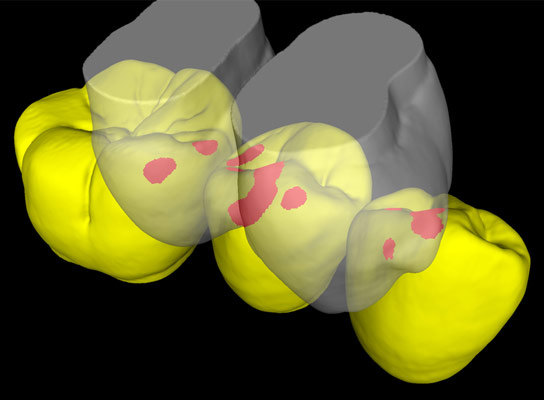
    Collision detection (red areas) between the lower right premolars and first molar and the upper right premolars. Credit: Senckenberg

    In a newly published study, researchers analyzed modern human teeth, finding that material loss protects teeth against fatigue failure.

    Scientists of the Max Planck Institute for Evolutionary Anthropology in Leipzig and the Senckenberg Research Institute in Frankfurt together with dental technicians have digitally analyzed modern human teeth using an engineering approach, finite element method, to evaluate the biomechanical behavior of teeth under realistic loading. They report results, showing that very widespread loss of dental material (enamel and dentine) at the base of the crown might be linked to the reduction of tooth wear in our industrialized societies. The study is published in the professional journal PLoS ONE.

    Our teeth are important and expensive for us. In this respect aesthetic aspects are of major interest. A healthy dentition should show shiny white tooth crowns and possibly no occlusal wear. The evolutionary history of our dentition teaches us something different. Natural tooth wear as an inevitable consequence of chewing food and habitat accompanying human evolution since ancient times.

    “In our industrialized societies we find an increase in dental cervical defects”, explains Ottmar Kullmer of the Senckenberg Research Institute: “Based on the results of our simulations of chewing loads, we assume that much of the enamel failure we find today frequently in tooth crowns is probably caused by cyclic tensile stresses during chewing.”

    The researchers used methods from engineering science (Finite Element Analysis, FEA), after applying a new Software tool (Occlusal Fingerprint Analyzer) developed in the Senckenberg Research Institute to precisely determine tooth to tooth contacts. “The computer simulation of chewing forces creates high tensile stresses exactly in the cervical areas where we frequently find tooth lesions in our teeth”, reconsiders Stefano Benazzi of the Max Plank Institute for Evolutionary Anthropology in Leipzig, who carried out the Finite Element Analysis. To investigate changes in the stress pattern in the same tooth crowns with varying tooth wear ages, two premolars were artificially abraded in the laboratory, based on their individual data of occlusal movement. So, it was possible to calculate the changes in the stress pattern, depending on the wear stage.

    The stress in the teeth with advanced wear shows a far better distribution of the loads over the whole tooth crown, so that the tensile stresses will be remarkably reduced. “Evolutionary factors have apparently led to a quite successful compromise between material loss and longest possible preservation of function”, says Benazzi. The extension of the lifespan and the quick changes in our lifestyle with a remarkable reduction in tooth wear present a major challenge for modern dentistry, say the scientists.

    Reference: “The Evolutionary Paradox of Tooth Wear: Simply Destruction or Inevitable Adaptation?” by Stefano Benazzi, Huynh Nhu Nguyen, Dieter Schulz, Ian R. Grosse, Giorgio Gruppioni, Jean-Jacques Hublin and Ottmar Kullmer, 24 April 2013, PLoS ONE.
    DOI: 10.1371/journal.pone.0062263

    Never miss a breakthrough: Join the SciTechDaily newsletter.
    Follow us on Google and Google News.

    Evolution Evolutionary Anthropology Max Planck Institute Teeth
    Share. Facebook Twitter Pinterest LinkedIn Email Reddit

    Related Articles

    Scientists Reveal the Complex Story Behind the Beaker Phenomenon

    Researchers Discover Oldest Images to Date of Dogs on Leashes

    New Findings Provide Further Evidence That Early Anthropoids Were Minuscule Creatures

    Scientists Discover A New Species of Hominin

    A New Timetable of Evolution – Reappraisal of Hydrocarbon Biomarkers in Archean Rocks

    Discovery Reveals That Neanderthals Were the First in Europe to Make Specialized Bone Tools

    Biomechanics of Dental Features and Tooth Wear

    400,000 Year Old Fossil Helps Shed New Light on Human Evolution

    Jawless Vertebrate Conodont Had Sharpest Yet Minuscule Teeth

    Leave A Reply Cancel Reply

    • Facebook
    • Twitter
    • Pinterest
    • YouTube

    Don't Miss a Discovery

    Subscribe for the Latest in Science & Tech!

    Trending News

    The Best Exercise Combination for Longevity, According to a 30-Year Study

    Popular Weight-Loss Drug Found To Slow Biological Aging in Landmark Human Trial

    NASA’s Fermi Telescope Caught a Supernova Doing Something Never Seen Before

    This Dinosaur Had the Claws of a Raptor but Hunted Like a Heron

    Doctors May Need To Rethink Calcium and Vitamin D Recommendations After Major Review

    Scientists Discover a Hidden Cause of Cellular Aging That Can Be Reversed

    Archaeologists Have Found Something Unexpected Inside a 1,600-Year-Old Egyptian Mummy

    Scientists May Have Found a Completely New Way To Treat Depression

    Follow SciTechDaily
    • Facebook
    • Twitter
    • YouTube
    • Pinterest
    • Newsletter
    • RSS
    SciTech News
    • Biology News
    • Chemistry News
    • Earth News
    • Health News
    • Physics News
    • Science News
    • Space News
    • Technology News
    Recent Posts
    • A Newly Found Cellular Shift May Explain Why Aging Leads to Disease
    • A Normal Kidney Test Could Still Signal Serious Risk
    • Scientists Discover Gut Signal That Turns Off Sugar Cravings
    • NASA Captures Typhoon Jangmi’s Massive Eye in Stunning Nighttime Image
    • Super Typhoon Sinlaku Was So Powerful It Made the Sky Ripple With Gravity Waves
    Copyright © 1998 - 2026 SciTechDaily. All Rights Reserved.
    • Science News
    • About
    • Contact
    • Editorial Board
    • Privacy Policy
    • Terms of Use

    Type above and press Enter to search. Press Esc to cancel.