
Close Menu
    Facebook X (Twitter) Instagram
    SciTechDaily
    • Biology
    • Chemistry
    • Earth
    • Health
    • Physics
    • Science
    • Space
    • Technology
    Facebook X (Twitter) Pinterest YouTube RSS
    SciTechDaily
    Home»Chemistry»Chemists Have Developed a New Way To Produce an Important Molecular Entity
    Chemistry

    Chemists Have Developed a New Way To Produce an Important Molecular Entity

    By University of MünsterJanuary 17, 2023No Comments3 Mins Read
    Facebook Twitter Pinterest Telegram LinkedIn WhatsApp Email Reddit
    Share
    Facebook Twitter LinkedIn Pinterest Telegram Email Reddit
    Blue Light Vizinal Diamines
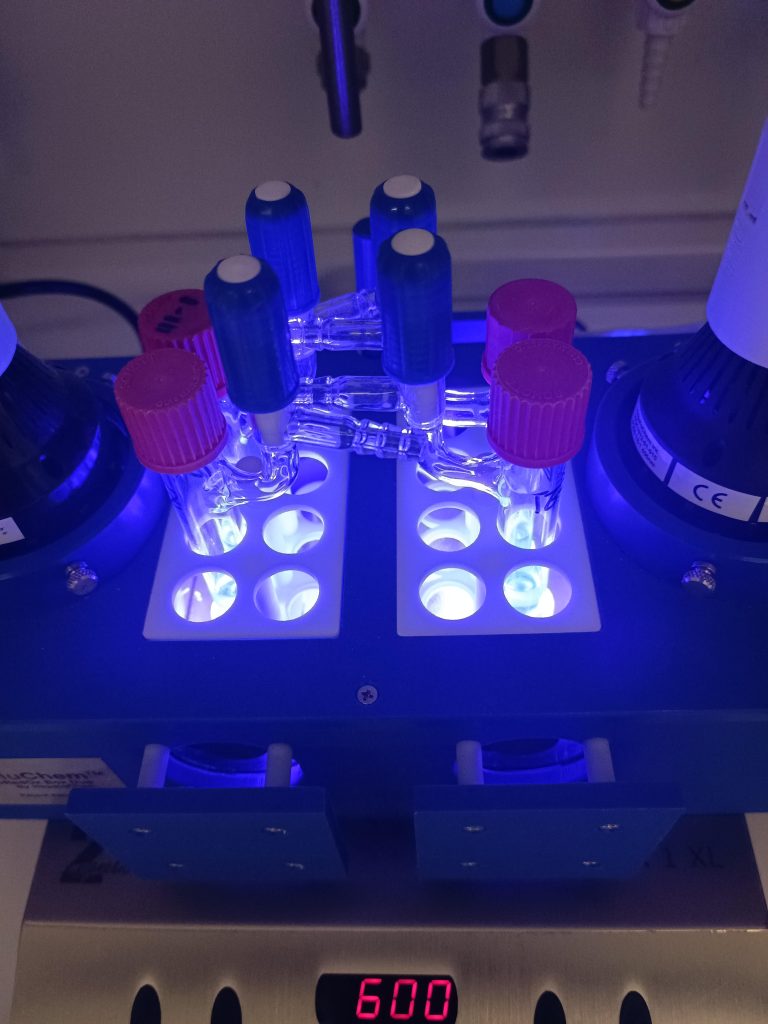
    The chemists use blue light to produce unsymmetrically structured vicinal diamines. Credit: University of Münster – Glorius group

    A new method for the easy production of vicinal diamines has been developed by chemists.

    A team led by Professor Frank Glorius of the University of Münster has developed a new method for producing vicinal diamines, a common structure found in biologically active molecules, natural products, and drugs. These compounds contain two functional groups, each with a nitrogen atom bonded to two neighboring carbon atoms. The team’s method, which was published in the journal Nature Catalysis, is a direct and efficient way to produce these compounds.

    The new method developed by the team at the University of Münster does not require the use of transition metals or iodine reagents as catalysts, unlike other methods. Instead, it utilizes light energy to produce the desired diamines from various electron-rich aromatic hydrocarbons, such as arenes and heteroarenes. This makes the process more efficient and effective than other methods.

    “In this way, we obtain a series of vicinal diamines that were previously difficult to produce. In doing so, we can precisely control the sites where the functional groups are located,” explains first author Dr. Guangying Tan.
    Unsymmetrical Diamines
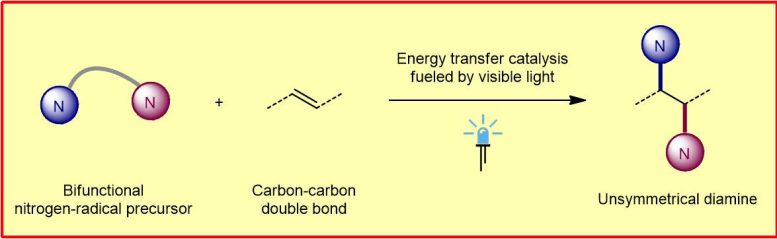
    So-called nitrogen radical precursors (left) and carbon-carbon double bonds react with the help of light energy to form unsymmetrical diamines (right). Credit: University of Münster – Glorius group

    Regioselective Reaction Control

    To this end, the chemists developed a class of special nitrogen radical precursors that simultaneously generate two nitrogen-centered radicals with different reactivities via an energy transfer process. By “regioselectively” adding two of these radicals stepwise via carbon-carbon double bonds, the scientists produce the unsymmetrically constructed vicinal diamines. “Regioselective” means that the reaction occurs at defined sites on the molecules. The functional groups (amino groups) can then be further modified. The fact that the diamines synthesized in this way are not symmetrical, in contrast to a symmetrical structure, opens up a much greater variety of functional groups to be considered.

    “The molecules of life consist largely of carbon chains and rings of varying size and complexity. The decoration of these ‘plain’ chains with other elements is crucial for the resulting properties of these compounds,” Frank Glorius explains the background. A key role is played by the elements oxygen and nitrogen. Chemists refer to these non-carbon elements as heteroatoms.

    “Methods for the efficient and controlled introduction of these heteroatoms into artificially produced, biologically active structures are therefore of great importance,” Frank Glorius emphasizes. “This also applies to the vicinal diamines we are focusing on.”

    The chemists perform the diamination reaction under irradiation with blue light-emitting diodes (LEDs) and use an inexpensive and commercially available thioxanthone as an organic photosensitizer.

    Reference: “Energy transfer-enabled unsymmetrical diamination using bifunctional nitrogen-radical precursors” by Guangying Tan, Mowpriya Das, Roman Kleinmans, Felix Katzenburg, Constantin Daniliuc and Frank Glorius, 8 December 2022, Nature Catalysis.
    DOI: 10.1038/s41929-022-00883-3

    The study was funded by the German Research Foundation, Alexander von Humboldt-Stiftung, and Fonds der Chemischen Industrie. 

    Never miss a breakthrough: Join the SciTechDaily newsletter.
    Follow us on Google and Google News.

    Organic Chemistry University of Münster
    Share. Facebook Twitter Pinterest LinkedIn Email Reddit

    Related Articles

    Scientists Solve a Long-Standing Chemistry Challenge With Light-Driven Catalysis

    Calcium’s Cosmic Secret: How a Common Mineral May Have Sparked Life on Earth

    New Samarium Catalyst Reduces Costs and Boosts Pharmaceutical Reaction Efficiency

    AI Cracks the Chemistry Code to Better, Longer-lasting Solar Panels

    Carbenes in Space? New Discovery Could Explain Life’s Cosmic Origins

    Superheated Flow Chemistry: A Leap Forward in Organic Synthesis

    Revolutionizing Organic Chemistry: Boronic Acid-Powered Enzyme Yields Groundbreaking Catalysis

    Bionanomachine Breakthrough: A Master Key for Sustainable Chemistry

    Century-Old Chemistry Puzzle Solved: Researchers Unveils Game-Changing Compound

    Leave A Reply Cancel Reply

    • Facebook
    • Twitter
    • Pinterest
    • YouTube

    Don't Miss a Discovery

    Subscribe for the Latest in Science & Tech!

    Trending News

    FDA-Approved Drug Shows Promise for Reversing Osteoarthritis Damage

    11,000-Year-Old Grains Reveal a Surprise About the Origins of Agriculture

    This Common Type of Medication Is Linked to Slower Cognitive Decline

    Quantum Computer Solves a Problem in 15 Minutes That Classical Methods Can’t Practically Compute

    Taking the Stairs Could Cut Your Risk of Heart-Related Death by 39%

    Scientists Uncover a Surprising New Route for Stonehenge’s Most Mysterious Stone

    A Star Near the Milky Way’s Black Hole Is Losing Mass at an Astonishing Rate

    Scientists Solve a Vitamin B12 Mystery With an Unexpected Culprit

    Follow SciTechDaily
    • Facebook
    • Twitter
    • YouTube
    • Pinterest
    • Newsletter
    • RSS
    SciTech News
    • Biology News
    • Chemistry News
    • Earth News
    • Health News
    • Physics News
    • Science News
    • Space News
    • Technology News
    Recent Posts
    • New Technique Could Slash AI’s Memory Energy Use by Thousands of Times
    • Scientists Find a Hidden Biological Link Across Different Forms of Autism
    • Scientists Discover a 3.7-Billion-Year-Old Secret of Early Life
    • Scientists Revisited a Forest Experiment That Was Forgotten for 30 Years. What They Found Was Astounding
    • Astronomers Discover a Ghostly River of Stars That Could Reveal Dark Matter
    Copyright © 1998 - 2026 SciTechDaily. All Rights Reserved.
    • Science News
    • About
    • Contact
    • Editorial Board
    • Privacy Policy
    • Terms of Use

    Type above and press Enter to search. Press Esc to cancel.