
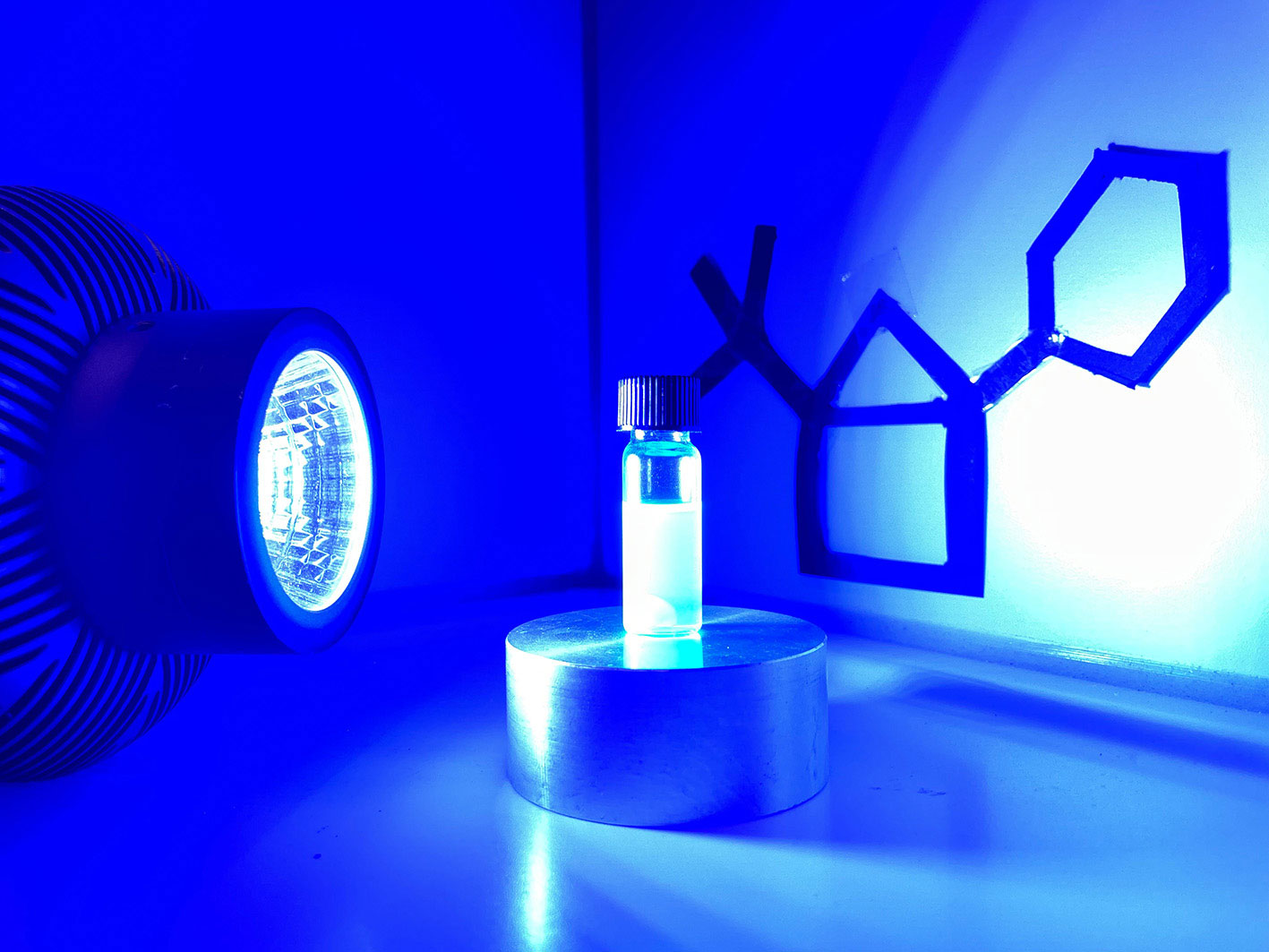
Chemists have developed a light-driven method for producing a rare and highly strained molecular structure known as “housane.”
Designing a new drug often starts with a basic but difficult task: making the exact molecular framework needed for a medicine to work. Some important drugs, including penicillin, depend on tiny ring-shaped structures made from three or four connected atoms. Although these compact motifs can have an outsized effect on biological activity, they are not always easy to build in a practical way.
Researchers led by Prof. Frank Glorius at the Institute of Organic Chemistry at the University of Münster have developed a new approach that converts simple and widely available starting materials into these compact ring structures with high efficiency. The resulting molecule has a shape that resembles a simple drawing of a house, which is why chemists refer to it as “housane.” The transformation relies on a photocatalyst that absorbs light and transfers that energy to the reacting molecules, allowing the chemical change to occur.
These small ring systems store a large amount of internal strain, similar to the tension in a bent branch. When that tension is released, it can drive additional chemical reactions. Because of this property, strained ring molecules are useful building blocks for creating more complex and valuable compounds. Despite their usefulness, producing molecules that contain this level of strain has proven challenging.
Earlier strategies for making housane often relied on “harsh” reaction conditions, including very high temperatures. Another limitation is that those methods generally do not tolerate many additional atoms or groups of atoms attached to the starting materials. Chemists refer to these attachments as functional groups, and they strongly influence the behavior and properties of a molecule.
Controlling Light-Driven Reactions
To solve this problem, the team turned to hydrocarbons known as (1,4-dienes). Under light, these molecules usually head off in the wrong direction, producing unwanted side reactions instead of the desired product. The researchers found that by adjusting the side chains on the starting materials, they could steer the chemistry away from those competing pathways and make the process much more selective.
Once those detours were blocked, the molecules were able to fold into the tense ring system needed to form housane. “This process is normally difficult to achieve because it is energetically ‘uphill’ and requires additional momentum. Photocatalysis provides the necessary energy,” Frank Glorius explains. Computer-aided analyses helped the team map out how the reaction proceeds, offering a clearer picture of why the method works.
Computer-aided analysis also helped the researchers clarify how the reaction proceeds at the molecular level.
The technique allows chemists to produce housane more easily and with greater efficiency. It also increases the ways in which this highly strained framework can be used to assemble more complex molecules. According to the researchers, the approach could support both fundamental chemical research and practical applications, including pharmaceutical manufacturing and the development of new materials.
Reference: “Divergent housane synthesis via intramolecular [2 + 2] cycloaddition of 1,4-dienes” by Fuhao Zhang, Julius Domack, Niklas Hölter, Constantin G. Daniliuc and Frank Glorius, 19 February 2026, Nature Synthesis.
DOI: 10.1038/s44160-026-00997-7
Funding: Hans and Ria Messer Foundation, German Academic Scholarship Foundation, University of Münster
Never miss a breakthrough: Join the SciTechDaily newsletter.
Follow us on Google and Google News.
1 Comment
thanks for this