

Research suggests that calcium may have played a key role in guiding the development of a specific molecular handedness in primitive polyesters and early biomolecules.
A new study from the Earth-Life Science Institute (ELSI) at the Institute of Science Tokyo has revealed an unexpected role for calcium in the formation of life’s earliest molecular structures. The researchers found that calcium ions can influence the way primitive polymers form, offering new insight into a long-standing mystery: why life’s molecules favor a single type of “handedness,” or chirality.
Many molecules exist in two mirror-image forms, like left and right hands. However, life on Earth strongly favors one side: the sugars in DNA are right-handed, while proteins are made from left-handed amino acids. This consistent preference, known as homochirality, is critical for life but its origin has remained unclear.
To explore how early Earth conditions might have shaped this molecular preference, the team studied tartaric acid (TA), a simple molecule with two chiral centers. They found that calcium has a major effect on how TA molecules join to form polyesters. In the absence of calcium, pure left- or right-handed TA forms polymers easily, while mixtures of both forms do not. When calcium is present, this behavior flips—polymerization of pure TA slows down, but mixed solutions begin to form polymers.
Calcium shapes early polymer formation
“This suggests that calcium availability could have created environments on early Earth where homochiral polymers were favored or disfavoured,” says Chen Chen, Special Postdoctoral Researcher at RIKEN Center for Sustainable Resource Science (CSRS), who co-led the study.
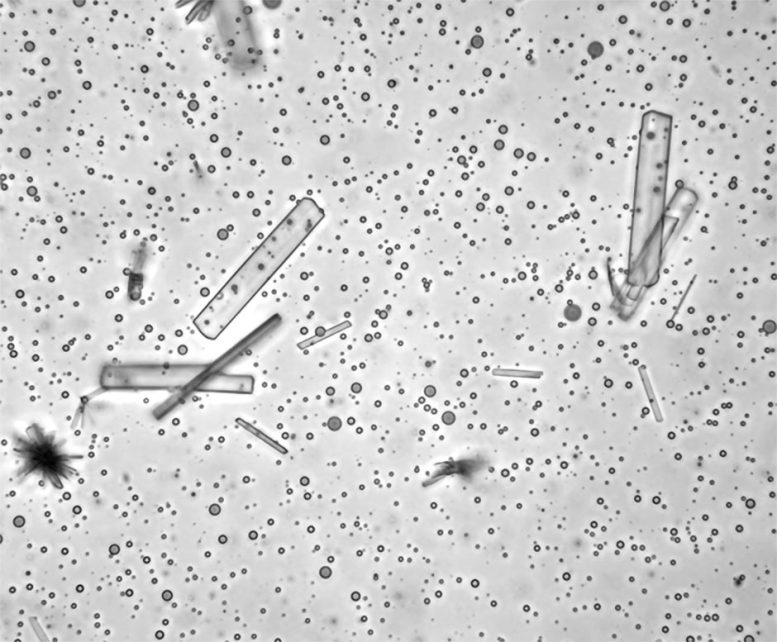
The researchers propose that calcium drives this effect through two mechanisms: first, by binding with TA to form calcium tartrate crystals, which selectively remove equal amounts of both left- and right-handed molecules from the solution; and second, by altering the polymerization chemistry of the remaining TA molecules. This process could have amplified small imbalances in chirality, ultimately leading to the uniform handedness seen in modern biomolecules.
What makes this study especially intriguing is its suggestion that polyesters—simple polymers formed from molecules like tartaric acid—could have been among life’s earliest homochiral molecules, even before RNA, DNA, or proteins. “The origin of life is often discussed in terms of biomolecules like nucleic acids and amino acids,” ELSI’s Specially Appointed Associate Professor Tony Z. Jia, who co-led the study, explains. “However, our work introduces an alternative perspective: that ‘non-biomolecules’ like polyesters may have played a critical role in the earliest steps toward life.”
The environmental factor in polymer outcomes
The findings also highlight how different environments on early Earth could have influenced which types of polymers formed. Calcium-poor settings, such as some lakes or ponds, may have promoted homochiral polymers, while calcium-rich environments might have favored mixed-chirality polymers.
Beyond chemistry, this research bridges multiple scientific fields—biophysics, geology, and materials science—to explore how simple molecules interact in dynamic prebiotic environments. The study is also the result of years of interdisciplinary collaboration, bringing together researchers from seven countries across Asia, Europe, Australia, and North America.
“We faced significant challenges in integrating all of the complex chemical, biophysical, and physical analyses in a clear and logical way,” says project co-leader Ruiqin Yi of the Guangzhou Institute of Geochemistry, Chinese Academy of Sciences. “But thanks to the hard work and dedication of our team, we’ve uncovered a compelling new piece of the origins of life puzzle.” This research not only deepens our understanding of life’s beginnings on Earth but also suggests that similar processes could be at play on other planets, helping scientists search for life beyond our world.
Reference: “Primitive homochiral polyester formation driven by tartaric acid and calcium availability” by Chen Chen, Ruiqin Yi, Motoko Igisu, Rehana Afrin, Mahendran Sithamparam, Kuhan Chandru, Yuichiro Ueno, Linhao Sun, Tommaso Laurenzi, Ivano Eberini, Tommaso P. Fraccia, Anna Wang, H. James Cleaves and Tony Z. Jia, 21 March 2025, Proceedings of the National Academy of Sciences.
DOI: 10.1073/pnas.2419554122
Funding: NSFC, International Partnership Program of the Chinese Academy of Sciences, RIKEN SPDR Program, JSPS Grant-in-Aid for Early Career Scientists, JSPS Grants-in-Aid, JSPS Grants-in-Aid, Tokyo Institute of Technology Yoshinori Ohsumi Fund for Fundamental Research, Mizuho Foundation for the Promotion of Sciences, Temporary Assistant Program by the DE&I Section of Science Tokyo (formerly Tokyo Institute of Technology), ELSI Brain Exchange Program
Never miss a breakthrough: Join the SciTechDaily newsletter.
Follow us on Google and Google News.
1 Comment
Interesting