
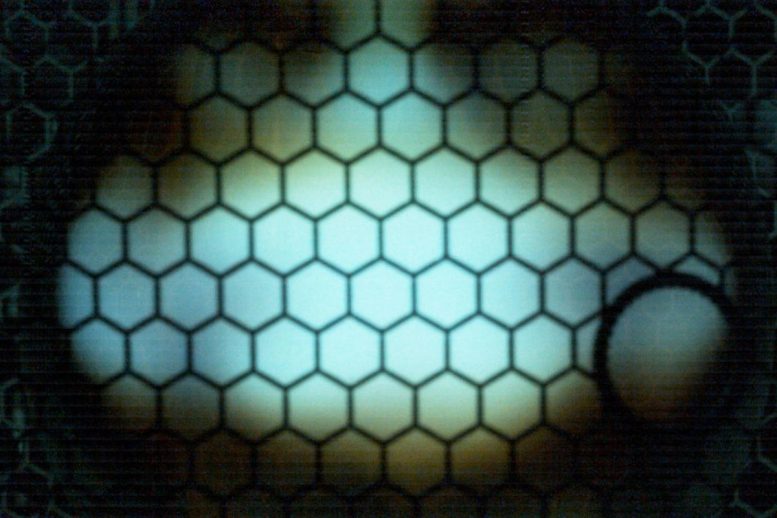
A study conducted at UCLA successfully overcomes the influence of Earth’s gravity, replicating conditions found on other planets and stars.
Solar flares and various forms of space weather can cause significant disruptions in spaceflight and satellite-based telecommunications. However, scientists’ efforts to find solutions to this problem have been hindered due to the fact that laboratory experiments on Earth are subject to gravity, leading to results that differ greatly from conditions in space.
A recent study conducted by physicists at the University of California, Los Angeles (UCLA) could finally provide a solution to this challenge, which could be a significant step towards protecting humans and equipment during space missions and maintaining the proper functioning of satellites. The researchers’ findings were recently published in the journal Physical Review Letters.
The UCLA researchers effectively reproduced the type of gravity that exists on or near stars and other planets inside of a glass sphere measuring 3 centimeters in diameter (about 1.2 inches). To do so, they used sound waves to create a spherical gravitational field and generate plasma convection — a process in which gas cools as it nears the surface of a body and then reheats and rises again as it nears the core — creating a fluid current that in turn generates a magnetic current.
The achievement could help scientists overcome the limiting role of gravity in experiments that are intended to model convection that occurs in stars and other planets.
Revolutionizing Space Weather Experiments
“People were so interested in trying to model spherical convection with laboratory experiments that they actually put an experiment in the space shuttle because they couldn’t get a strong enough central force field on the ground,” said Seth Putterman, a UCLA physics professor and the study’s senior author. “What we showed is that our system of microwave-generated sound produced gravity so strong that Earth’s gravity wasn’t a factor. We don’t need to go into space to do these experiments anymore.”
UCLA researchers used microwaves to heat sulfur gas to 5,000 degrees Fahrenheit inside the glass sphere. The sound waves inside the ball acted like gravity, constraining the movement of the hot, weakly ionized gas, known as plasma, into patterns that resemble the currents of plasma in stars.
“Sound fields act like gravity, at least when it comes to driving convection in gas,” said John Koulakis, a UCLA project scientist and the study’s first author. “With the use of microwave-generated sound in a spherical flask of hot plasma, we achieved a gravity field that is 1,000 times stronger than Earth’s gravity.”
On Earth’s surface, hot gas rises because gravity holds denser, colder gas closer to the planet’s center.
Indeed, the researchers found that hot, bright gas near the outer half of the sphere also moved outward toward the walls of the sphere. The strong, sustained gravity generated turbulence that resembled that seen near the Sun’s surface. In the inner half of the sphere, the acoustic gravity changed direction and pointed outward, which causes hot gas to sink to the center. In the experiment, acoustic gravity naturally held the hottest plasma at the center of the sphere, where it also occurs in stars.
Spacecraft and Satellite Protection
The ability to control and manipulate plasma in ways that mirror solar and planetary convection will help researchers understand and predict how solar weather affects spacecraft and satellite communications systems. Last year, for example, a solar storm knocked out 40 SpaceX satellites. The phenomenon has also been problematic for military technology: the formation of turbulent plasma around hypersonic missiles, for example, can interfere with weapons systems’ communications.
Putterman and his colleagues are now scaling up the experiment in order to better replicate conditions they’re studying and so that they can observe the phenomenon in more detail and for longer periods of time.
Reference: “Thermal Convection in a Central Force Field Mediated by Sound” by John P. Koulakis, Yotam Ofek, Seth Pree and Seth Putterman, 20 January 2023, Physical Review Letters.
DOI: 10.1103/PhysRevLett.130.034002
The study was funded in part by the Defense Department’s Defense Advanced Research Projects Agency, or DARPA, and by the Air Force Office of Scientific Research.
Never miss a breakthrough: Join the SciTechDaily newsletter.
Follow us on Google and Google News.