
Close Menu
    Facebook X (Twitter) Instagram
    SciTechDaily
    • Biology
    • Chemistry
    • Earth
    • Health
    • Physics
    • Science
    • Space
    • Technology
    Facebook X (Twitter) Pinterest YouTube RSS
    SciTechDaily
    Home»Physics»Future Circular Collider: The Race To Build the World’s Most Powerful Particle Collider
    Physics

    Future Circular Collider: The Race To Build the World’s Most Powerful Particle Collider

    By CERNApril 7, 20232 Comments4 Mins Read
    Facebook Twitter Pinterest Telegram LinkedIn WhatsApp Email Reddit
    Share
    Facebook Twitter LinkedIn Pinterest Telegram Email Reddit
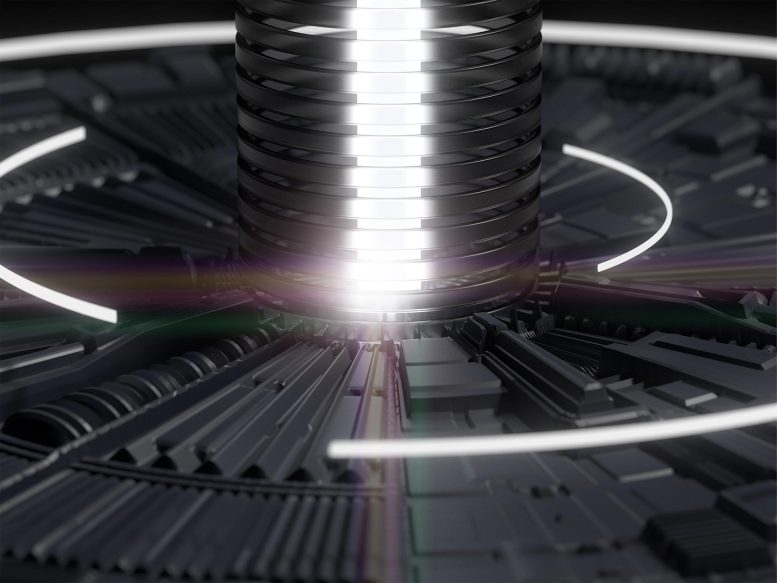
    Physics Technology Particle Collider Concept
    CERN is working on the Future Circular Collider (FCC), a possible successor to the Large Hadron Collider (LHC), with the European Strategy for Particle Physics confirming its scientific value. The FCC would be situated in a 91-kilometer tunnel between France and Switzerland, and a feasibility study has been initiated. The first phase includes a visual inspection, followed by seismic studies and drilling in 2024. Environmental aspects, such as geological characteristics and landscape effects, will be assessed, and the project must adhere to sustainable development principles. A decision about the FCC will be made in 2028, with potential commissioning in the 2040s. The FCC would optimize and extend the life of existing infrastructure while furthering our understanding of the universe.

    The first phase involves a major geographical, geological, and environmental data-gathering effort.

    CERN is exploring the Future Circular Collider (FCC) as a potential successor to the LHC, with a feasibility study underway. The FCC would be located in a 91-km tunnel between France and Switzerland. A decision on the project will be made in 2028, considering environmental and sustainable development factors. If approved, the FCC could be commissioned in the 2040s, optimizing existing infrastructure and advancing our knowledge of the universe.

    CERN’s main facility, the LHC, will complete its mission around 2040, and the international particle physics community is already working on various options for the design of the accelerator that will succeed it.

    One of these options is the Future Circular Collider (FCC), which would be installed in a tunnel measuring some 91 kilometers in circumference at a depth of between 100 and 400 meters on French and Swiss territory, passing under Lake Geneva.
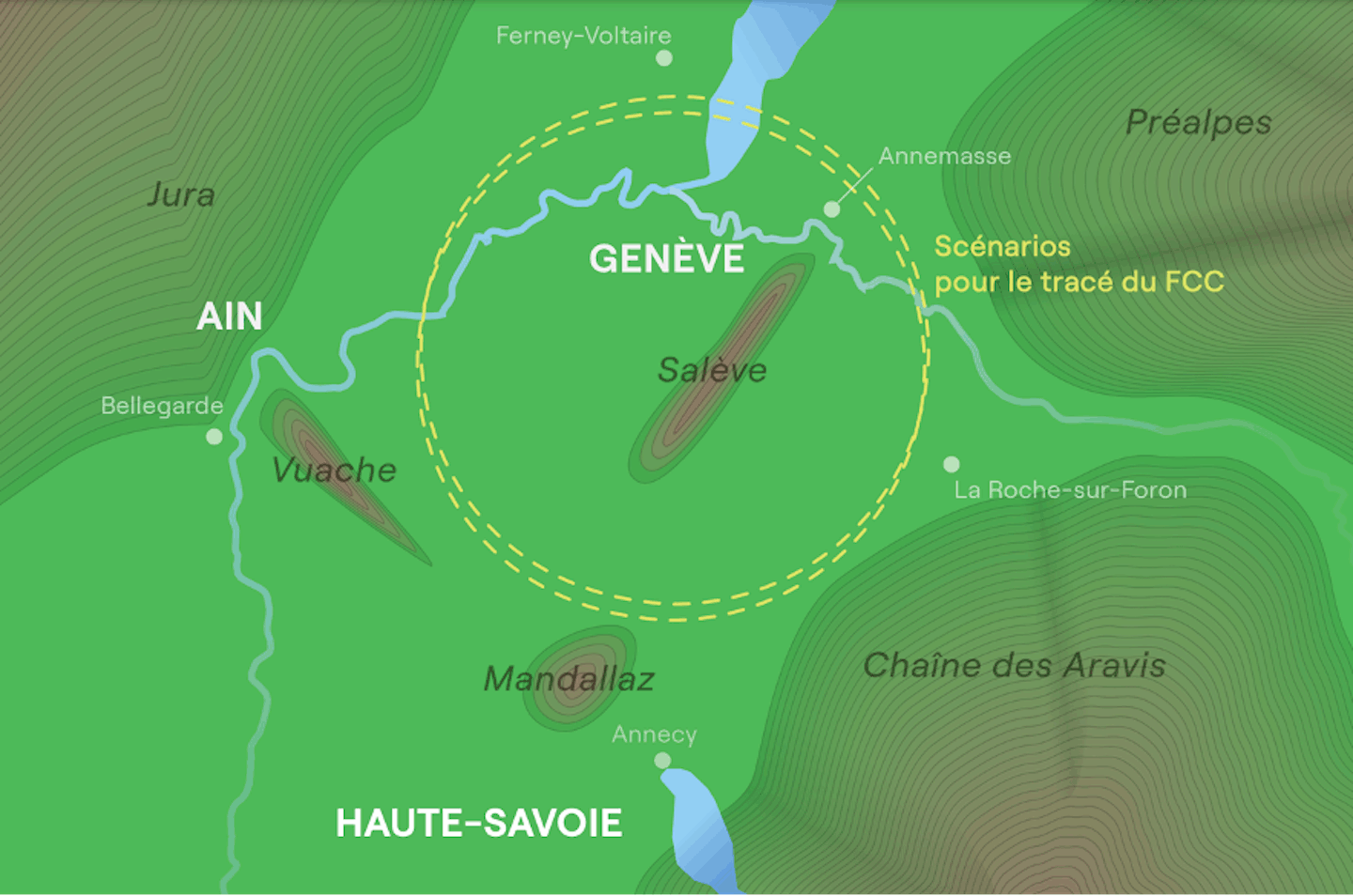
    CERN FCC Placement
    Two of the possible scenarios for the FCC’s placement. Credit: CERN

    The scientific value of the FCC was confirmed by the European Strategy for Particle Physics, which was updated by the CERN Member States in 2020, as the most suitable option to take over from the existing facilities.

    CERN was therefore tasked by its Member States with initiating the Feasibility Study.

    In 2028, depending on the results of the Study, the Member States will take a decision about the project as a whole, and in particular about the prospects for commissioning the FCC in the 2040s.

    Environmental and Geological Assessments

    For now, CERN will be conducting initial assessments on the ground in order to refine the existing geological and seismic data as well as the data on the fauna and flora for conservation purposes. The first phase will involve a visual inspection of the areas of land concerned, and will be followed in 2024 by seismic studies and drilling. The project’s environmental aspects, namely the geological characteristics of the tunnel and surface sites and the effects on the landscape, will also be studied.
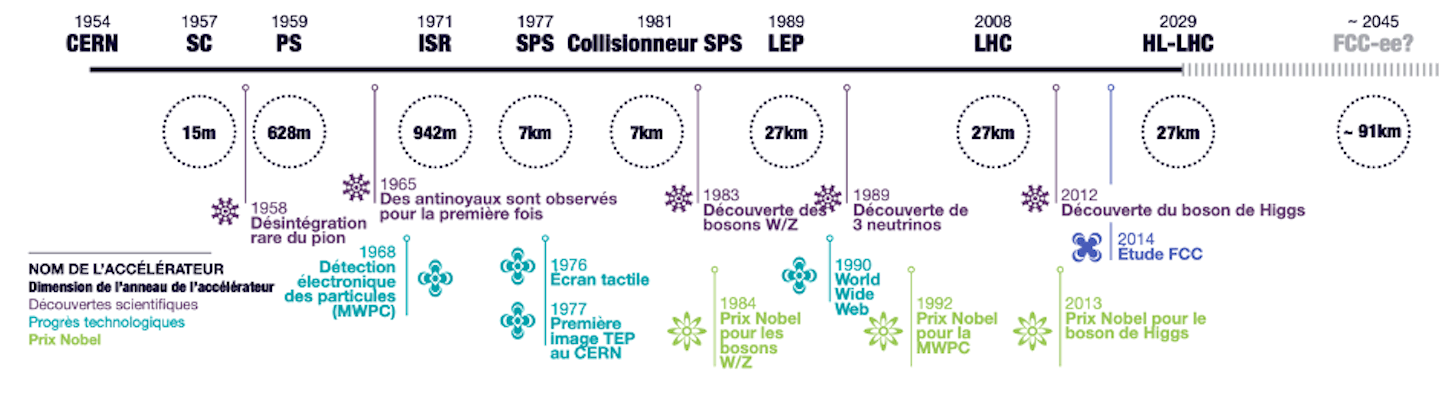
    CERN Accelerators Timeline
    Timeline of CERN’s main accelerators since the Laboratory was founded and looking ahead to the FCC. Credit: CERN

    The results of these assessments will make it possible to refine the placement scenarios and determine which should be prioritized if the project is approved, taking into account both the environmental objectives for the areas on the surface and the underground constraints.

    Environmental Commitments and Sustainable Development

    This work is being carried out in conjunction with local stakeholders to ensure that future activities will take all the relevant aspects and different interests into consideration. CERN, France, and Switzerland are working together closely to identify and resolve any issues that might arise from the FCC’s planning and construction, which must respect sustainable development principles. In this regard, CERN has already made environmental commitments in all its areas of activity, based on the “avoid–reduce–compensate” principle. It is working with local stakeholders to ensure that the project is adapted to the local area and its priorities and fosters cooperation, along the lines of the initiative that is already in place to recover waste heat from CERN’s accelerators to heat a nearby residential complex.

    Operating as part of one of the most sophisticated scientific complexes in the world, the FCC, if it goes ahead, would optimize and extend the life of the existing infrastructure until the end of the twenty-first century, while helping to further our understanding of the Universe.

    Never miss a breakthrough: Join the SciTechDaily newsletter.
    Follow us on Google and Google News.

    CERN Large Hadron Collider Particle Physics
    Share. Facebook Twitter Pinterest LinkedIn Email Reddit

    Related Articles

    New CERN Study Suggests Subatomic Particles Could Defy the Standard Model

    CERN Reports Observation of Pentaquark Particles

    Physicists Confirm Discovery of Four-Quark Hadron

    New Results Indicate That Particle Discovered at LHC Is a Higgs Boson

    The Large Hadron Collider Prepares for Shutdown

    CERN to Announce the Latest Results from ATLAS and CMS

    Discussing the Search for the Higgs Particle

    More Data of Elusive Higgs Boson from Defunct US Tevatron Collider

    Higgs Boson Signals Gain Strength at Large Hadron Collider

    2 Comments

    1. Oliver on April 7, 2023 10:18 am

      Amazes me how we have so much money to blow on this s***, when we could be concerned about sustainable fusion power. Priorities are f***ed.

      Reply
    2. Sue Hucknall on April 8, 2023 6:42 am

      Magnificent

      Reply
    Leave A Reply Cancel Reply

    • Facebook
    • Twitter
    • Pinterest
    • YouTube

    Don't Miss a Discovery

    Subscribe for the Latest in Science & Tech!

    Trending News

    Nanoscale “Defects” Unlock a Major Heat Transfer Breakthrough

    Adults Taking More Vitamin D Scored 13% Higher on a Cognitive Test

    A 35,000-Year-Old Neanderthal Pelvis May Explain Why Men and Women Walk Differently

    Dual Stem Cell Treatment Restores Vision in First Human Trial

    Your Waist Size May Reveal More About Your Health Than You Think

    Scientists Turn Red Strawberries White With a Single Gene Edit

    A SpaceX Falcon 9 Rocket Hit the Moon and Blasted Open a 60-Foot Crater

    Study Reveals Your Organs May Be Aging at Very Different Speeds

    Follow SciTechDaily
    • Facebook
    • Twitter
    • YouTube
    • Pinterest
    • Newsletter
    • RSS
    SciTech News
    • Biology News
    • Chemistry News
    • Earth News
    • Health News
    • Physics News
    • Science News
    • Space News
    • Technology News
    Recent Posts
    • FDA Clears First-of-Its-Kind Nonmedication Treatment for PTSD
    • Quantum Simulators Put a 40-Year-Old Physics Theory to the Test
    • 125-Million-Year-Old Crocodile Fossil Reveals Astonishing New Secrets
    • Scientists Discover an “Impossible” Way Muscle Filaments Can Grow
    • Scientists Discover a Mysterious New Snake Species Hiding in New Guinea
    Copyright © 1998 - 2026 SciTechDaily. All Rights Reserved.
    • Science News
    • About
    • Contact
    • Editorial Board
    • Privacy Policy
    • Terms of Use

    Type above and press Enter to search. Press Esc to cancel.