
Close Menu
    Facebook X (Twitter) Instagram
    SciTechDaily
    • Biology
    • Chemistry
    • Earth
    • Health
    • Physics
    • Science
    • Space
    • Technology
    Facebook X (Twitter) Pinterest YouTube RSS
    SciTechDaily
    Home»Space»Cassini Views Saturn’s Hexagonal Shaped Jet Stream
    Space

    Cassini Views Saturn’s Hexagonal Shaped Jet Stream

    By Jet Propulsion LaboratoryFebruary 4, 20142 Comments2 Mins Read
    Facebook Twitter Pinterest Telegram LinkedIn WhatsApp Email Reddit
    Share
    Facebook Twitter LinkedIn Pinterest Telegram Email Reddit
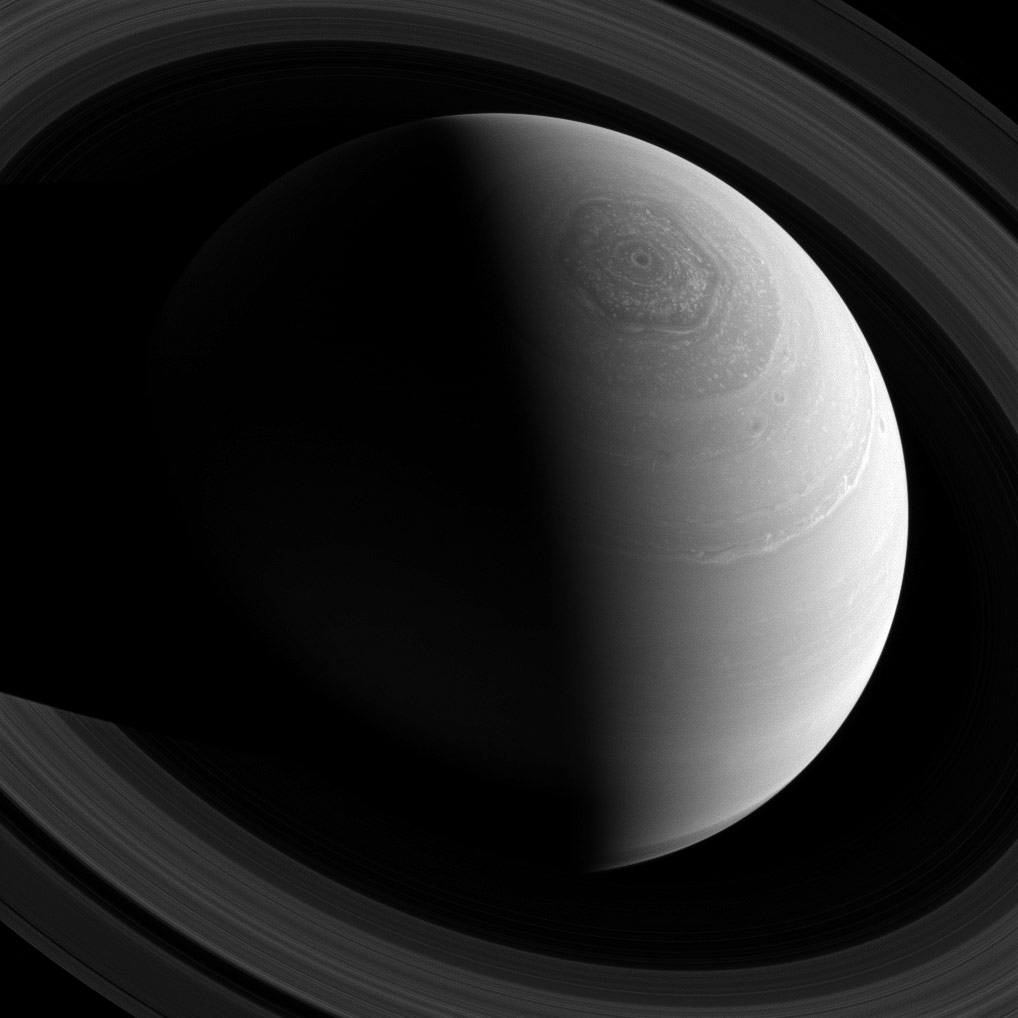
    New Image of Saturns Hexagonal Shaped Jet Stream
     Saturn’s hexagonal shaped jet stream. Credit: NASA/JPL-Caltech/Space Science Institute

    This newly released image from the Cassini spacecraft shows Saturn’s hexagonal shaped jet stream.

    Just as Saturn’s famous hexagonal shaped jet stream encircles the planet’s north pole, the rings encircle the planet, as seen from Cassini’s position high above. Around and around everything goes!

    This view looks toward the sunlit side of the rings from about 43 degrees above the ringplane. The image was taken with the Cassini spacecraft wide-angle camera on November 23, 2013, using a spectral filter that preferentially admits wavelengths of near-infrared light centered at 752 nanometers.

    The view was obtained at a distance of approximately 1.6 million miles (2.5 million kilometers) from Saturn and at a Sun-Saturn-spacecraft, or phase, angle of 97 degrees. Image scale is 93 miles (150 kilometers) per pixel.
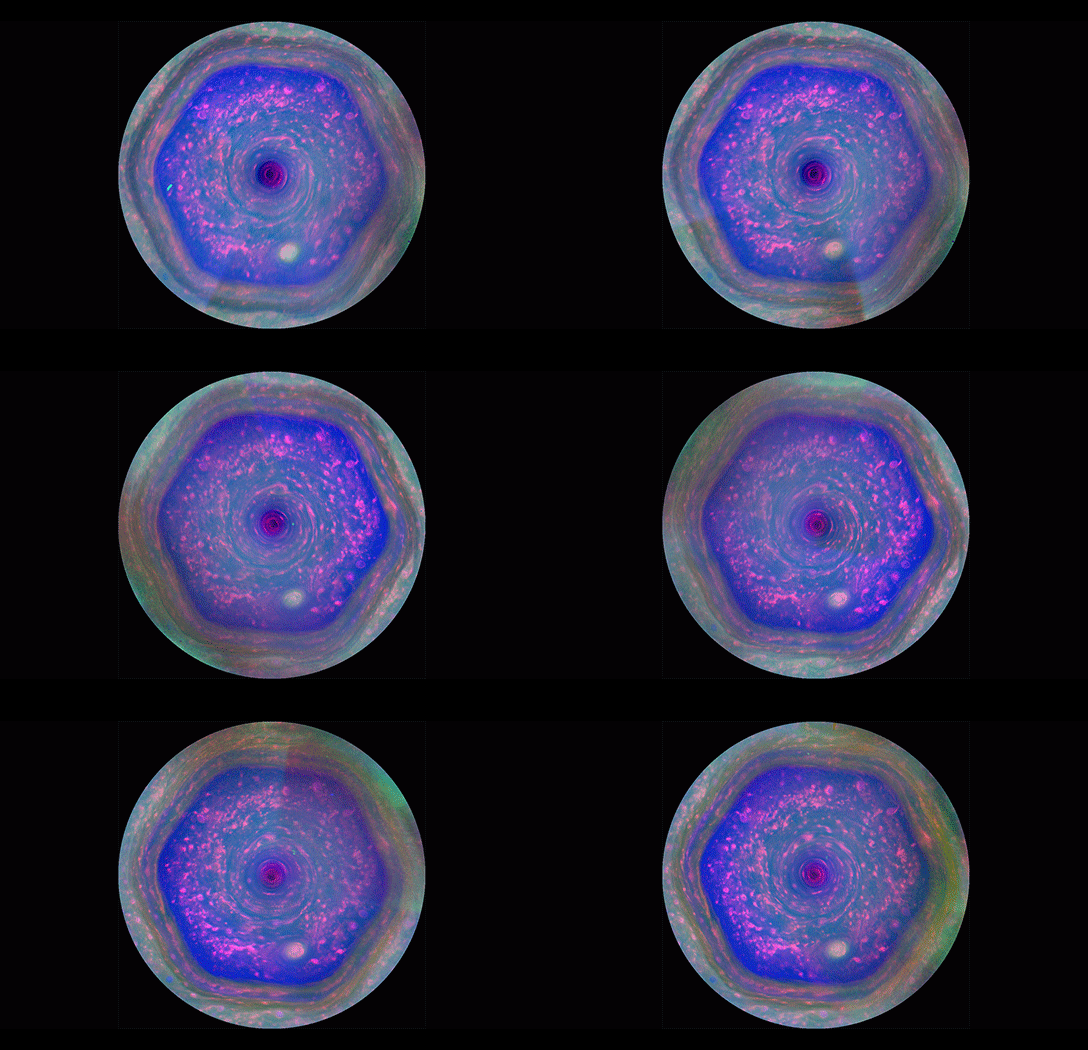
    Saturns Hexagonal Shaped Jet Stream
    This colorful view from NASA’s Cassini mission is the highest-resolution view of the unique six-sided jet stream at Saturn’s north pole known as “the hexagon.” This movie, made from images obtained by Cassini’s imaging cameras, is the first to show the hexagon in color filters, and the first movie to show a complete view from the north pole down to about 70 degrees north latitude. Credit: NASA/JPL-Caltech/SSI/Hampton University

    The Cassini-Huygens mission is a cooperative project of NASA, the European Space Agency, and the Italian Space Agency. The Jet Propulsion Laboratory, a division of the California Institute of Technology in Pasadena, manages the mission for NASA’s Science Mission Directorate, Washington, D.C. The Cassini orbiter and its two onboard cameras were designed, developed, and assembled at JPL. The imaging operations center is based at the Space Science Institute in Boulder, Colorado.

    Never miss a breakthrough: Join the SciTechDaily newsletter.
    Follow us on Google and Google News.

    Astronomy Cassini-Huygens Mission JPL NASA Saturn
    Share. Facebook Twitter Pinterest LinkedIn Email Reddit

    Related Articles

    New NASA Video Shows a 360-Degree View of Saturn’s Auroras

    New Cassini Images of Saturn and Its Moons

    Cassini Provides New View of Saturn and Earth

    Cassini Data Suggests Saturn’s Moons and Rings Are More Than 4 Billion Years Old

    Storm Spawns the Largest Tropospheric Vortex Ever Seen on Saturn

    New Cassini Image of Saturn and Its Rings

    NASA’s Cassini Spots Lightning in Saturn’s Northern Hemisphere

    Cassini Data Reveals Likely Subsurface Ocean on Titan

    Heat from Within the Planet Powers Saturn’s Jet Streams

    2 Comments

    1. Amir Zaidi on February 4, 2014 8:09 am

      Is this even remotely understood in terms of a fluid dynamics model or some concrete physical theory?

      Reply
      • Staff on February 4, 2014 8:23 am

        Added lower image…JPL has “a movie made from images obtained by Cassini’s imaging cameras, it is the first to show the hexagon in color filters, and the first movie to show a complete view from the north pole down to about 70 degrees north latitude.”
        http://www.jpl.nasa.gov/news/news.php?release=2013-350

        Reply
    Leave A Reply Cancel Reply

    • Facebook
    • Twitter
    • Pinterest
    • YouTube

    Don't Miss a Discovery

    Subscribe for the Latest in Science & Tech!

    Trending News

    Scientists May Have Discovered How To Heal Damaged Kidneys

    Interstellar Visitor 3I/ATLAS Is Bursting With an Unexpected Chemical

    Scientists Just Found All 5 Genetic “Letters” of DNA and RNA on an Asteroid

    The 4,000-Year-Old City That Defied History’s Rules on Wealth and Power

    The World’s Biggest Population Fear Has Flipped – and It Could Change Everything

    This “Fake” Pill Improved Memory and Physical Performance in Just 3 Weeks

    Scientists Say Frequent Ejaculation May Improve Sperm Quality and Fertility

    Scientists Have Found “The Heaven Sword” After Years of Looking

    Follow SciTechDaily
    • Facebook
    • Twitter
    • YouTube
    • Pinterest
    • Newsletter
    • RSS
    SciTech News
    • Biology News
    • Chemistry News
    • Earth News
    • Health News
    • Physics News
    • Science News
    • Space News
    • Technology News
    Recent Posts
    • Scientists Create Tiny “Mini Livers” That Could One Day Replace Liver Transplants
    • This Surprising Factor May Predict Heart Disease Decades Before It Strikes
    • New Nonsurgical Knee Treatment Delivers Lasting Pain Relief
    • Scientists Discover Hidden Rule That Could Make Fuel Cells Cheaper and More Powerful
    • New Water-Harvesting Jacket Pulls up to 30 Ounces of Drinking Water From the Air Daily
    Copyright © 1998 - 2026 SciTechDaily. All Rights Reserved.
    • Science News
    • About
    • Contact
    • Editorial Board
    • Privacy Policy
    • Terms of Use

    Type above and press Enter to search. Press Esc to cancel.