
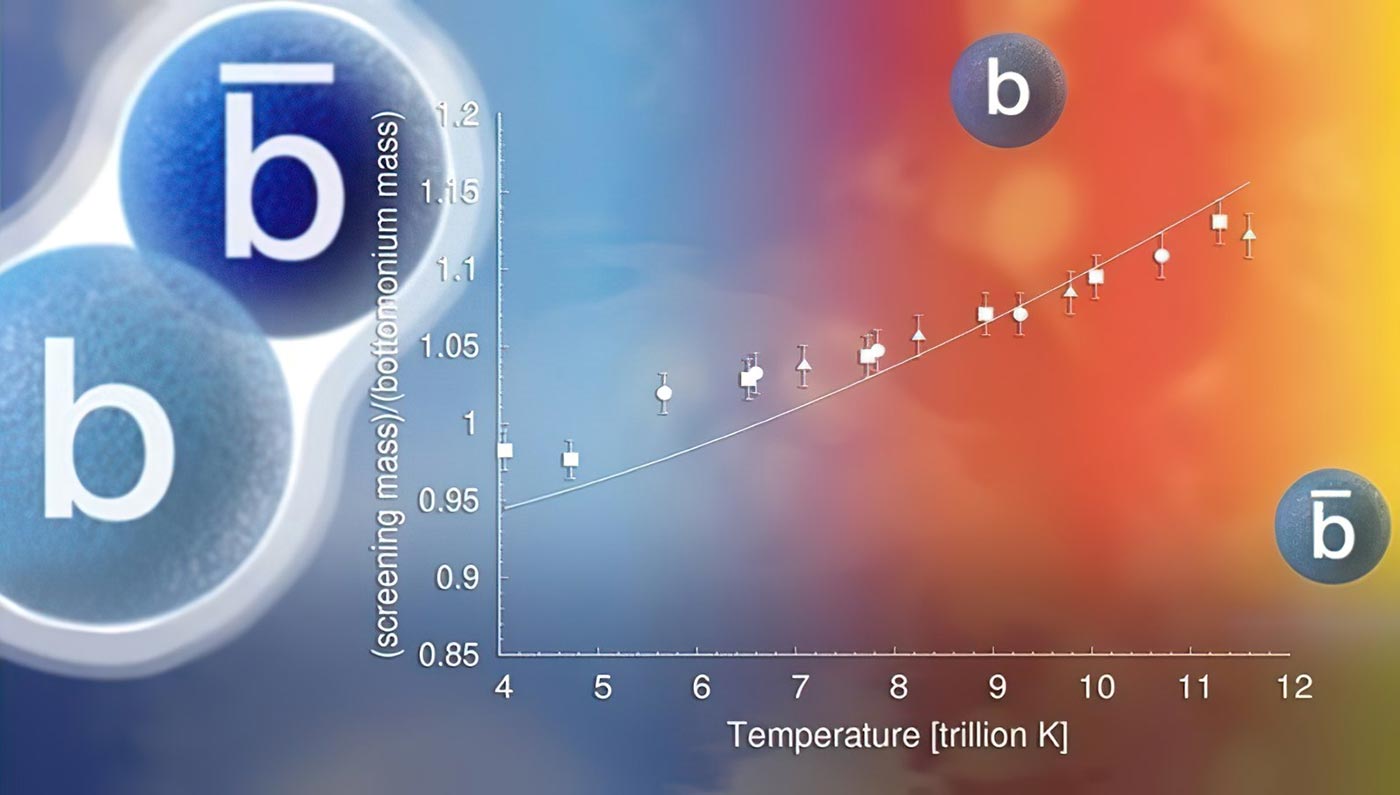
Scientists’ calculations indicate that bottomonium mesons, formed by a bottom quark and its antimatter counterpart, require temperatures above 5.8 trillion degrees Celsius to melt. This offers insight into why fewer bottomonium particles are observed in high-energy collisions at the Large Hadron Collider compared to the Relativistic Heavy Ion Collider, and provides new avenues for studying quark-gluon plasma properties.
The Science
Theorists have performed calculations to predict the temperature at which bottomonium mesons will melt. Bottomonium mesons are particles made of one of the six types of quark: a heavy bottom quark bound to its antimatter partner, an antibottom quark. Bottomonium mesons come in several different states. The two particles can be bound loosely, more tightly, and very tightly (creating the smallest bottomonium meson). The calculations show that the smallest bottomonium particles can stay intact at very high temperatures and require extreme conditions to melt.
The Impact
The findings offer a possible explanation for why scientists observe fewer bottomonium particles in heavy ion collisions at the Large Hadron Collider (LHC) than at the Relativistic Heavy Ion Collider (RHIC). The LHC particle accelerator is at CERN in Europe, and the RHIC is a Department of Energy user facility at Brookhaven National Laboratory. Collisions between atomic nuclei at both facilities can melt protons and neutrons to set free the quarks and gluons within. However, the resulting quark-gluon plasma (QGP) may not be sufficiently hot to completely melt bottomonium. These collisions can still produce bottomonium particles, albeit at a lower rate. This theoretical guidance could advance the use of bottomonium melting as a tool for studying the properties of QGP.
Summary
To determine the temperature at which bottomonium states melt in the quark-gluon plasma, scientists at Brookhaven Lab, Homi Bhabha National Institute in India, and Humboldt-University in Berlin calculated meson correlation functions. These functions are a measure of the interaction between the quark and antiquark making up bottomonium. The researchers used powerful supercomputers and a technique called lattice quantum chromodynamics (QCD) to model the interactions in one of the spatial dimensions. They found that this correlation function decays exponentially in the spatial separation. The rate of this exponential decay is related to the screening mass. The value of the screening mass is related to the binding energy between the bottom (b) quark and the anti-b quark. The temperature dependence of this screening mass is very different depending on whether the heavy quark and anti-quark are bound inside a meson or move independently in QGP as an unbound pair (such as if the meson has melted).
The lattice QCD calculations show that only for temperatures above 5.8 trillion degrees Celsius is the behavior of the screening masses consistent with the expectations of an unbound b quark and anti-b quark. Therefore, the smallest bottomonium (one five times smaller than a proton) only melts at this temperature. Scientists do not expect to reach such temperatures in heavy ion collisions at RHIC, and they can only achieve these temperatures in heavy ion collisions at LHC for a short time. This may explain the significant bottomonium yield at both RHIC and LHC.
Reference: “Bottomonium melting from screening correlators at high temperature” by Peter Petreczky, Sayantan Sharma and Johannes Heinrich Weber, 24 September 2021, Physical Review D.
DOI: 10.1103/PhysRevD.104.054511
This research was funded by the Department of Energy Office of Science, Nuclear Physics program.
Never miss a breakthrough: Join the SciTechDaily newsletter.
Follow us on Google and Google News.
2 Comments
Today’s physics has long been in line with theology rather than science, which is the vilest and unforgettable era in the history of human science. It deceives and mocks the wisdom of the public, which can be described as unprecedented.
Thank you will keep in touch