
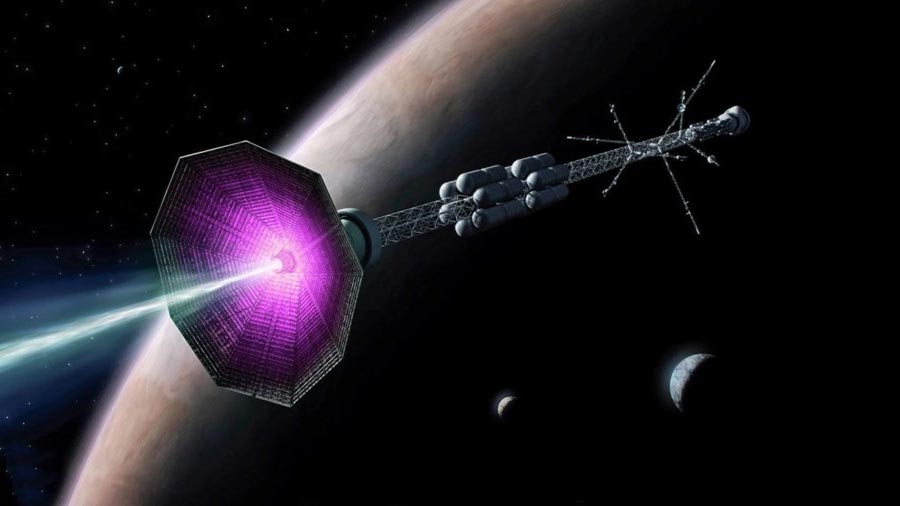
A new rocket thruster using magnetic reconnection could enable much faster space travel.
A new type of rocket thruster that could take humankind to Mars and beyond has been proposed by a physicist at the U.S. Department of Energy’s (DOE) Princeton Plasma Physics Laboratory (PPPL).
The device would apply magnetic fields to cause particles of plasma, electrically charged gas also known as the fourth state of matter, to shoot out the back of a rocket and, because of the conservation of momentum, propel the craft forward. Current space-proven plasma thrusters use electric fields to propel the particles.
The new concept would accelerate the particles using magnetic reconnection, a process found throughout the universe, including the surface of the sun, in which magnetic field lines converge, suddenly separate, and then join together again, producing lots of energy. Reconnection also occurs inside doughnut-shaped fusion devices known as tokamaks.
“I’ve been cooking this concept for a while,” said PPPL Principal Research Physicist Fatima Ebrahimi, the concept’s inventor and author of a paper detailing the idea in the Journal of Plasma Physics. “I had the idea in 2017 while sitting on a deck and thinking about the similarities between a car’s exhaust and the high-velocity exhaust particles created by PPPL’s National Spherical Torus Experiment (NSTX),” the forerunner of the laboratory’s present flagship fusion facility. “During its operation, this tokamak produces magnetic bubbles called plasmoids that move at around 20 kilometers per second, which seemed to me a lot like thrust.”
Fusion and Plasma: Power of the Universe on a Spacecraft
Fusion, the power that drives the sun and stars, combines light elements in the form of plasma — the hot, charged state of matter composed of free electrons and atomic nuclei that represents 99% of the visible universe — to generate massive amounts of energy. Scientists are seeking to replicate fusion on Earth for a virtually inexhaustible supply of power to generate electricity.
Current plasma thrusters that use electric fields to propel the particles can only produce low specific impulse, or speed. But computer simulations performed on PPPL computers and the National Energy Research Scientific Computing Center, a DOE Office of Science User Facility at Lawrence Berkeley National Laboratory in Berkeley, California, showed that the new plasma thruster concept can generate exhaust with velocities of hundreds of kilometers per second, 10 times faster than those of other thrusters.
That faster velocity at the beginning of a spacecraft’s journey could bring the outer planets within reach of astronauts, Ebrahimi said. “Long-distance travel takes months or years because the specific impulse of chemical rocket engines is very low, so the craft takes a while to get up to speed,” she said. “But if we make thrusters based on magnetic reconnection, then we could conceivably complete long-distance missions in a shorter period of time.”
Three Key Innovations in Ebrahimi’s Thruster Design
There are three main differences between Ebrahimi’s thruster concept and other devices. The first is that changing the strength of the magnetic fields can increase or decrease the amount of thrust. “By using more electromagnets and more magnetic fields, you can in effect turn a knob to fine-tune the velocity,” Ebrahimi said.
Second, the new thruster produces movement by ejecting both plasma particles and magnetic bubbles known as plasmoids. The plasmoids add power to the propulsion and no other thruster concept incorporates them.
Third, unlike current thruster concepts that rely on electric fields, the magnetic fields in Ebrahimi’s concept allow the plasma inside the thruster to consist of either heavy or light atoms. This flexibility enables scientists to tailor the amount of thrust for a particular mission. “While other thrusters require heavy gas, made of atoms like xenon, in this concept you can use any type of gas you want,” Ebrahimi said. Scientists might prefer light gas in some cases because the smaller atoms can get moving more quickly.
This concept broadens PPPL’s portfolio of space propulsion research. Other projects include the Hall Thruster Experiment which was started in 1999 by PPPL physicists Yevgeny Raitses and Nathaniel Fisch to investigate the use of plasma particles for moving spacecraft. Raitses and students are also investigating the use of tiny Hall thrusters to give small satellites called CubeSats greater maneuverability as they orbit the Earth.
Ebrahimi stressed that her thruster concept stems directly from her research into fusion energy. “This work was inspired by past fusion work and this is the first time that plasmoids and reconnection have been proposed for space propulsion,” Ebrahimi said. “The next step is building a prototype!”
Reference: “An Alfvenic reconnecting plasmoid thruster” by Fatima Ebrahimi, 21 December 2020, Journal of Plasma Physics.
DOI: 10.1017/S0022377820001476
Support for this research came from the DOE Office of Science (Fusion Energy Sciences) and Laboratory Directed Research and Development (LDRD) funds made available through the Office of Science.
Never miss a breakthrough: Join the SciTechDaily newsletter.
Follow us on Google and Google News.
7 Comments
Interesting concept , be curious with the power consumption required to achieve the plasma and magnetic bubbles described . For instance using so-called high-temperature superconductors and argon gas . Definitely need to be looking at new concepts if we ever hope to get off this rock. And yes a government definitely needs to provide seed money for such research.
Why not use the VASIMR plasma drive that has already been developed? I agree this concept has more functionality, but VASIMR will get you to Mars and it’s ready to go!
“The required power generation technology for fast interplanetary travel does not currently exist and is not feasible with current state-of-the-art technology.”
[“Variable Specific Impulse Magnetoplasma Rocket” @ Wikipedia]
Paper here: https://arxiv.org/pdf/2011.04192.pdf .
I’d never thought solar/planetary scale magnetic reconnections could become technology, but this scales very well! Apparently the astronomical environment is low magnetic diffusivity and/or high temperature, here they use “strong” 0.1 T magnetic field instead. They get down to a meter scale drive chamber with natural pulse drift, they can control the exhaust velocity with the magnetic field and it takes most any gas as propellant. The only chamber erosion they foresee is at the plasmoid formation site.
The downer is that it is no different from other ion thrusters in having relatively low thrust and high power requirement. So it is still a weighty complement, not a complete system like a chemically driven rocket.
How nice of them to use a flipped recolored artwork. That way they don’t have to credit the original artist. Very scummy
https://www.wboc.com/story/43525382/antimatter-rocket-for-future-space-exploration
Antimatter Rocket for Future Space Exploration
This is NOT new technology and it is a waste of time and money !