
Close Menu
    Facebook X (Twitter) Instagram
    SciTechDaily
    • Biology
    • Chemistry
    • Earth
    • Health
    • Physics
    • Science
    • Space
    • Technology
    Facebook X (Twitter) Pinterest YouTube RSS
    SciTechDaily
    Home»Chemistry»Brewing Beer That Tastes Fresh Longer Using Chemistry and Genetics
    Chemistry

    Brewing Beer That Tastes Fresh Longer Using Chemistry and Genetics

    By American Chemical SocietyDecember 6, 2019No Comments2 Mins Read
    Facebook Twitter Pinterest Telegram LinkedIn WhatsApp Email Reddit
    Share
    Facebook Twitter LinkedIn Pinterest Telegram Email Reddit
    Fresh Tasting Beer
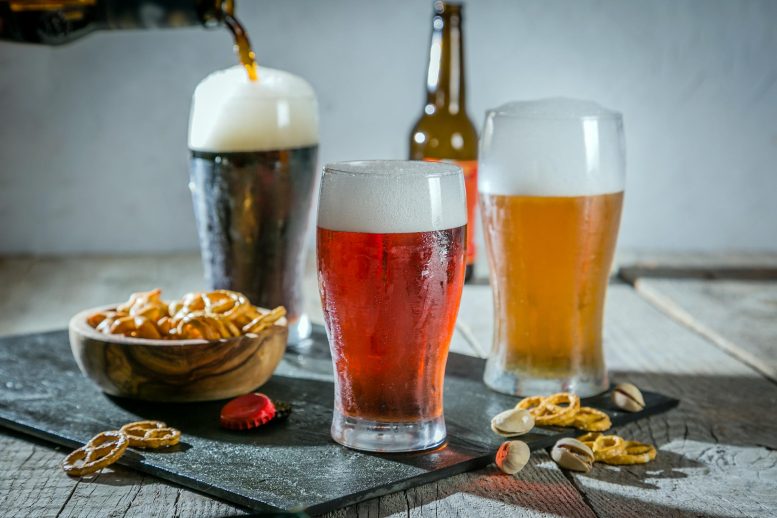
    Researchers have modified lager yeast to produce more molecules that prevent beer from spoiling, hence enhancing taste stability.

    Unlike wine, which generally improves with time, beer does not age well. Usually within a year of bottling, the beverage starts to develop an unpleasant papery or cardboard-like flavor that drinkers describe as “stale.” Now, researchers reporting in ACS’ Journal of Agricultural and Food Chemistry have engineered lager yeast to make more molecules that protect beer against staling, resulting in improved flavor stability.

    Scientists have linked stale beer flavors to aldehyde compounds, such as (E)-2-nonenal and acetaldehyde. Many of these compounds are produced by yeast during fermentation, and chemical reactions during beer storage can increase their levels. Brewers have tried different approaches to reduce levels of these compounds, such as controlling the fermentation conditions or adding antioxidants, but staling remains a problem for the beer industry. That’s why Qi Li and colleagues wanted to genetically modify lager yeast to produce more of a molecule called NADH. Extra NADH could boost the activities of natural yeast enzymes that change aldehydes into other types of compounds that don’t contribute to a stale flavor, the researchers reasoned.

    The researchers used a genetic technique called “overexpression,” in which they artificially increased the levels of various genes related to NADH production. With this method, they identified four genes that, when overexpressed, increased NADH levels. The team found that beer from the overexpressing yeast contained 26.3-47.3% less acetaldehyde than control beer, as well as decreased levels of other aldehydes. In addition, the modified strains produced more sulfur dioxide, a natural antioxidant that also helps reduce staling. Other flavor components were marginally changed. This approach could be useful for improving the flavor stability and prolonging the shelf life of beer, the researchers say.

    Reference: “Higher NADH availability of lager yeast increases the flavor stability of beer” by Xin Xu, Yumei Song, Liyun Guo, Wang Qi Cheng, Yu Zhou, Xinge Li, Yingjian Mu and Qi Li, 17 October 2019, Journal of Agricultural and Food Chemistry.
    DOI: 10.1021/acs.jafc.9b05812

    The authors acknowledge funding from the National Natural Science Foundation of China, Priority Academic Program Development of Jiangsu Higher Education Institutions, Program of Introducing Talents of Discipline to Universities, Postgraduate Research & Practice Innovation Program of Jiangsu Province, the Fundamental Research Funds for the Central Universities and China Scholarship Council.

    Never miss a breakthrough: Join the SciTechDaily newsletter.
    Follow us on Google and Google News.

    Alcohol American Chemical Society Food Science Genetics
    Share. Facebook Twitter Pinterest LinkedIn Email Reddit

    Related Articles

    Four New Discoveries About Beer and Wine That Might Change How You Drink

    Making Apple Spirits – Such As Calvados and Applejack Brandy – Taste Better

    Researchers Slow Down Grape Ripening to Improve Berry Quality for Winemaking

    New Method to Separate Beer Waste Into Proteins for Foods, and Fiber for Biofuels

    Small Molecule Identified That Targets Genes of COVID-19 Virus for Destruction

    Rice Genetically Altered to Contain Anti-Hypertensive Peptides – Eating a Spoonful Lowers Blood Pressure

    Diagnostic Biosensor Detects SARS-CoV-2 From Nasopharyngeal Swab in Less Than a Minute

    Human Cells Made Magnetic With Engineered Protein Crystals

    What’s in Dog Food? The Fascinating Chemistry Behind Kibble.

    Leave A Reply Cancel Reply

    • Facebook
    • Twitter
    • Pinterest
    • YouTube

    Don't Miss a Discovery

    Subscribe for the Latest in Science & Tech!

    Trending News

    The Universe Is Expanding Too Fast and Scientists Can’t Explain Why

    “Like Liquid Metal”: Scientists Create Strange Shape-Shifting Material

    Early Warning Signals of Esophageal Cancer May Be Hiding in Plain Sight

    Common Blood Pressure Drug Shows Surprising Power Against Deadly Antibiotic-Resistant Superbug

    Scientists Uncover Dangerous Connection Between Serotonin and Heart Valve Disease

    Scientists Discover a “Protector” Protein That Could Help Reverse Hair Loss

    Bone-Strengthening Discovery Could Reverse Osteoporosis

    Scientists Uncover Hidden Trigger Behind Stem Cell Aging

    Follow SciTechDaily
    • Facebook
    • Twitter
    • YouTube
    • Pinterest
    • Newsletter
    • RSS
    SciTech News
    • Biology News
    • Chemistry News
    • Earth News
    • Health News
    • Physics News
    • Science News
    • Space News
    • Technology News
    Recent Posts
    • Scientists Overcome Major Quantum Bottleneck, Potentially Transforming Teleportation and Computing
    • Quantum Physics’ Strangest Problem May Hold the Key to Time Itself
    • Scientists Create “Liquid Gears” That Spin Without Touching
    • The Simple Habit That Could Help Prevent Cancer
    • Forgotten Medicinal Plant Shows Promise in Fighting Dangerous Superbugs
    Copyright © 1998 - 2026 SciTechDaily. All Rights Reserved.
    • Science News
    • About
    • Contact
    • Editorial Board
    • Privacy Policy
    • Terms of Use

    Type above and press Enter to search. Press Esc to cancel.