
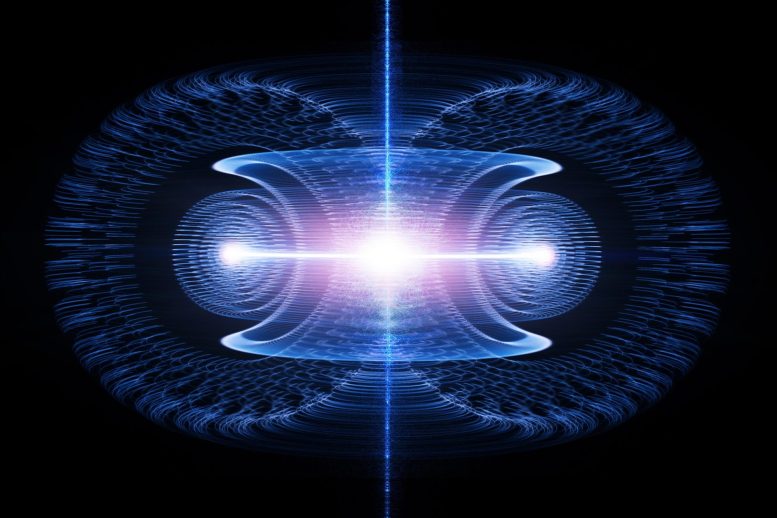
PPPL’s new device mitigates disruptions in fusion reactors by firing high-speed projectiles to cool plasma. It offers a faster response than existing methods.
When ITER, the international fusion experiment, starts up in 2025, one of the major priorities will be to minimize or mitigate violent disruptions that could seriously damage the massive machine. Scientists at the U.S. Department of Energy’s (DOE) Princeton Plasma Physics Laboratory (PPPL) have developed and successfully simulated a prototype of a new device to lessen the impacts of a damaging disruption before one can proceed.
Risk of Disruptions
The risk of disruption applies to all doughnut-shaped facilities known as “tokamaks,” which are widely used in the worldwide effort to capture the fusion energy that powers the sun and stars on Earth. Tokamaks employ enormous magnetic fields to confine the state of matter known as plasma, which powers fusion reactions, and heat it to temperatures several times that of the sun. This causes the atomic nuclei, or ions, in plasma to combine and unleash vast amounts of energy. The goal is to create a safe and clean source of power for generating the world’s electricity.
Disruptions occur when the magnetic bottle used to confine the hot plasma becomes unstable, causing large electromagnetic forces and thermal loads to slam against the vessel’s walls. The bottle resembles a gas balloon with the gas gradually leaking out. A mitigation system cannot stop the disruption, which is like a sudden rupture in the skin of the balloon, but can only adjust how the disruption evolves to limit damage to the reactor components.
Electromagnetic Particle Injector
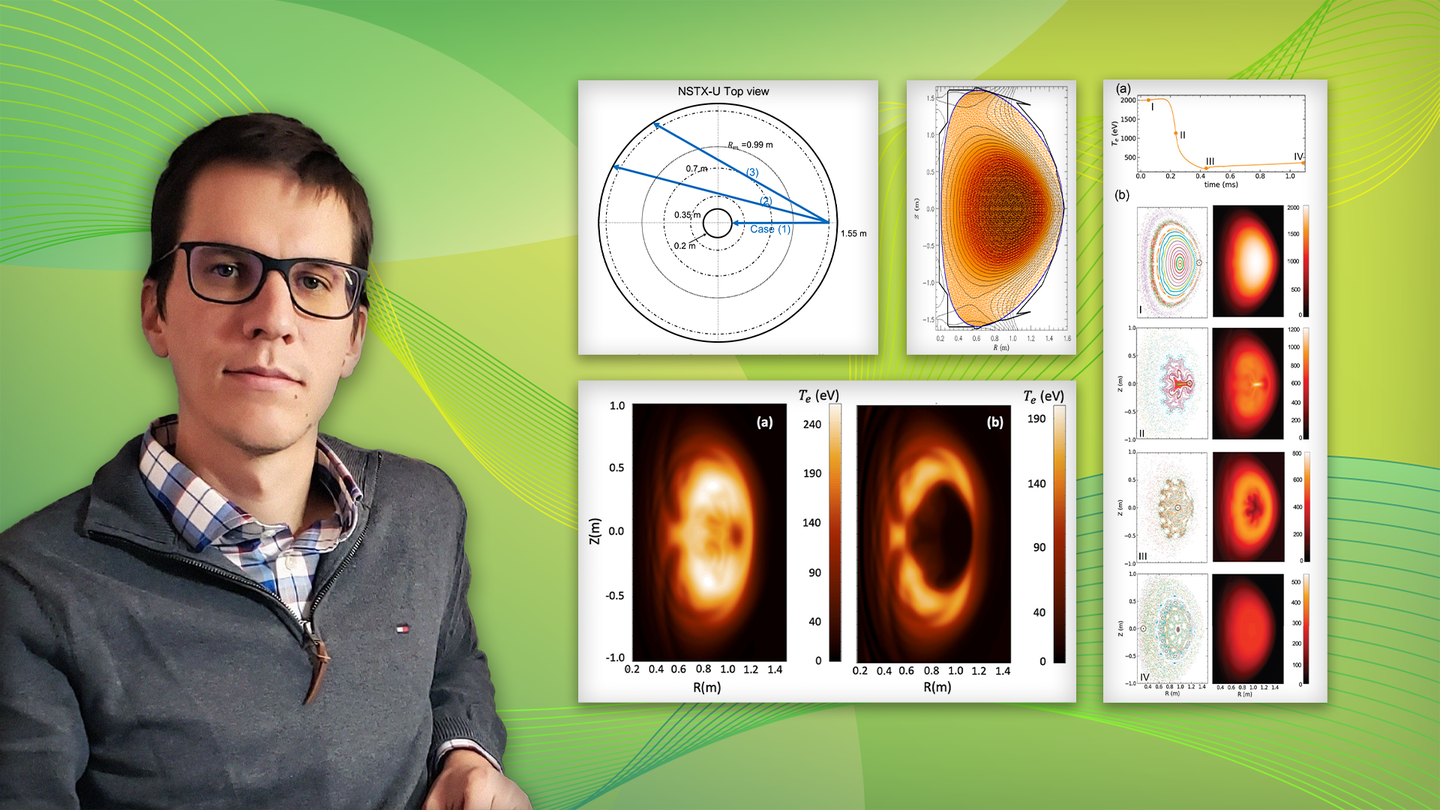
The simulated railgun-like device, called an “electromagnetic particle injector” (EPI), is designed to mitigate the problem by firing a high-speed projectile of material that will radiate away the energy in the core of the plasma at the first sign of a disruption. The payload will cool and shut down the reaction in a controlled manner to avoid damage to the walls of the reactor chamber.
Researchers modeled the pellet injector with a PPPL fusion code that describes plasma as a fluid that conducts electricity. “This has been a very challenging simulation,” said physicist Cesar Clauser, a postdoctoral researcher at Lehigh University assigned to PPPL and the first author of a paper describing the modeling process in Nuclear Fusion. “This work marks an important step towards the study, modelling and planning of disruption mitigation systems that will be extremely important for future fusion devices,” Clauser said.
The pellet injector could serve as an alternative to the mitigation system presently planned for ITER, which aims to demonstrate the practicality of reproducing fusion energy on Earth. Current plans for controlling ITER disruptions call for shattering gas-propelled frozen gas pellets against a metal plate to spread fusion reaction-cooling shards into the edge of the plasma.
Ten Times Faster
However, “The electromagnetic system is 10 times faster,” said Roger Raman, a University of Washington physicist on long-term assignment to PPPL, a principal designer of the EPI and a co-author of the paper. The bullet-like high-speed projectile could create a near-instant response to the initial warning of a disruption that could unfold in one-to-two thousandths of a second, Raman said, a period known as the thermal quench timescale.
Plans now call for testing the injector, which is under further development at PPPL, on the flagship National Spherical Torus Experiment (NSTX-U) at the Laboratory when the facility is back online. The injector could be tested on other tokamaks as well. “Simulations must be validated by comparison with experiments,” said Steve Jardin, head of the macroscopic stability group in the Theory Department at PPPL, co-author of the paper and a co-developer of the PPPL code that the researchers pushed to its limits to produce the simulation.
The research thus far suggests that the injector has the potential to counter disruptions that threaten to arise on ITER. Simulations going forward, said Clauser, will focus on responses to the payload of more targeted configurations of the plasma.
Reference: “Modeling of carbon pellets disruption mitigation in an NSTX-U plasma” by C.F. Clauser, S.C. Jardin, R. Raman, B.C. Lyons and N.M. Ferraro, 4 October 2021, Nuclear Fusion.
DOI: 10.1088/1741-4326/ac233b
PPPL, on Princeton University’s Forrestal Campus in Plainsboro, N.J., is devoted to creating new knowledge about the physics of plasmas — ultra-hot, charged gases — and to developing practical solutions for the creation of fusion energy.
Never miss a breakthrough: Join the SciTechDaily newsletter.
Follow us on Google and Google News.