
Close Menu
    Facebook X (Twitter) Instagram
    SciTechDaily
    • Biology
    • Chemistry
    • Earth
    • Health
    • Physics
    • Science
    • Space
    • Technology
    Facebook X (Twitter) Pinterest YouTube RSS
    SciTechDaily
    Home»Physics»Nuclear Physicists Use High-Energy Electron Beam To Hunt for Clues of Color Transparency in Protons
    Physics

    Nuclear Physicists Use High-Energy Electron Beam To Hunt for Clues of Color Transparency in Protons

    By U.S. Department of EnergyAugust 16, 2021No Comments3 Mins Read
    Facebook Twitter Pinterest Telegram LinkedIn WhatsApp Email Reddit
    Share
    Facebook Twitter LinkedIn Pinterest Telegram Email Reddit
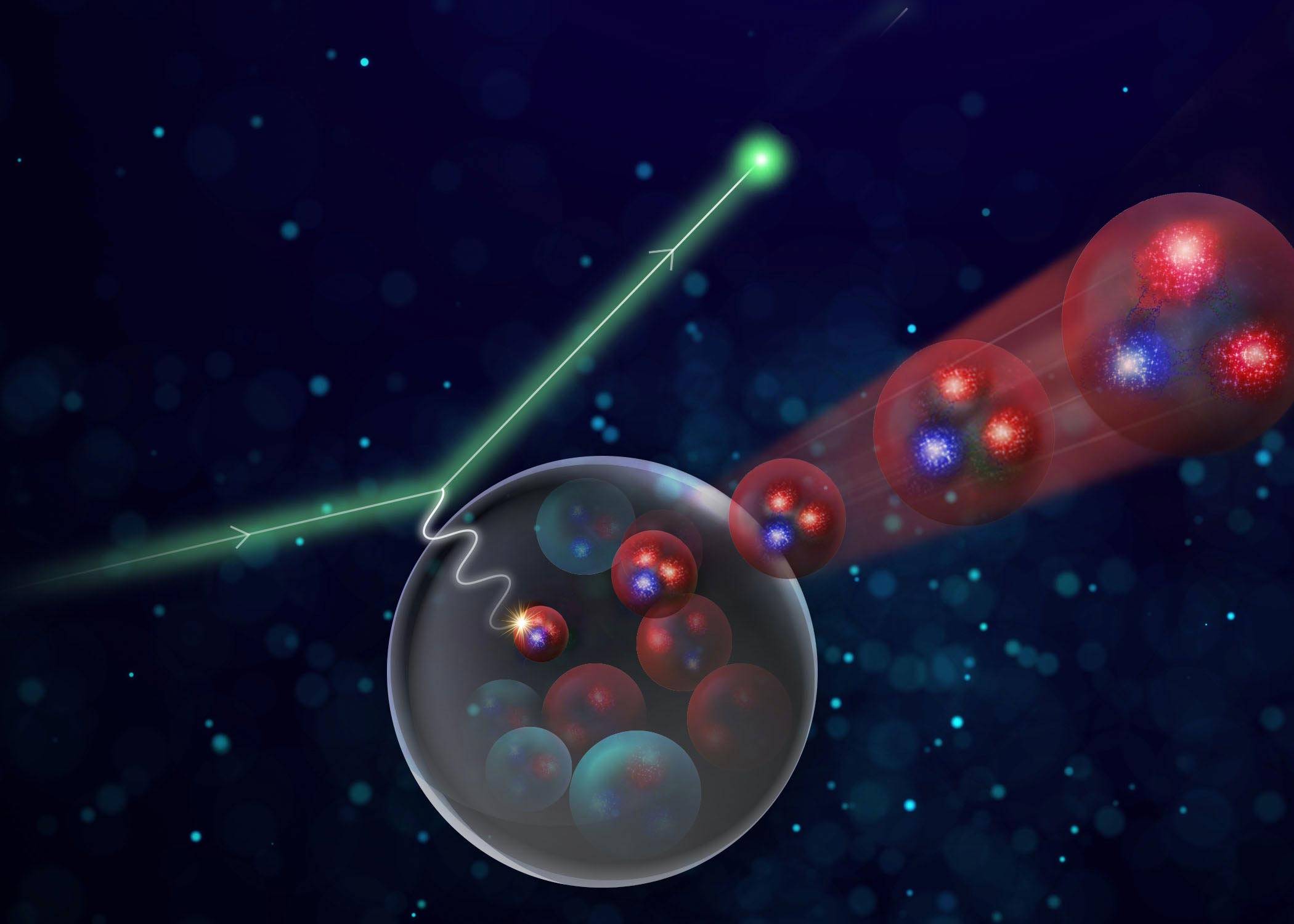
    Protons Electron Probe
    Nuclear physicists hoped to observe color transparency in protons (red) by spotting small-size protons with an electron probe (green). These small-size protons could more easily exit the nucleus of the atom, shown here, demonstrating color transparency. Credit: DOE’s Jefferson Lab

    The Science

    Protons populate the nucleus of every atom in the universe. Inside the nucleus, they cling tightly to neighboring protons and neutrons. However, it may be possible to knock out protons that are in a smaller size configuration, so that they interact less with nearby particles as they exit the nucleus. This phenomenon is called color transparency. Nuclear physicists hunting for signs of color transparency in protons recently came up empty handed.

    The Impact

    The theory that describes the behavior of particles made of quarks is called quantum chromodynamics (QCD). QCD includes many common subatomic particles, such as protons and neutrons. It also predicts the phenomenon of color transparency. Physicists have observed color transparency in simpler, two-quark particles called pions. If physicists can observe or rule out color transparency for protons, a more complicated three-quark system, they would gain important clues regarding the differences between two- and three-quark systems in QCD.

    Summary

    Protons are made of three quarks bound up by the strong force that is part of the Standard Model of Particle Physics. In an ordinary proton, the strong force leaks out, making the proton interact with nearby protons and neutrons in the nucleus. That’s according to QCD, the theory that describes how quarks and the strong force interact. In QCD, the strong force is also referred to as the color force. QCD predicts that the proton can fluctuate to a state where its constituent quarks become even more tightly knit and wrapped up so tightly that the color force no longer leaks out. When that happens, the proton can move more freely. This phenomenon is called “color transparency,” since the proton has become invisible to the color force of nearby particles.

    An earlier experiment showed color transparency in simpler particles made of just two quarks called pions, and another experiment suggested that protons also exhibit color transparency. This newest experiment was conducted with the Continuous Electron Beam Accelerator Facility (CEBAF), an Office of Science user facility. CEBAF’s high-energy electrons crashed into the nuclei of carbon atoms, and physicists measured outgoing electrons and several thousand protons. The researchers observed no signs of color transparency. The next step is to conduct higher-precision experiments to both better observe the phenomenon in two-quark particles and to continue to hunt for it in three-quark particles. These further measurements may help physicists better elucidate the differences between two- and three-quark systems in QCD.

    Never miss a breakthrough: Join the SciTechDaily newsletter.
    Follow us on Google and Google News.

    Atomic Physics DOE Particle Physics
    Share. Facebook Twitter Pinterest LinkedIn Email Reddit

    Related Articles

    Decoding Nuclear Matter: A Two-Dimensional Solution Unveils Neutron Star Secrets

    Reimagining the Universe: Right-Handed Currents and Neutron Decay Interaction

    Science Made Simple: What Are Neutrons?

    A Quantum of Solace: Resolving a Mathematical Puzzle in Quarks and Gluons in Nuclear Matter

    Science Made Simple: What Are Protons?

    Secrets of Hypernuclei Flow: First Observations at Relativistic Heavy Ion Collider

    U.S. RHIC Atom Smasher Reveals a Surprising Preference in Particle Spin Alignment

    Science Made Simple: What Are Atomic Nuclei?

    Science Made Simple: What Is Nucleosynthesis?

    Leave A Reply Cancel Reply

    • Facebook
    • Twitter
    • Pinterest
    • YouTube

    Don't Miss a Discovery

    Subscribe for the Latest in Science & Tech!

    Trending News

    Scientists Discover Game-Changing New Way To Treat High Cholesterol

    This Small Change to Your Exercise Routine Could Be the Secret to Living Longer

    Scientists Discover 430,000-Year-Old Wooden Tools, Rewriting Human History

    AI Could Detect Early Signs of Alzheimer’s in Under a Minute – Far Before Traditional Tests

    What if Dark Matter Has Two Forms? Bold New Hypothesis Could Explain a Cosmic Mystery

    This Metal Melts in Your Hand – and Scientists Just Discovered Something Strange

    Beef vs. Chicken: Surprising Results From New Prediabetes Study

    Alzheimer’s Breakthrough: Scientists Discover Key Protein May Prevent Toxic Protein Clumps in the Brain

    Follow SciTechDaily
    • Facebook
    • Twitter
    • YouTube
    • Pinterest
    • Newsletter
    • RSS
    SciTech News
    • Biology News
    • Chemistry News
    • Earth News
    • Health News
    • Physics News
    • Science News
    • Space News
    • Technology News
    Recent Posts
    • Revolutionary Imaging Technique Unlocks Secrets of Matter at Extreme Speeds
    • Where Does Mass Come From? Scientists Find Evidence of a New Exotic Nuclear State
    • Quantum Breakthrough: Unhackable Keys Sent Over 120 km Using Quantum Dots
    • Researchers Discover Unknown Beetle Species Just Steps From Their Lab
    • Jellyfish Caught Feasting on Exploding Sea Worms for the First Time
    Copyright © 1998 - 2026 SciTechDaily. All Rights Reserved.
    • Science News
    • About
    • Contact
    • Editorial Board
    • Privacy Policy
    • Terms of Use

    Type above and press Enter to search. Press Esc to cancel.